Andy Burnham reaches 100 days as PM with Labour polling up about 10 points
Andy Burnham reaches his 100th day as prime minister on 27 October. Press Association polling averages show Labour at 29%, up from 19% before Keir Starmer resigned, while a commentator says Burnham's approval is unusually durable.

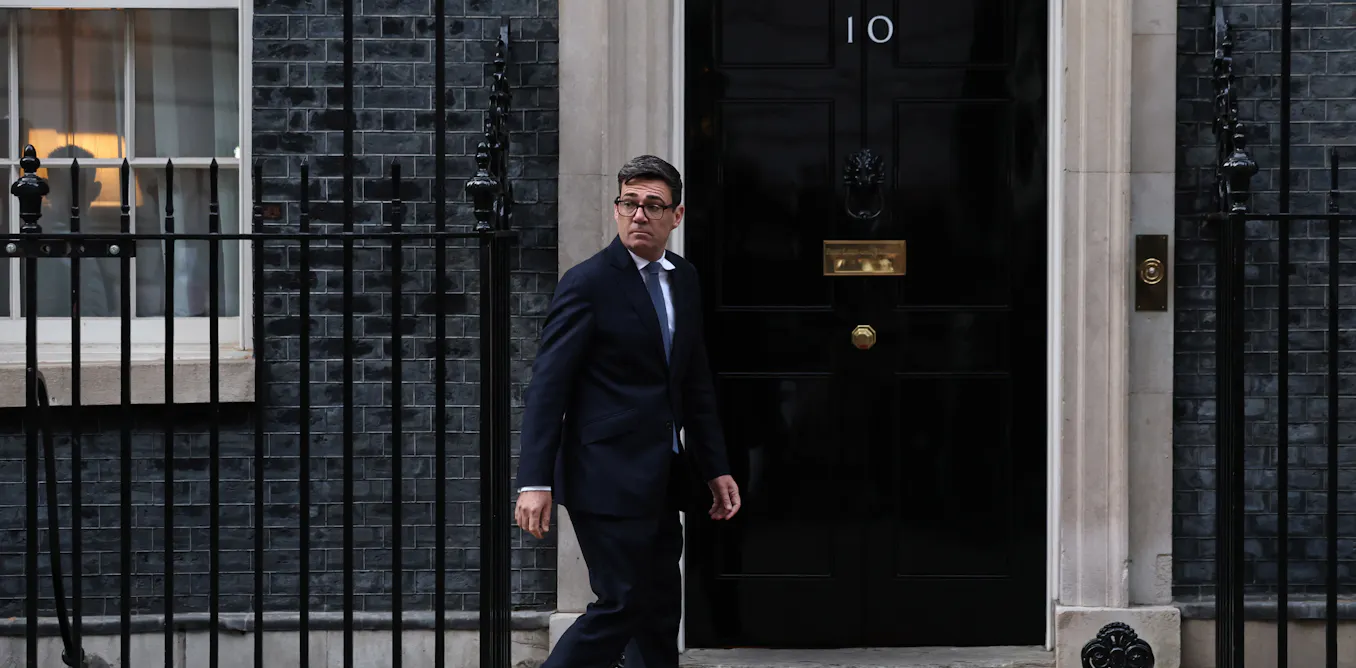
1 / 2
The story, neutrally told
Mixed · 2Andy Burnham reaches the 100th day of his premiership on 27 October, with Labour's poll ratings having risen since before he took office. Evening StandardN “Mr Burnham reaches the 100th day of his premiership on October 27.” Read at Evening Standard ↗ The ConversationLC “In his first 100 days in office, Andy Burnham has challenged the economic consensus” Read at The Conversation ↗ Centre · 1Press Association analysis of public polling shows that in the week ending 21 June, a day before Sir Keir Starmer announced his resignation on 22 June, Labour averaged 19%, level with the Conservatives. Reform UK led on 27%, the Greens were on 14% and the Liberal Democrats on 12%. Evening StandardN “Labour averaged 19% in nationwide polls of how people would vote at the next general election – the same figure as the Conservatives.”“Reform UK were on 27%, an eight-point lead, while the Greens were on 14% and the Liberal Democrats on 12%” Read at Evening Standard ↗ Centre · 1Burnham became prime minister on 20 July. Labour had already moved to 21% and Reform down to 24% in the week ending 19 July, then reached 26% in the week to 2 August, overtaking Reform on 24% for the first time in weekly averages since March 2025. Evening StandardN “Labour now averaged 21%, up two points from a month earlier, while Reform were on 24%, down three points.”“then reached 26% in the week to August 2, overtaking Reform on 24%.” Read at Evening Standard ↗
Centre · 1Labour stayed in the mid-20s through August and September. Since conference season some polls have put it in the high 20s or low 30s, and the average for the week ending 25 October is 29%, its highest since the end of 2024. Evening StandardN “The latest averages, for the week ending October 25, show Labour on 29%: the party’s highest such rating since the end of 2024.” Read at Evening Standard ↗ Centre · 1In the same latest figures Reform and the Conservatives are tied on 22%, the Greens are on 10% and the Liberal Democrats on 9%. The Conservatives rose slightly after conference season, while the Greens and Lib Dems have fallen since the summer. Evening StandardN “Reform and the Conservatives are tied on 22%, the Greens are on 10% and the Liberal Democrats are on 9%.”“There has also been a fall since the summer in the poll averages for both the Greens and the Liberal Democrats.” Read at Evening Standard ↗ Centre · 1Pollsters agree the polls have moved. Ipsos's 15–22 October poll put Labour on 32%, the Conservatives on 24% and Reform on 20%. Keiran Pedley of Ipsos called Labour "resurgent", Survation's PJ Stock described a "clear upward trajectory since June", and YouGov described "a small recovery for both the Conservatives and Labour". Evening StandardN “puts Labour on 32%, the Tories on 24% and Reform on 20%”“a small recovery for both the Conservatives and Labour” Read at Evening Standard ↗
Mixed · 2Opinium found Burnham is the only party leader with a positive net approval rating and leads Kemi Badenoch and Nigel Farage on who would make the better prime minister. Stephen Coleman, a University of Leeds professor writing in The Conversation, cites a 46% approval rating for Burnham against 33% for Badenoch, 25% for Farage and 24% for Ed Davey, and says no prime minister has gone so long without negative net favourability in nearly ten years. Evening StandardN “remains the only party leader with a positive net approval rating” Read at Evening Standard ↗ The ConversationLC “His 46% approval rating comfortably beats those of Conservative leader Kemi Badenoch (33%), Reform’s Nigel Farage (25%) and Ed Davey of the Liberal Democrats (24%).” Read at The Conversation ↗ Left · 1Coleman argues Burnham has made big moves: challenging the economic consensus, setting up a prime ministerial office outside London to devolve power, reopening the Brexit debate and starting the biggest social house-building programme since the post-war period. He compares the ambition to the 1945 Attlee government and says no prime minister's first 100 days has been so bold since Margaret Thatcher in 1979. The ConversationLC “set up a prime ministerial office outside London with a remit to rewire the state and devolve power”“Such boldness has not marked the first 100 days of any British prime minister since Margaret Thatcher in 1979.” Read at The Conversation ↗ Left · 1Coleman also notes limits: the government has kept to the fiscal rules and the Nato defence spending target, bond markets are a threat, the right-wing press has cast Burnham as incompetent and dangerous, and Reform UK remains in the wings despite diminished ratings. He puts Labour's parliamentary majority at 158. The ConversationLC “In agreeing to stay within the fiscal rules established by its predecessors, as well as to meet the Nato target for defence spending”“The right-wing press has lost no time in casting Burnham as (alternately) incompetent and dangerous.” Read at The Conversation ↗
Centre · 1The Press Association piece cautions that polls are snapshots, not forecasts. Pedley notes the government faces a challenging Budget this coming week and that British politics is volatile. Evening StandardN “Polls are snapshots, not forecasts or predictions”“The Government faces a challenging Budget this coming week” Read at Evening Standard ↗
Every sentence links to the reporting it rests on. The pill in front of each says where its sources sit: Left, Centre or Right when one side supplies at least half of them, Mixed when they are evenly split. The number is how many outlets it cites.
Left1 outlet
- Framing
- Opinion piece by an academic that credits Burnham with bold, change-oriented policy and sustained public approval, while noting risks.
- Emphasis
- Policy ambition, historical comparisons with Attlee and Thatcher, and approval ratings.
- Leaves out or plays down
- Does not give the detailed party-by-party polling averages; critical views of the government are mostly attributed to the right-wing press.
- Charged language
- “neoliberal doctrine”“isolationist fantasy”“act of radicalism”
- For example
-
“To challenge neoliberal doctrine in these times is in itself an act of radicalism.” — The Conversation
“The British electorate is not used to feeling approval. Let’s see if it lasts.” — The Conversation
Centre1 outlet
- Framing
- Data-led explainer built on Press Association weekly polling averages, tracing Labour's rise and Reform's fall since Starmer's resignation.
- Emphasis
- Week-by-week averages, pollster quotes and the caution that polls are snapshots.
- Leaves out or plays down
- Little on Burnham's policy record or the constraints on his government.
- Charged language
- “resurgent”
- For example
-
“The story of Mr Burnham’s first 100 days in Downing Street is one of a clear and sustained improvement in Labour’s poll ratings” — Evening Standard
Right0 outlets
No right outlet in our sources has covered this story yet.
What every side reports
- Burnham's 100th day as PM is 27 October.
- Labour's poll standing has improved since Starmer resigned, and Reform's has fallen.
- Burnham leads rival party leaders on approval.
Andy Burnham person
Burnham has described his premiership as a "circuit-breaker for Britain" and told Labour's conference Britain had been on the "wrong path" for years. He is presented as the most popular party leader.
“making this moment a circuit-breaker for Britain, bringing forward the biggest changes in the last 40 years.” — The Conversation
“Britain had been on the “wrong path” for years” — The Conversation
Left1 article
-
The ConversationLC · · Opinion
Sympathetic Opinion piece praising Burnham's boldness and durable approval while flagging constraints.
Centre1 article
-
Andy Burnham’s first 100 days as PM: How the polls have changed
Neutral Press Association-based data account of Labour's poll recovery, with pollster quotes and caveats.
Right0 articles
No coverage yet.
- 26 Oct 12:15 First Evening StandardN Andy Burnham’s first 100 days as PM: How the polls have changed
- 26 Oct 16:45 +4h 29m The ConversationLC Andy Burnham has maintained the public’s approval through his first 100 days as the UK’s PM – that’s unheard of these days Opinion
Times are when each article was published, or when we first saw it if the outlet gave no time.
Ask about this story
Loading…