Most distant fast radio burst yet traced to galaxy 3 billion years after the big bang
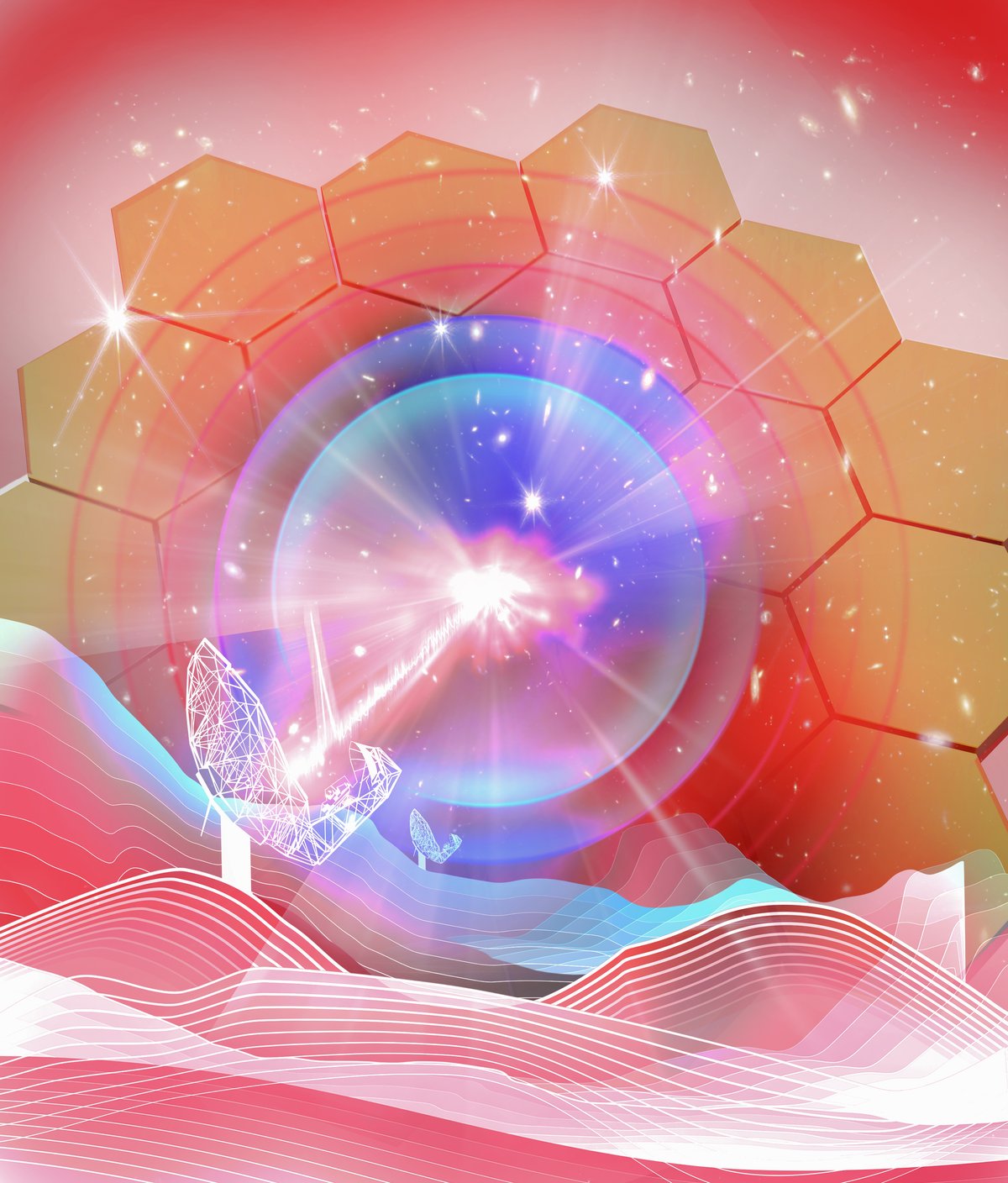
A study in Science reports FRB 20240304B, detected by South Africa's MeerKAT telescope, as the most distant fast radio burst recorded. The James Webb Space Telescope placed it in a small, star-forming galaxy that existed about 3 billion years after the big bang.

1 / 3
The story, neutrally told
Left · 2A study published in Science reports the most distant fast radio burst (FRB) yet detected, named FRB 20240304B, whose radio waves travelled for more than 10 billion years before reaching Earth. ABC News (Australia)LC “A study published in Science today captures the moment the flash, called FRB 20240304B, arrived on Earth 10 billion years later.” Read at ABC News (Australia) ↗ The GuardianLC “a burst of radio waves which travelled for more than 10bn years before reaching Earth” Read at The Guardian ↗ Left · 2The burst was recorded in 2024 by the MeerKAT radio telescope in South Africa, and the James Webb Space Telescope was then used to identify its host galaxy, which existed about 3 billion years after the big bang. ABC News (Australia)LC “The newly discovered FRB was recorded in 2024 by the MeerKAT telescope in South Africa” Read at ABC News (Australia) ↗ The GuardianLC “subsequently identified its host galaxy using Nasa’s James Webb space telescope (JWST)” Read at The Guardian ↗ Left · 1The Guardian says the burst travelled through "approximately 80% of cosmic history" and is believed to be more than double the previous distance record. The GuardianLC “The burst, dubbed FRB 20240304B, is believed to be the farthest yet detected, more than double the previous distance record.” Read at The Guardian ↗
Left · 1The ABC reports that the burst's dispersion measure, about 2,400 units against the few hundred to a thousand typical for FRBs, told the team it came from very far away. ABC News (Australia)LC “With about 2,400 units of DM we figured it had to be coming from really far away.” Read at ABC News (Australia) ↗ Left · 2The host is a small galaxy forming stars rapidly with few heavy elements; Manisha Caleb of the University of Sydney, described by the ABC as lead author, called it a "puny little dwarf galaxy" that was unexpected. ABC News (Australia)LC “We didn't expect to find the FRB to be associated with such a puny little dwarf galaxy that's actively forming stars.” Read at ABC News (Australia) ↗ The GuardianLC “young, very small galaxy which is forming stars at a very high speed, with not many metals around it” Read at The Guardian ↗ Left · 1The Guardian quotes Dr Themiya Nanayakkara, also of the University of Sydney and described as one of the lead researchers, saying that whatever causes FRBs must be able to operate in very young, metal-poor galaxies. The GuardianLC “Whatever the mechanism that causes this radio burst has to account for that fact that it can be produced in … very young galaxies with very low amount of metals” Read at The Guardian ↗
Left · 2What produces FRBs remains unknown. The first was found in 2007 with the Parkes telescope in Australia, and magnetars (neutron stars with very strong magnetic fields) are one candidate; Ryan Shannon of Swinburne University, who was not involved, said more than one mechanism may exist. ABC News (Australia)LC “The first FRB was found by an Australian team using the Parkes telescope in 2007.”“But I wouldn't rule out having more than one way to produce an FRB.” Read at ABC News (Australia) ↗ The GuardianLC “There are several theories as to what the source of FRBs is, including that they originate from magnetars” Read at The Guardian ↗ Left · 2The sources describe the bursts' energy differently: the ABC quotes Caleb saying an FRB emits in milliseconds as much energy as the Sun would over several days, while the Guardian says as much as the sun does in months or years. ABC News (Australia)LC “In those few milliseconds, they emit as much energy as the Sun would over several days,” Read at ABC News (Australia) ↗ The GuardianLC “can emit as much energy in milliseconds as the sun does in months or years” Read at The Guardian ↗ Left · 2Researchers say distant FRBs could map matter in the universe, including the cosmic web, because the bursts are affected by the material they pass through; Matthew Bailes of Swinburne University called the result "a validation of how powerful the FRBs are for probing the universe". ABC News (Australia)LC “We're able to use the FRBs now to study the cosmic web in ways that were impossible before.” Read at ABC News (Australia) ↗ The GuardianLC “a validation of how powerful the FRBs are for probing the universe” Read at The Guardian ↗
Left · 1More than 10,000 FRBs have been detected since 2007, according to the Guardian; some repeat and some do not, and whether this one will repeat is not yet known. The GuardianLC “Whether the new distant burst is a one-off flash or will yield recurrent signals remains to be seen.”“More than 10,000 FRBs have been detected since 2007.” Read at The Guardian ↗
Every sentence links to the reporting it rests on. The pill in front of each says where its sources sit: Left, Centre or Right when one side supplies at least half of them, Mixed when they are evenly split. The number is how many outlets it cites.
Left3 outlets
- Framing
- Both outlets present the finding as a wonder-of-science story, leaning on a Star Wars-style "galaxy far, far away" opening and on researcher quotes about the scale of cosmic time.
- Emphasis
- The age and distance of the signal, the unexpectedly small host galaxy, the unsolved origin of FRBs, and their use for mapping unseen matter and the cosmic web.
- Leaves out or plays down
- Neither gives the study's full author list or detailed methods. The Guardian does not give the dispersion measure, and the ABC does not give the distance-record comparison.
- Charged language
- “mysterious”“insane”“puny little dwarf galaxy”
- For example
-
“said this time frame was "insane", even for astronomers.” — ABC News (Australia)
“A long time ago in a galaxy far, far away, a mysterious flash of energy was released into the universe.” — The Guardian
Centre0 outlets
No centre outlet in our sources has covered this story yet.
Right0 outlets
No right outlet in our sources has covered this story yet.
What every side reports
- The study was published in Science and names the burst FRB 20240304B.
- The burst was detected by MeerKAT in South Africa and its host galaxy located with the James Webb Space Telescope.
- The host galaxy is small, star-forming and dates to about 3 billion years after the big bang.
- The signal travelled more than 10 billion years to reach Earth.
- The cause of FRBs is still unknown; magnetars are one candidate.
- Distant FRBs could help map matter in the universe.
Where accounts differ
-
How much energy an FRB releases
- Left
- The ABC quotes Caleb: as much as the Sun emits over several days. The Guardian says as much as the sun does in months or years.
-
Who led the study
- Left
- The ABC calls Manisha Caleb the study lead author. The Guardian calls Themiya Nanayakkara one of the lead researchers.
Left3 articles
-
It took 10 billion years for this signal from the early universe to reach us
Celebratory Explainer built around Caleb's and Shannon's quotes, stressing the extreme timescale, the surprising dwarf host galaxy and the cosmic-web payoff.
-
Astronomers detect mysterious burst of energy from a galaxy far, far away
Neutral Concise report foregrounding the distance record, with expert quotes on FRB use for counting matter and the open question of whether the burst repeats.
-
Centre0 articles
No coverage yet.
Right0 articles
No coverage yet.
- 8 Oct 16:05 First ABC News (Australia)LC It took 10 billion years for this signal from the early universe to reach us
- 8 Oct 19:00 +2h 54m The GuardianLC Astronomers detect mysterious burst of energy from a galaxy far, far away
- 8 Oct 19:30 +3h 24m Scientific AmericanLC Astronomers discover record-breaking ancient cosmic outburst
Times are when each article was published, or when we first saw it if the outlet gave no time.