Bangkok floods and Ayutthaya's deliberate flooding expose limits of Thailand's flood defences
Extreme rain in late September flooded Bangkok, and by 12 October floods had hit 51 provinces. Reporting also shows rural communities near Ayutthaya bearing the cost of defences that protect the capital.
1 / 2
The story, neutrally told
Centre · 1More than 300mm of rain fell in 48 hours from 24 to 26 September, overwhelming Bangkok's drainage and prompting an emergency in all 50 districts. CNAN “More than 300mm fell in just 48 hours from Sep 24 to Sep 26, prompting an emergency to be declared in all 50 districts.” Read at CNA ↗ Centre · 1A government assessment put the affected population at about 329,000 households, around 700,000 Bangkok residents. CNAN “Approximately 329,000 households - around 700,000 Bangkok residents - were affected, according to a government assessment in the aftermath.” Read at CNA ↗ Centre · 1By 12 October flooding had affected 51 provinces and about 908,000 households nationally. CNAN “By Oct 12, flooding had affected 51 provinces and about 908,000 households.” Read at CNA ↗
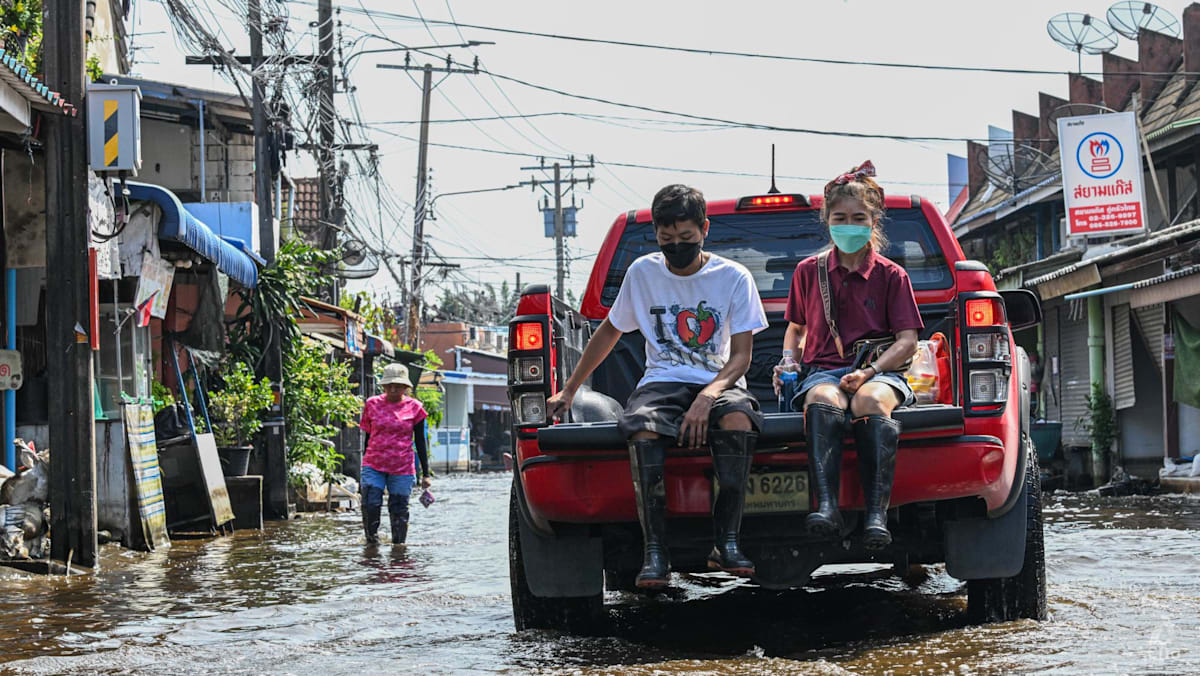
Centre · 1In Lat Krabang, on Bangkok's low-lying eastern fringe, water exceeded 1m at its peak and had not fully receded two weeks later. Residents said clogged drains, construction debris and inadequate pumping prolonged it, and that warnings came too late. CNAN “Flood levels reached more than 1m here during its peak, despite the installation of more water pumps as an immediate response by city officials.”“In Lat Krabang, local residents complained that clogged drains, construction debris and inadequate pumping were factors prolonging flooding in their area” Read at CNA ↗ Centre · 1Experts told CNA that the Bangkok flooding was driven mainly by extreme local rainfall rather than the large volumes arriving from upstream on the Chao Phraya that caused the 2011 disaster, in which 815 people died nationwide. CNAN “Bangkok's main driver was extreme local rainfall, rather than enormous volumes of water arriving from upstream down the Chao Phraya river and its tributaries as in 2011.”“815 people died across the country” Read at CNA ↗ Centre · 1Experts also pointed to urban growth that has filled floodplains and drainage routes, the loss of about half of Bangkok's estimated 3,000 canals, obstructed drains, and high tides that slowed drainage to the sea. CNAN “losing about half of its estimated 3,000 canals and its “porous capacity””“But many drainage systems and canals are known to be obstructed with rubbish or other materials, reducing their effectiveness, Nuanchan said.” Read at CNA ↗
Centre · 1Kasetsart University's Nuchanart Sriwongsitanon estimated that Bangkok's reported pumping capacity would in theory need three to four days to clear the runoff from 300mm of rain, and warned of compound events if heavy rain, high river flows and high tides coincide. CNAN “Bangkok's reported pumping capacity alone would theoretically need three to four days to remove the runoff generated by 300mm of rain.”““There is a higher future risk from compound events. If everything happens at the same time, we will face problems for sure,” she said.” Read at CNA ↗ Centre · 1Bangkok's Metropolitan Authority said pumping stations and floodgates ran at full capacity, while Governor Chadchart Sittipunt acknowledged that accurate warnings were hard to issue because rainfall is difficult to forecast precisely. CNAN “Bangkok’s Metropolitan Authority said pumping stations and floodgates were operating at full capacity throughout the emergency period”“Bangkok Governor Chadchart Sittipunt publicly acknowledged that issuing accurate flood warnings was difficult” Read at CNA ↗ Centre · 1Preliminary estimates put losses in the tens of billions of baht; a Rangsit University assessment estimated 25.3 billion baht (US$780 million) nationwide over four days. CNAN “One Rangsit University assessment estimated economic losses of 25.3 billion baht (US$780 million) nationwide over just four days.” Read at CNA ↗
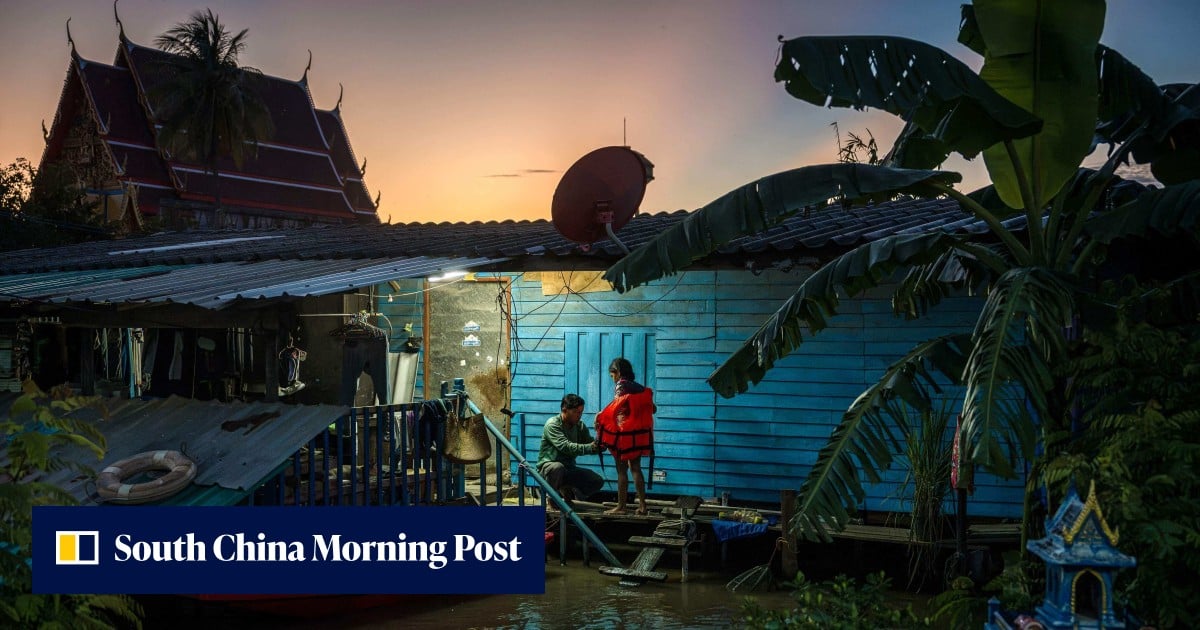
Centre · 1AFP, carried by the South China Morning Post, reports that authorities are deliberately flooding riverside communities north of Bangkok, including in Ayutthaya province, to spare the capital and other business hubs. South China Morning PostN “Stilt houses in villages north of Bangkok are no longer high enough to stay dry as Thai authorities deliberately flood riverside communities to spare the capital.” Read at South China Morning Post ↗ Centre · 1After the 2011 floods the government expanded embankments and water gates; the defences have largely kept commercial centres safe, but other residents say they are left to fend for themselves. South China Morning PostN “The defences have largely kept commercial centres safe, but residents of other areas have been left to fend for themselves.” Read at South China Morning Post ↗ Centre · 1Irrigation department spokesman Thanet Somboon said climate change, low-lying geography and new embankments that altered the Chao Phraya's natural flow worsened downstream flooding, and that authorities had "no choice but to discharge the remaining water downstream" once channels were full. He acknowledged infrastructure may need review. South China Morning PostN “he said authorities had “no choice but to discharge the remaining water downstream”.”“Thanet acknowledged that officials may need to review infrastructure” Read at South China Morning Post ↗
Centre · 1Villagers describe floods that once reached the knees now rising above heads and lasting months. Raising a house costs 100,000 to 1 million baht, and resident Kamonchanok Sathaphonamonwut's village has flooded six years in a row. South China Morning PostN “Raising a house can cost between 100,000 and 1 million baht (US$3,000 to US$30,000), depending on its size and height, residents say.”“Her village has been flooded six years in a row” Read at South China Morning Post ↗ Centre · 1Conservationist Sasin Chalermlarp called the government's flood management "excellent" but "cruel" to those affected and proposed a "flood-free tax" on beneficiaries; Thanet said the idea warranted further study. The government's flagship fix, a US$780-million diversion canal around Ayutthaya, is expected by 2030. South China Morning PostN “Sasin, who lives in a protected part of Ayutthaya, has proposed a “flood-free tax” on those who benefit from the defences”“It is expected to be completed by 2030.” Read at South China Morning Post ↗
Every sentence links to the reporting it rests on. The pill in front of each says where its sources sit: Left, Centre or Right when one side supplies at least half of them, Mixed when they are evenly split. The number is how many outlets it cites.
Left0 outlets
No left outlet in our sources has covered this story yet.
Centre2 outlets
- Framing
- Both outlets treat the floods as a failure of planning and infrastructure rather than just weather: CNA explains why Bangkok flooded through experts and residents, while AFP via SCMP looks at who pays for protecting the capital.
- Emphasis
- Expert and resident testimony, urban development, drainage limits, climate risk, and the unequal burden on rural communities.
- Leaves out or plays down
- Neither carries a detailed official defence of the response beyond brief statements, and the two pieces cover different areas (Bangkok versus Ayutthaya) with little overlap in casualty or damage figures.
- Charged language
- “Submerged to save Bangkok”“cruel”
- For example
-
“recent extreme rainfall has exposed persistent weaknesses in drainage, urban planning and water management, say experts.” — CNA
“rural Thais bear brunt of capital’s flood defences” — South China Morning Post
Right0 outlets
No right outlet in our sources has covered this story yet.
What every side reports
- Thailand strengthened flood defences after the 2011 floods, yet heavy rain and flooding persist.
- Climate change and low-lying terrain are cited as raising flood risk.
- Bangkok's defences and drainage protect the capital but leave other areas or districts exposed.
Where accounts differ
-
Whether warnings and the response were adequate
- Centre
- CNA reports residents saying warnings came too late; the Metropolitan Authority says pumps and floodgates ran at full capacity and the governor says precise forecasts are hard.
Bangkok place
City officials say pumps and floodgates ran at full capacity, and the governor says precise warnings are hard to give; residents say warnings came late and drains were clogged.
“Bangkok’s Metropolitan Authority said pumping stations and floodgates were operating at full capacity throughout the emergency period” — CNA
““The warning came too late.” — CNA
Ayutthaya place
Ayutthaya residents say they bear the cost of defences protecting Bangkok, and ask for water-level caps and financial support.
“rather a cap on water levels and financial support for those whose homes sit below the flood line.” — South China Morning Post
Thailand place
Thai authorities say discharges downstream were unavoidable once channels filled, and they point to a US$780-million diversion canal due by 2030.
“authorities had “no choice but to discharge the remaining water downstream”.” — South China Morning Post
“It is expected to be completed by 2030.” — South China Morning Post
Left0 articles
No coverage yet.
Centre2 articles
-
CNAN ·
Extreme rain, overwhelmed drains: Why Bangkok flooded and what could have been avoided
Critical Explanatory feature on why Bangkok flooded, mixing expert analysis with resident complaints about warnings, drains and planning.
-
South China Morning PostN · · via AFP
Submerged to save Bangkok: rural Thais bear brunt of capital’s flood defences
Sympathetic AFP wire feature centred on Ayutthaya villagers who are flooded on purpose to protect Bangkok.
Right0 articles
No coverage yet.
- 13 Oct 23:00 First CNAN Extreme rain, overwhelmed drains: Why Bangkok flooded and what could have been avoided
- 14 Oct 06:07 +7h 8m South China Morning PostN Submerged to save Bangkok: rural Thais bear brunt of capital’s flood defences via AFP
Times are when each article was published, or when we first saw it if the outlet gave no time.
Ask about this story
Loading…