Bedford rail crash: interim report says train accelerated after red-signal warning
The Rail Accident Investigation Branch's interim report says the East Midlands Railway train that hit another near Bedford in June acknowledged a red-signal warning but kept accelerating to 76mph. The cause of the signal being passed is still under investigation.

1 / 2
The story, neutrally told
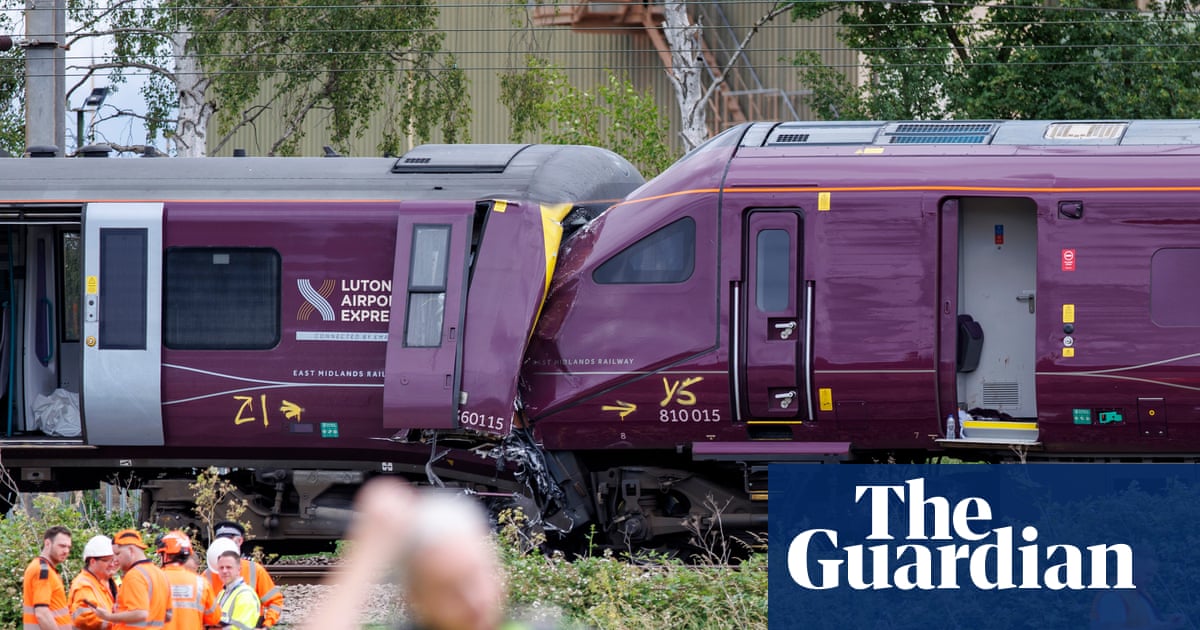
The Rail Accident Investigation Branch (RAIB) said in an interim report published on Thursday 1 October that an East Midlands Railway train acknowledged a red-signal warning but continued to accelerate before the 19 June crash near Bedford. The GuardianLC “sped up after the driver received a warning he had passed a red light” Read at The Guardian ↗ Evening StandardN “continued to accelerate, reaching a maximum speed of 76mph” Read at Evening Standard ↗ The driver, 60-year-old Shaun Burton, died when the Corby to London St Pancras train hit the back of a stationary Nottingham to London train of the same operator near Elstow. Evening StandardN “Shaun Burton, 60, died when the East Midlands Railway (EMR) train he was driving hit the back of a stationary train” Read at Evening Standard ↗ The GuardianLC “the collision killed the driver, 60-year-old Shaun Burton” Read at The Guardian ↗ According to the Standard's account of the report, the full service brake was applied about 10 seconds before the crash and the emergency brake about two seconds later, at around 75mph and about 200 metres from the other train. Evening StandardN “applied the full service brake around 10 seconds before the crash” Read at Evening Standard ↗ Evening StandardN “the emergency brake was applied when the train was travelling at around 75mph, around 200 metres from the back of the other train” Read at Evening Standard ↗
Speed had fallen to about 50mph at impact, and the report said the braking likely showed the driver detecting the train ahead. Evening StandardN “It is likely this sequence represents the driver of train 1H46 detecting the presence of train 1B67 on the line ahead and responding to it” Read at Evening Standard ↗ The GuardianLC “the train slowed to 49mph before it collided” Read at The Guardian ↗ The stationary train had stopped unexpectedly after a fault with its automatic warning system equipment applied its brakes, which turned the signal behind it red. Evening StandardN “a fault with its automatic warning system equipment caused its brakes to apply” Read at Evening Standard ↗ The Guardian adds that both the driver and a driving instructor in the cab did not recognise the sound as an AWS warning, in a new Hitachi Aurora class 810 cab with an unfamiliar layout, and that another class 810 train later received a false AWS warning at the same signal on green. The GuardianLC “neither the driver nor driving instructor recognised this sound as being an AWS warning indication”“another class 810 train had also incorrectly received an AWS warning indication at the same signal on green” Read at The Guardian ↗
More than 160 passengers were injured and 102 were taken to hospital, with around 257 people on board. Evening StandardN “More than 160 passengers were injured and 102 were taken to hospital.” Read at Evening Standard ↗ The RAIB stressed that an early report describes immediate events without necessarily explaining them, and said why the train passed the signal at danger remains under investigation. Evening StandardN “The reasons why train 1H46 passed signal WH154 at danger continue to form part of the ongoing investigation.” Read at Evening Standard ↗ East Midlands Railway called the crash a tragic incident, said the findings may be refined, and promised to co-operate fully. Evening StandardN “Its findings may be refined as the investigation progresses” Read at Evening Standard ↗
Every sentence links to the reporting it rests on.
Left1 outlet
- Framing
- Leads with the finding that the train sped up after the warning, and adds context on the new class 810 train, the unrecognised warning sound and a repeat false warning at the same signal.
- Emphasis
- Human-factors and equipment context: unfamiliar cab, a warning not expected, and rarity of a red at that signal.
- Leaves out or plays down
- Does not give the 10-second braking timeline, passenger numbers on board or the operator's response.
- For example
-
“acknowledged the automatic warning but did not appear to act after passing a danger signal that was rarely ever red” — The Guardian
Centre1 outlet
- Framing
- Reports the findings as a data-led sequence of events, with the report's caveats and the operator's statement; the second piece headlines the driver's 'horror' crash.
- Emphasis
- Braking timings, speeds, visibility on the curve, injury figures and the RAIB's caution that the report is interim.
- Leaves out or plays down
- Does not mention the unfamiliar cab, the driving instructor or the later false warning on another class 810 train.
- Charged language
- “London trains horror”
- For example
-
“A train driver killed in a crash in Bedfordshire continued to speed up after acknowledging a red signal” — Evening Standard
“London trains horror: Driver sped up after going past red signal and hit brake 10 seconds before crash” — Evening Standard
Right0 outlets
No right outlet in our sources has covered this story yet.
What every side reports
- The RAIB interim report was published on Thursday 1 October.
- The East Midlands train acknowledged a red-signal warning and accelerated to a maximum of 76mph.
- Driver Shaun Burton, 60, died in the 19 June collision with a stationary train.
- More than 160 people were injured.
- The reasons the signal was passed remain under investigation.
Where accounts differ
-
What the driver did after the warning
- Left
- The Guardian says the driver acknowledged the warning but did not appear to act, then braked when the train ahead came into view.
- Centre
- The Standard reports the driver braked about 10 seconds before the crash and quotes the report saying this likely shows the driver detecting the train ahead; it does not say the driver failed to act.
East Midlands Railway organisation
Says the crash had a serious and lasting impact, stresses the report is interim and may be refined, and pledges to co-operate with the RAIB and act on lessons.
“As RAIB makes clear, this is an interim report.” — Evening Standard
Bedford rail crash event
The RAIB says it will continue to examine why the train passed the signal at danger and whether safety systems worked.
“The RAIB said it would continue to seek to understand why the Corby train had passed a red light” — The Guardian
Left1 article
-
Bedford rail crash: train sped up after red light warning, say investigators
Neutral Investigative summary stressing the warning system and cab-design context alongside the acceleration finding.
Centre2 articles
-
Train ‘sped up after acknowledging red signal’ before Bedford crash – report
Neutral Detailed, data-driven account with RAIB caveats and the operator's response.
-
Mixed Same facts as the other Standard piece under a more dramatic headline, with less on the operator's response.

Right0 articles
No coverage yet.
- 1 Oct 13:21 First The GuardianLC Bedford rail crash: train sped up after red light warning, say investigators
- 1 Oct 13:41 +21m Evening StandardN Train ‘sped up after acknowledging red signal’ before Bedford crash – report
- 1 Oct 13:47 +26m Evening StandardN London trains horror: Driver sped up after going past red signal and hit brake 10 seconds before crash
Times are when each article was published, or when we first saw it if the outlet gave no time.