Colorado chemists develop tattoo ink switched on by UV and off by white light
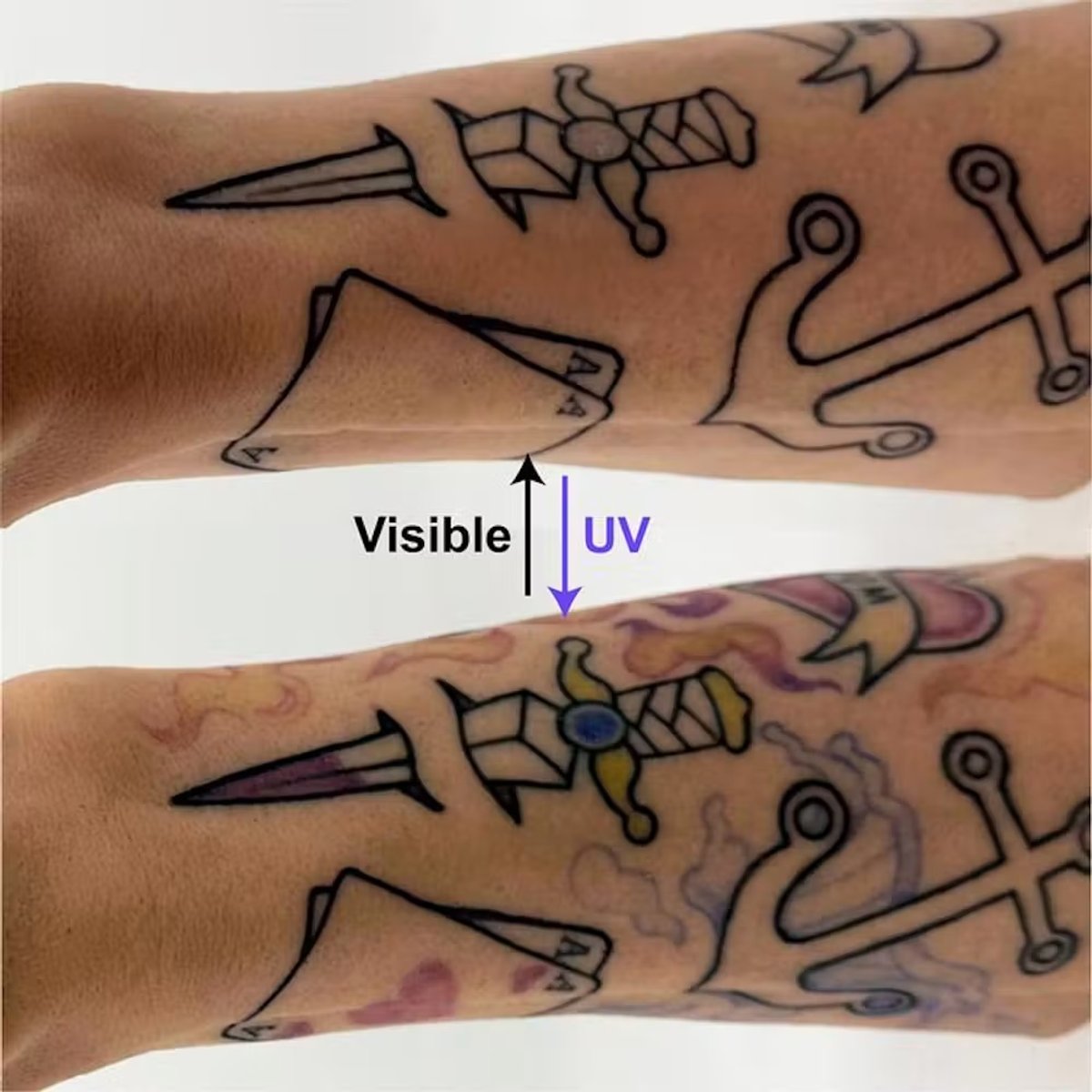
Researchers at the University of Colorado Boulder have made photochromic tattoo inks that appear under UV light and vanish under white light. Safety testing is still needed before tattoo shops can use them.

1 / 2
The story, neutrally told
Left · 2Researchers at the University of Colorado Boulder have developed invisible tattoo ink that is revealed with a UV torch and stays visible until it is switched off with white light. The ConversationLC “Researchers at the University of Colorado Boulder have developed invisible tattoo ink than can be revealed with a UV torch and stays visible until switched off with white light.” Read at The Conversation ↗ Scientific AmericanLC “Researchers at the University of Colorado Boulder have developed invisible tattoo ink than can be revealed with a UV torch and stays visible until switched off with white light.” Read at Scientific American ↗ Left · 1The work is reported as published in the journal Matter & Light. Motifs created with the ink include a lantern that reveals its light when activated and multicoloured scales like those in The Rainbow Fish. The ConversationLC “They have published their research in the journal Matter & Light.”“ranging from a lantern that reveals its light when activated, to multicoloured scales like those in the much-loved children’s book The Rainbow Fish.” Read at The Conversation ↗ Left · 1The pigments are photochromic dyes, compounds that change colour in light and have long been used in colour-changing sunglasses. Two or three seconds of bright UV light forms a new ring in the dye molecule, turning a colourless pigment coloured, and a blast of bright white light breaks the ring and switches the colour off. The ConversationLC “two or three seconds of bright ultraviolet (UV) light is enough to form a new ring in the dye molecule, which switches a colourless pigment to a coloured one.”“A blast of bright white light reverses the reaction, breaking the ring and turning the colour off again.” Read at The Conversation ↗
Left · 1Earlier photochromic dyes were unstable in their coloured form and degraded after repeated cycles. The article says recently designed dyes hold their colour for months and survive over 10,000 activation and deactivation cycles. The ConversationLC “remarkably stable dyes have been designed that reliably hold their colour for months and can undergo over 10,000 activation and deactivation cycles without degrading.” Read at The Conversation ↗ Left · 1Carson Bruns' team encapsulated the pigments in poly(methyl methacrylate) (PMMA), a polymer used in bone cement, dentures and intraocular lenses. The resulting family of inks is called PhotoTat. The ConversationLC “encapsulating them in poly(methyl methacrylate) (PMMA), a polymer approved for medical use in bone cement, dentures and intraocular lenses. This family of inks is known as PhotoTat.” Read at The Conversation ↗ Left · 1A red pigment was launched in 2024 as Magic Ink by the Colorado biotech company Hyprskn. A 2 ml vial costs £77, about 100 times regular tattoo ink, and the ink is said to comply with EU Reach regulations. The team has now developed blue, magenta and yellow PhotoTat inks that can combine into 16 other colours. The ConversationLC “A red pigment was already launched in 2024 under the name Magic Ink by Colorado-based biotech company Hyprskn.”“Bruns’ research team has developed three more PhotoTat inks – blue, magenta and yellow – that can combine into 16 other colours.” Read at The Conversation ↗
Left · 1Bruns said he is the only person to have tested the ink so far, with hundreds of these tattoos on his legs, and that they have all gone well. The ConversationLC ““So far,” Bruns says, “the only person who’s tested this ink is me. I actually have hundreds of these tattoos on my legs now and they’ve all gone really well.”” Read at The Conversation ↗ Left · 1Limitations remain. Direct sunlight contains enough UV to activate the tattoos unless sunscreen protects them, and indoor light slowly switches them off over several days. The blue ink degrades after only 10–100 activations, leaving a permanent purple mark. The inks need thorough toxicity and safety testing before general use, which the article says will likely take several years. The ConversationLC “direct sunlight contains enough UV radiation to activate the tattoos unless they are protected by sunscreen. Indoor light will slowly switch them off over a period of several days.”“the blue ink currently degrades after only 10–100 activations, leaving a permanent, purple-coloured mark.” Read at The Conversation ↗ Left · 1Reception of Magic Ink in the tattoo community was mixed: some saw a revolutionary creative tool, others an overpriced gimmick. Bruns also sees medical uses, such as markings that guide radiation therapy or identify biopsy sites and could be made invisible once no longer needed. The ConversationLC “some tattoo enthusiasts viewed it as a revolutionary creative tool, others thought it was an overpriced gimmick.”“for patients who need permanent skin markings to guide radiation therapy or identify sites for biopsies.” Read at The Conversation ↗
Every sentence links to the reporting it rests on. The pill in front of each says where its sources sit: Left, Centre or Right when one side supplies at least half of them, Mixed when they are evenly split. The number is how many outlets it cites.
Left2 outlets
- Framing
- Explanatory science pieces by a University of Nottingham chemist, framed around how the chemistry works and the appeal of tattoos that can be hidden for work and shown at a party. Scientific American republished The Conversation article, so the two share the same text.
- Emphasis
- The photochromic mechanism, dye stability, the PhotoTat inks, price, remaining limitations and likely years of safety testing, and possible medical uses.
- Leaves out or plays down
- No independent safety data, outside experts or tattoo artists are quoted. Bruns is the only named researcher and the only reported tester. The pieces give no study details beyond the journal name.
- Charged language
- “magically”
- For example
-
“This sounds like science fiction, but it may soon be reality.” — The Conversation
“This article was first published by The Conversation.” — Scientific American
Centre0 outlets
No centre outlet in our sources has covered this story yet.
Right0 outlets
No right outlet in our sources has covered this story yet.
What every side reports
- University of Colorado Boulder researchers developed UV-activated, white-light-erasable tattoo ink.
- Carson Bruns leads the team, and the inks are called PhotoTat.
- The inks need years of safety testing before use in tattoo shops.
Left2 articles
-
Chemists create disappearing tattoos: here’s the science behind how they work
Mixed Expert explainer that is enthusiastic about the science but cautions readers not to expect the tattoos soon.
-
These tattoos can magically' disappear—here’s how they work
Mixed Republication of The Conversation piece with a headline that stresses 'magically' disappearing tattoos; the body text is the same cautious explainer.
Centre0 articles
No coverage yet.
Right0 articles
No coverage yet.
- 30 Oct 13:17 First The ConversationLC Chemists create disappearing tattoos: here’s the science behind how they work
- 1 Nov 10:00 +44h 42m Scientific AmericanLC These tattoos can magically' disappear—here’s how they work
Times are when each article was published, or when we first saw it if the outlet gave no time.
Ask about this story
Loading…