Philippines moves to drive off Chinese research ship near Batanes amid undersea cable concerns
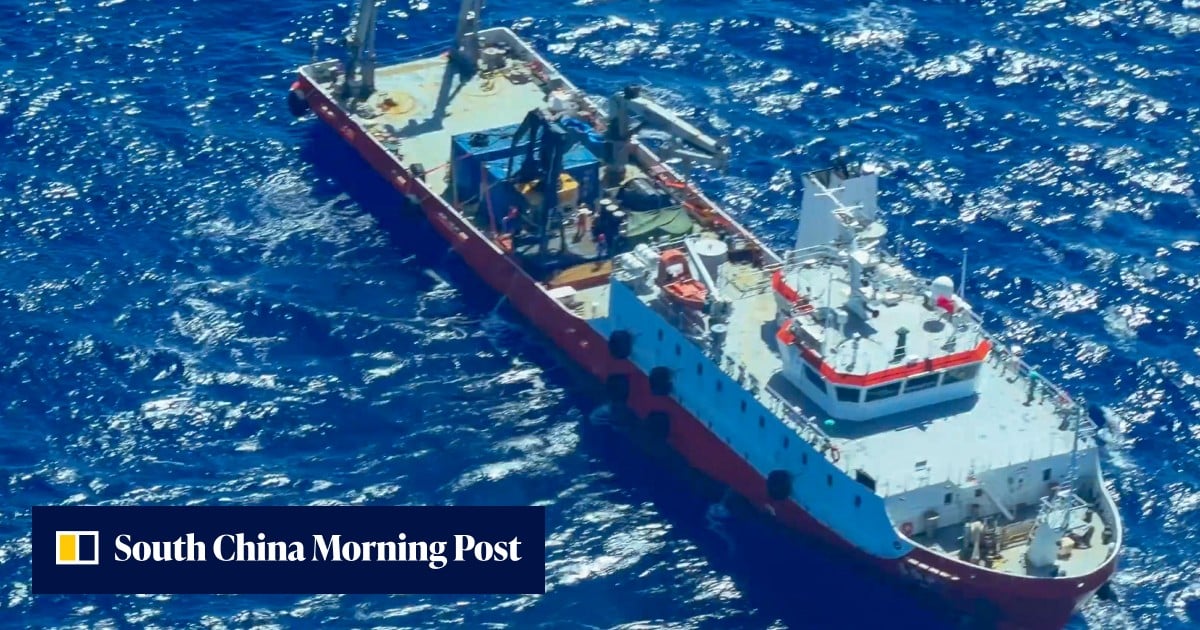
The Chinese research vessel Jia Hai Ke 7 has been operating off the Philippines' Batanes Islands since late September. Manila says it sent a coast guard ship and aircraft to drive it away and fears for undersea cables, while China says the ship is working in its own waters.
1 / 2
The story, neutrally told
A Chinese civilian research vessel, the Jia Hai Ke 7, has been operating in waters off the Philippines' Batanes Islands for more than a week, according to the South China Morning Post. South China Morning PostN “A Chinese civilian research vessel has spent more than a week conducting operations in waters off the Philippines’ Batanes Islands” Read at South China Morning Post ↗ AIS data tracked by MarineTraffic show the ship left Xiamen on 19 September, arrived near Itbayat in Batanes on 22 September and stayed through at least Tuesday. South China Morning PostN “departed from Xiamen on China’s southeastern coast on September 19, arrived near Itbayat in the province of Batanes on September 22” Read at South China Morning Post ↗ Philippine Coast Guard spokesman Jay Tarriela said the ship was loitering and holding position, a pattern he said is typical of marine scientific research rather than transit. The SCMP puts it about 38 nautical miles (70km) northwest of Itbayat, while Anadolu cites 37 nautical miles. South China Morning PostN “Jia Hai Ke 7 has been loitering and holding position in the same area” Read at South China Morning Post ↗ Anadolu AgencyN “about 37 nautical miles (43 miles) northwest of Itbayat, Batanes” Read at Anadolu Agency ↗
Both outlets say the coast guard confirmed the ship's presence on Monday, 28 September. Philippine aerial patrols issued three radio challenges demanding it declare its mission and stop unauthorised surveys, and received no response. South China Morning PostN “Philippine aerial patrols issued three radio challenges demanding that the ship declare its mission and cease unauthorised surveys, but received no response.” Read at South China Morning Post ↗ Anadolu AgencyN “since the PCG first confirmed its presence on 28 Sept.” Read at Anadolu Agency ↗ On Thursday 1 October, Tarriela said the coast guard had deployed BRP Teresa Magbanua (MRRV-9701) and a PCG Islander aircraft to challenge the vessel, disrupt its activities and drive it away from Philippine waters. Anadolu AgencyN “challenge the Chinese research vessel JIA HAI KE 7, disrupt its activities, and drive it away from Philippine waters” Read at Anadolu Agency ↗ He said China Coast Guard vessel CCG-2503 arrived abruptly, moved toward the Philippine ship and issued repeated radio challenges, and that BRP Teresa Magbanua shadowed it at about 1,000 yards while staying close to the research vessel. Anadolu AgencyN “China Coast Guard vessel CCG-2503 abruptly arrived in the vicinity.” Read at Anadolu Agency ↗
Tarriela said the Chinese coast guard's move to shield a supposedly private vessel raises questions about who the ship is working for, and about what data it has collected over undersea cable corridors in the Luzon Strait. Anadolu AgencyN “raises serious questions about who JIA HAI KE 7 is really working for.” Read at Anadolu Agency ↗ The SCMP says the presence of the ship has stirred concern in Manila over subsea telecommunications cables in the Luzon Strait that link Southeast Asia to North America and northeast Asia. It also notes wider concern about China using research vessels to assert claims, map the seabed for possible military use and gather intelligence on undersea infrastructure. South China Morning PostN “critical subsea telecommunications cables traversing the seabed of the Luzon Strait, which connect Southeast Asia to North America and northeast Asia”“map seabed terrain for potential military applications, and gather intelligence on undersea infrastructure in disputed waters” Read at South China Morning Post ↗ The Chinese embassy in Manila said the vessel was operating within waters under Chinese jurisdiction. The state-run Global Times called its work legitimate and lawful offshore marine geological surveys and accused the Philippines of overstretching the concept of security. South China Morning PostN “operating within waters under Chinese jurisdiction”“By forcibly overstretching the concept of security and militarising civilian research” Read at South China Morning Post ↗
Anadolu reported that Beijing had not yet responded to Manila's latest claims. Anadolu AgencyN “Beijing has yet to respond to claims made by Manila.” Read at Anadolu Agency ↗ The SCMP places the episode in a wider dispute. Manila and Tokyo agreed in May to start talks on delimiting their overlapping exclusive economic zones and continental shelves, and Beijing called this unlawful and void, saying the waters form part of Chinese maritime zones projected from Taiwan. The SCMP adds that some Chinese scholars argued in June that the Batanes are a natural extension of Taiwan, a view Beijing has not officially endorsed. South China Morning PostN “Beijing denounced the bilateral initiative as unlawful and void”“The assertion is not officially endorsed by Beijing.” Read at South China Morning Post ↗ The SCMP describes the 70-metre Jia Hai Ke 7 as China's first privately owned research ship with a Dynamic Positioning Class 2 system, built for Zhuhai Jiahai Marine Technology Co and in service since April last year. It also recalls that last month Manila accused another Chinese survey vessel, the Haiyang Dizhi 10, of 25 days of illegal operations in the Philippine EEZ, including at Scarborough Shoal. South China Morning PostN “China’s first privately owned research ship equipped with a Dynamic Positioning Class 2 (DP2) system”“Haiyang Dizhi 10, of conducting “illegal” operations for 25 days within the Philippine exclusive economic zone” Read at South China Morning Post ↗
Every sentence links to the reporting it rests on.
Left0 outlets
No left outlet in our sources has covered this story yet.
Centre2 outlets
- Framing
- Both centre outlets lead with Manila's concerns and actions. The SCMP gives a broader explainer with Chinese responses and the Manila-Tokyo delimitation context, while Anadolu reports Manila's statement on driving the ship away and notes Beijing has not responded.
- Emphasis
- The SCMP stresses undersea cables, the geopolitical context around Batanes and the pattern of Chinese research vessel deployments. Anadolu stresses the coast guard operation and the China Coast Guard's arrival.
- Leaves out or plays down
- Anadolu does not include China's earlier defence of the ship, the Manila-Tokyo delimitation talks or the cable details. The SCMP, published earlier, does not cover the 1 October operation to drive the ship away or the China Coast Guard vessel's arrival. The two also differ on how long the ship has been in the area.
- Charged language
- “new geopolitical battleground”“illegal MSR”
- For example
-
“an area that has become a new geopolitical battleground as Beijing ramps up pressure against Manila-Tokyo delimitation efforts” — South China Morning Post
“disrupt and drive” away a Chinese research vessel conducting “unauthorized” marine scientific research” — Anadolu Agency
Right0 outlets
No right outlet in our sources has covered this story yet.
What every side reports
- The Chinese research vessel Jia Hai Ke 7 is operating northwest of Itbayat in Batanes, in waters the Philippines treats as its exclusive economic zone.
- The Philippine Coast Guard confirmed its presence on 28 September and spokesman Jay Tarriela has publicly criticised its activity.
- The vessel's presence raises concern about undersea cables in the Luzon Strait.
Where accounts differ
-
Whether the ship is lawfully operating in the area
- Centre
- The SCMP reports Manila calling the survey unauthorised and the Chinese embassy and Global Times saying it is lawful and in waters under Chinese jurisdiction. Anadolu relays Manila's account and notes Beijing has not yet responded.
-
Whether the ship is a purely private research vessel
- Centre
- Tarriela, quoted by Anadolu, calls it a supposedly private vessel and questions who it works for, citing the China Coast Guard's arrival. The SCMP describes it as a civilian, privately owned research ship and reports China saying its work is scientific.
Philippines place
Manila, through the coast guard, says the ship is conducting illegal marine scientific research in its EEZ. It says it sent a vessel and aircraft to drive it away and questions what data it is collecting over cable corridors.
“conducting illegal MSR in another country's EEZ raises serious questions” — Anadolu Agency
“displaying behaviour inconsistent with innocent passage” — South China Morning Post
China place
The Chinese embassy and the state-run Global Times say the ship is carrying out lawful surveys in waters under Chinese jurisdiction and accuse Manila of militarising civilian research. Beijing had not yet responded to Manila's latest claims, per Anadolu.
““legitimate and lawful” offshore marine geological surveys and scientific investigations in waters under Chinese jurisdiction” — South China Morning Post
“Beijing has yet to respond to claims made by Manila.” — Anadolu Agency
Left0 articles
No coverage yet.
Centre2 articles
-
Chinese research ship near the Batanes sparks undersea cable concerns in Manila
Neutral Explainer on the ship's movements and the cable concerns, placing them in the Batanes delimitation dispute and giving both Manila's and Beijing's positions.
-
Philippines says it deployed vessel, aircraft to ‘drive’ away Chinese research vessel
Neutral Short report relaying the Philippine coast guard's account of driving off the ship and the China Coast Guard's arrival, noting Beijing has not responded.
Right0 articles
No coverage yet.
- 1 Oct 05:00 First South China Morning PostN Chinese research ship near the Batanes sparks undersea cable concerns in Manila
- 1 Oct 14:44 +9h 44m Anadolu AgencyN Philippines says it deployed vessel, aircraft to ‘drive’ away Chinese research vessel
Times are when each article was published, or when we first saw it if the outlet gave no time.