CSA report ranks Kuwait, Lebanon and Syria likeliest next Abraham Accords members
The Council for a Secure America's 8 October report ranks nine Muslim-majority countries by how likely they are to join the Abraham Accords, placing Kuwait first, then Lebanon and Syria, with Iran last.
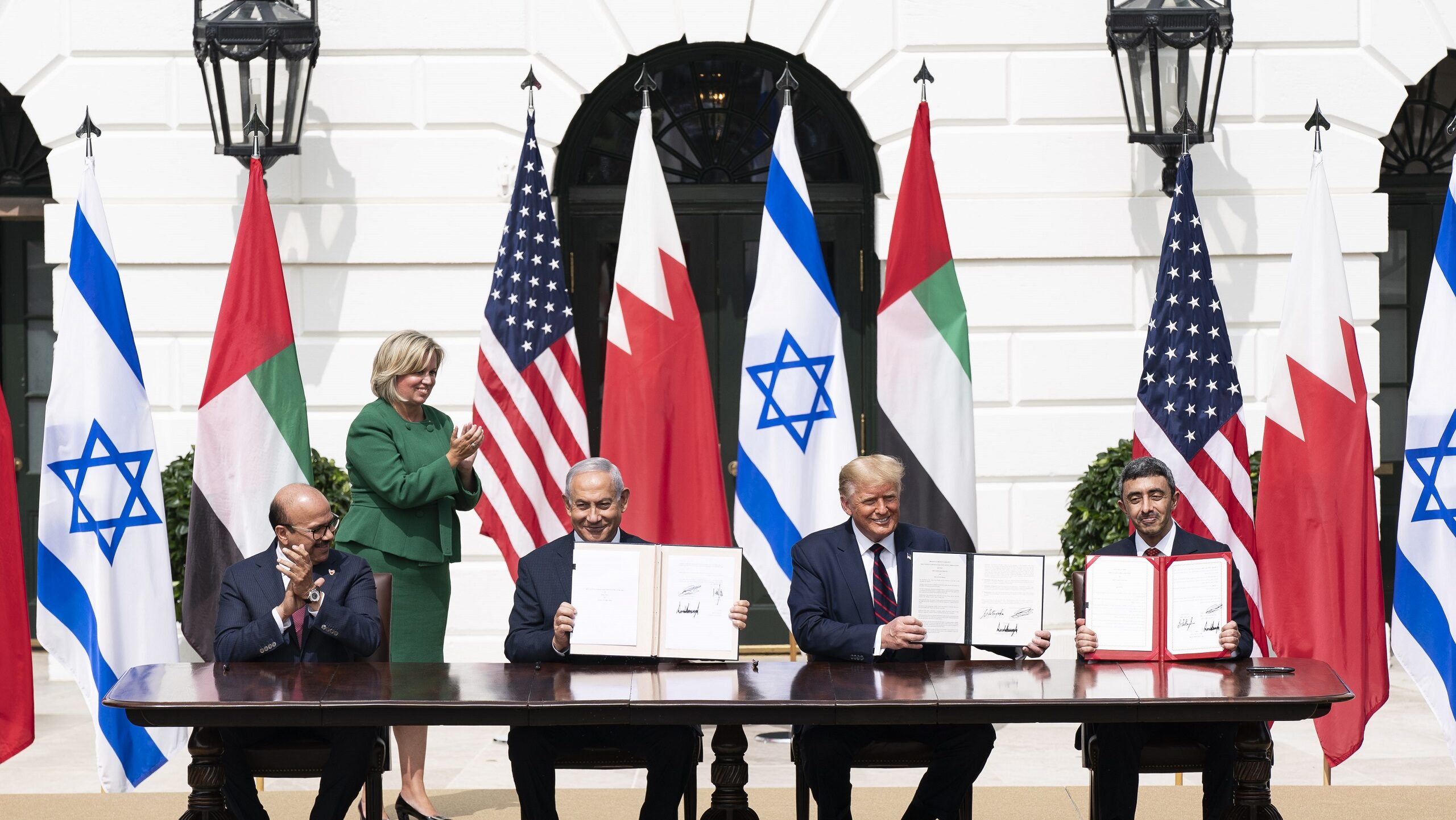

1 / 2
The story, neutrally told
Mixed · 2The Council for a Secure America (CSA) ranked Kuwait as the Middle Eastern country most likely to join the Abraham Accords, followed by Lebanon and Syria. The Media LineN “The Council for a Secure America (CSA) has ranked Kuwait as the Middle Eastern country most likely to join the Abraham Accords, followed by Lebanon and Syria” Read at The Media Line ↗ The Jerusalem PostRC “The Council for a Secure America (CSA) has ranked Kuwait as the Middle Eastern country most likely to join the Abraham Accords, followed by Lebanon and Syria” Read at The Jerusalem Post ↗ Centre · 1The report, "Abraham Accords Expansion Opportunities: Middle East Analysis", was released on 8 October and assessed nine Muslim-majority countries without formal diplomatic relations with Israel: Kuwait, Lebanon, Syria, Saudi Arabia, Oman, Qatar, Iraq, Yemen and Iran. The Media LineN “assessing nine Muslim-majority countries without formal diplomatic relations with Israel: Kuwait, Lebanon, Syria, Saudi Arabia, Oman, Qatar, Iraq, Yemen and Iran.” Read at The Media Line ↗ Centre · 1The rankings drew on expert analysis, primary and secondary sources and CSA polling, and CSA said they measure both governments' willingness and political ability to normalise relations and could change as conditions evolve. The Media LineN “CSA said the rankings measure both governments’ willingness and political ability to normalize relations and could change as regional conditions evolve.” Read at The Media Line ↗
Centre · 1CSA said more than 80% of Israelis it surveyed in June 2026 support the Abraham Accords, which established relations between Israel and the UAE, Bahrain, Morocco and Sudan in 2020. CSA Executive Director Jennifer Sutton said recent events have "reinforced the need for America's continued engagement in the region." The Media LineN “More than 80% of Israelis surveyed by CSA in June 2026 support the Abraham Accords”“reinforced the need for America’s continued engagement in the region.” Read at The Media Line ↗ Centre · 1Kuwait ranked first despite its longstanding opposition to normalisation and laws barring trade with Israel. CSA cited the growing authority of Mishal Al-Ahmad Al-Jaber Al-Sabah since he suspended parliament in May 2024, closer ties with the UAE, strong security ties with Washington, and Iranian attacks on Kuwait during the 2026 Iran War. Israel's ambassador to the UAE, Yossi Shelley, said in September that Kuwait could join within six months. The Media LineN “Kuwait ranked first despite its longstanding opposition to normalization and laws barring trade with Israel.”“Israel’s ambassador to the UAE, Yossi Shelley, said in September that Kuwait could join the accords within six months.” Read at The Media Line ↗ Mixed · 2Lebanon placed second after significant diplomatic activity with Israel, including a US-brokered "Trilateral Framework" signed in June under which Lebanon recognised Israeli sovereignty for the first time. CSA polling found 41% of Lebanese thought peace with Israel likely but only 32% supported normalisation, and Hezbollah's presence and incomplete disarmament remain major obstacles. The Media LineN “CSA polling found 41% of Lebanese believed peace with Israel was likely, although only 32% supported normalization.” Read at The Media Line ↗ The Jerusalem PostRC “Hezbollah's continued presence and failure to fully disarm remain major obstacles.” Read at The Jerusalem Post ↗
Mixed · 2Syria ranked third as talks with Israel accelerated after the fall of the Assad regime. President Ahmed al-Sharaa said in September the sides had "almost reached agreements on 90%" of outstanding issues. CSA found 54% of Syrians thought peace likely, 53% backed a security arrangement and 46% backed normalisation; the Golan Heights dispute remains a key obstacle. The Media LineN “CSA found 54% of Syrians believed peace was likely, 53% supported a security arrangement and 46% supported normalization.” Read at The Media Line ↗ The Jerusalem PostRC “The dispute over the Golan Heights remains a key obstacle.” Read at The Jerusalem Post ↗ Centre · 1Among the less likely candidates, CSA said Saudi Arabia has moved further away since 7 October 2023 and the 2026 Iran War, despite Crown Prince Mohammed bin Salman saying in November 2025 he was prepared to work toward joining; Oman has repeatedly rejected normalisation under Sultan Haitham bin Tariq; and Qatar says full relations depend on an Israeli-Palestinian peace agreement. The Media LineN “CSA said the Iran war and concerns over Israel’s regional alliances have made Riyadh increasingly wary.”“under Sultan Haitham bin Tariq, Oman has repeatedly rejected normalization”“says full diplomatic relations depend on an Israeli-Palestinian peace agreement” Read at The Media Line ↗ Centre · 1Iraq is unlikely because of Iranian influence and a 2022 law criminalising normalisation, though CSA singled out Iraqi Kurdistan as an exception; Yemen's civil war and the hostile Houthis make normalisation highly unlikely; and Iran ranked last, with CSA concluding normalisation is not possible under its current regime. The Media LineN “CSA singled out Iraqi Kurdistan as an exception”“CSA concluded that normalization is not possible under Iran’s current regime.” Read at The Media Line ↗
Every sentence links to the reporting it rests on. The pill in front of each says where its sources sit: Left, Centre or Right when one side supplies at least half of them, Mixed when they are evenly split. The number is how many outlets it cites.
Left0 outlets
No left outlet in our sources has covered this story yet.
Centre1 outlet
- Framing
- The Media Line reports the CSA ranking as a straightforward country-by-country summary of the report, with no outside commentary.
- Emphasis
- The ranking order, CSA polling figures and obstacles for each country.
- Leaves out or plays down
- No independent reaction from Kuwaiti, Lebanese or Syrian officials or critics of the methodology.
- For example
-
“Kuwait, Lebanon and Syria Emerge as Top Abraham Accords Prospects” — The Media Line
Right1 outlet
- Framing
- The Jerusalem Post runs the same Media Line staff text under a headline stressing Abraham Accords 'expansion' options, adding subheads such as 'Kuwait thought to be closest to normalization with Israel'.
- Emphasis
- Expansion prospects and Kuwait as closest to normalisation.
- Leaves out or plays down
- No independent reporting or reaction beyond the CSA report; the text matches The Media Line's.
- Charged language
- “leading options”
- For example
-
“Kuwait, Lebanon, Syria leading options for Abraham Accords expansion, CSA report assesses” — The Jerusalem Post
“Kuwait thought to be closest to normalization with Israel, CSA survey shows” — The Jerusalem Post
What every side reports
- CSA ranked Kuwait first, Lebanon second and Syria third among nine countries assessed.
- The report was released on 8 October and Iran ranked last.
- Obstacles cited include Hezbollah in Lebanon and the Golan Heights dispute in Syria.
Council for a Secure America organisation
CSA presents its ranking as an assessment of both willingness and political ability to normalise, open to change as conditions shift, and says recent events reinforce the need for continued US engagement.
“CSA said the rankings measure both governments’ willingness and political ability to normalize relations” — The Media Line
“reinforced the need for America’s continued engagement in the region.” — The Media Line
Abraham Accords topic
The accords are described as having established relations between Israel and the UAE, Bahrain, Morocco and Sudan in 2020, with expansion hinging on regional politics and security conditions.
“which established relations between Israel and the United Arab Emirates, Bahrain, Morocco, and Sudan in 2020” — The Jerusalem Post
Left0 articles
No coverage yet.
Centre1 article
-
Kuwait, Lebanon and Syria Emerge as Top Abraham Accords Prospects
Neutral Plain summary of the CSA report's rankings and country assessments.
Right1 article
-
Kuwait, Lebanon, Syria leading options for Abraham Accords expansion, CSA report assesses
Neutral Republishes The Media Line's report text, framed around accords expansion, with added subheads.
- 11 Oct 10:29 First The Media LineN Kuwait, Lebanon and Syria Emerge as Top Abraham Accords Prospects
- 11 Oct 12:56 +2h 26m The Jerusalem PostRC Kuwait, Lebanon, Syria leading options for Abraham Accords expansion, CSA report assesses
Times are when each article was published, or when we first saw it if the outlet gave no time.