53 critically endangered giant burrowing frogs released in East Gippsland after Black Summer rescue
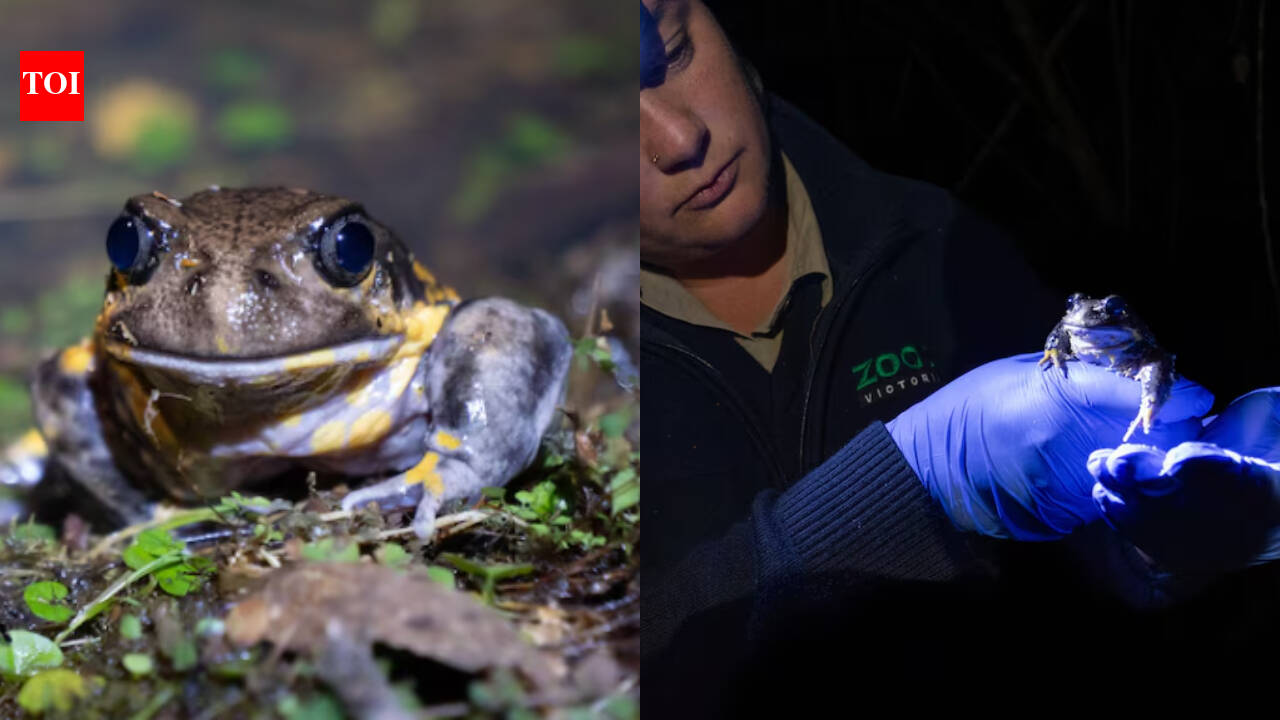
Fifty-three southern giant burrowing frogs, descended from tadpoles found after the 2019–20 Black Summer fires, have been released in East Gippsland, Victoria, after a Zoos Victoria breeding program.
1 / 2
The story, neutrally told
Mixed · 2Fifty-three critically endangered southern giant burrowing frogs have been released into the wild in East Gippsland, Victoria, almost six years after the Black Summer fires. ABC News (Australia)LC “Fifty-three critically endangered Southern Giant Burrowing Frogs have been released into the wild after a successful conservation breeding program with Zoos Victoria.” Read at ABC News (Australia) ↗ The Times of IndiaN “Nearly six years after the fires devastated their habitat, 53 critically endangered Southern Giant Burrowing Frogs have returned to the forests” Read at The Times of India ↗ Mixed · 2The frogs were discovered as tadpoles, in areas no larger than a puddle, after the 2019/2020 fires destroyed large areas of their forest habitat; the Times of India, citing ABC News, puts the number rescued at about 160. ABC News (Australia)LC “The frogs were initially discovered as tadpoles after the 2019/2020 fires destroyed large swathes of their forest habitat in East Gippsland.” Read at ABC News (Australia) ↗ The Times of IndiaN “the frogs were originally discovered as approximately 160 tadpoles in small pockets of water” Read at The Times of India ↗ Left · 1Snowline Ecology herpetologist Matt Clancy called the discovery a miracle, saying many areas were burnt to no vegetation, which he thinks severely affected some populations. ABC News (Australia)LC “"A lot of those areas were just completely burnt and reduced to no vegetation at all, which we think had quite a severe impact on some of the populations of this species," he said.” Read at ABC News (Australia) ↗
Mixed · 2In 2021 Clancy and other experts took the tadpoles to Healesville Sanctuary, where keepers from Melbourne Zoo and Healesville raised them through metamorphosis. ABC News (Australia)LC “In 2021, Mr Clancy worked with other scientists and wildlife experts at Healesville Sanctuary to return the rescued tadpoles to the sanctuary.” Read at ABC News (Australia) ↗ The Times of IndiaN “Herpetologist Matt Clancy of Snowline Ecology took the rescued tadpoles to Healesville Sanctuary in 2021.” Read at The Times of India ↗ Mixed · 2Last year the species was bred in captivity for the first time; Zoos Victoria described this as a world first, according to the Times of India. ABC News (Australia)LC “last year successfully bred the species for the first time in captivity.” Read at ABC News (Australia) ↗ The Times of IndiaN “Zoos Victoria described the achievement as a world first” Read at The Times of India ↗ Left · 1Zoos Victoria keeper Meagan Lane said the program secured the frogs' genetics for future generations and gave insight into a species never before held in a zoo. ABC News (Australia)LC “scientists have been able to secure the frogs' genetics for future generations, while also gaining valuable insight for the species.” Read at ABC News (Australia) ↗
Mixed · 2The frog is about the size of a cricket ball, with large eyes and muscular limbs, and lives from south of Kangaroo Valley in New South Wales through Victoria to Walhalla in central Gippsland. ABC News (Australia)LC “the southern giant burrowing frog is roughly the size of a cricket ball.” Read at ABC News (Australia) ↗ The Times of IndiaN “extending from areas south of Kangaroo Valley in New South Wales through Victoria to Walhalla in central Gippsland” Read at The Times of India ↗ Mixed · 2Bushfires, drought and the amphibian disease chytridiomycosis have hit wild numbers; there is no population census because the frogs are secretive and mostly underground, and Victoria has fewer than five known breeding sites. ABC News (Australia)LC “There are fewer than five known breeding sites in Victoria.” Read at ABC News (Australia) ↗ The Times of IndiaN “Habitat destruction, prolonged drought, bushfires and chytridiomycosis, a widespread amphibian disease, have all contributed to declining populations.” Read at The Times of India ↗ Mixed · 2Scientists will monitor the released frogs; song meters in the forest will detect their calls and help find potential breeding sites. The Times of India adds that each frog carries a PIT microchip tag, and that a federal Wildlife and Habitat Bushfire Recovery Program funded the project. ABC News (Australia)LC “Song meters have also been set up through the forest to detect the frogs' distinct call and help field teams identify potential breeding sites.” Read at ABC News (Australia) ↗ The Times of IndiaN “each released frog received a microchip or passive integrated transponder (PIT) tag.” Read at The Times of India ↗
Every sentence links to the reporting it rests on. The pill in front of each says where its sources sit: Left, Centre or Right when one side supplies at least half of them, Mixed when they are evenly split. The number is how many outlets it cites.
Left1 outlet
- Framing
- ABC News (Australia) tells it as a local conservation success, led by the return home of fire survivors, with quotes from scientists and keepers.
- Emphasis
- Clancy's and Lane's quotes, the secretive nature of the species and monitoring plans.
- Leaves out or plays down
- Does not mention the tadpole count, PIT tags or funding.
- Charged language
- “miracle”
- For example
-
“an unsuspecting colony of survivors is finally making its way home.” — ABC News (Australia)
Centre1 outlet
- Framing
- The Times of India rewrites the ABC report as an uplifting nature story, leading with the rescue from the ashes.
- Emphasis
- The 160 tadpoles, the world-first claim, PIT tags and funding, with heavy attribution to ABC News and Zoos Victoria.
- Leaves out or plays down
- Includes no direct quotes from the scientists or keepers.
- Charged language
- “extraordinary conservation success”“pioneering captive-breeding programme”
- For example
-
“has grown into an extraordinary conservation success” — The Times of India
Right0 outlets
No right outlet in our sources has covered this story yet.
What every side reports
- 53 critically endangered southern giant burrowing frogs were released in East Gippsland.
- They descend from tadpoles found after the 2019–20 Black Summer fires and raised at Zoos Victoria facilities.
- Captive breeding of the species happened for the first time last year.
- Fewer than five breeding sites are known in Victoria, and song meters are deployed to monitor calls.
Left1 article
-
Critically endangered frogs returned six years after Black Summer
Sympathetic Hopeful local report of fire survivors returning home, built on scientist and keeper quotes.
Centre1 article
-
53 rare frogs return to Australian forests years after devastating Black Summer fires
Celebratory Derivative feature presenting the release as an extraordinary conservation success, with extra detail on tagging and funding.
Right0 articles
No coverage yet.
- 7 Nov 22:33 First ABC News (Australia)LC Critically endangered frogs returned six years after Black Summer
- 10 Nov 10:30 +59h 56m The Times of IndiaN 53 rare frogs return to Australian forests years after devastating Black Summer fires
Times are when each article was published, or when we first saw it if the outlet gave no time.
Ask about this story
Loading…