Divers find bronze ring engraved with Lighthouse of Alexandria at sunken palace
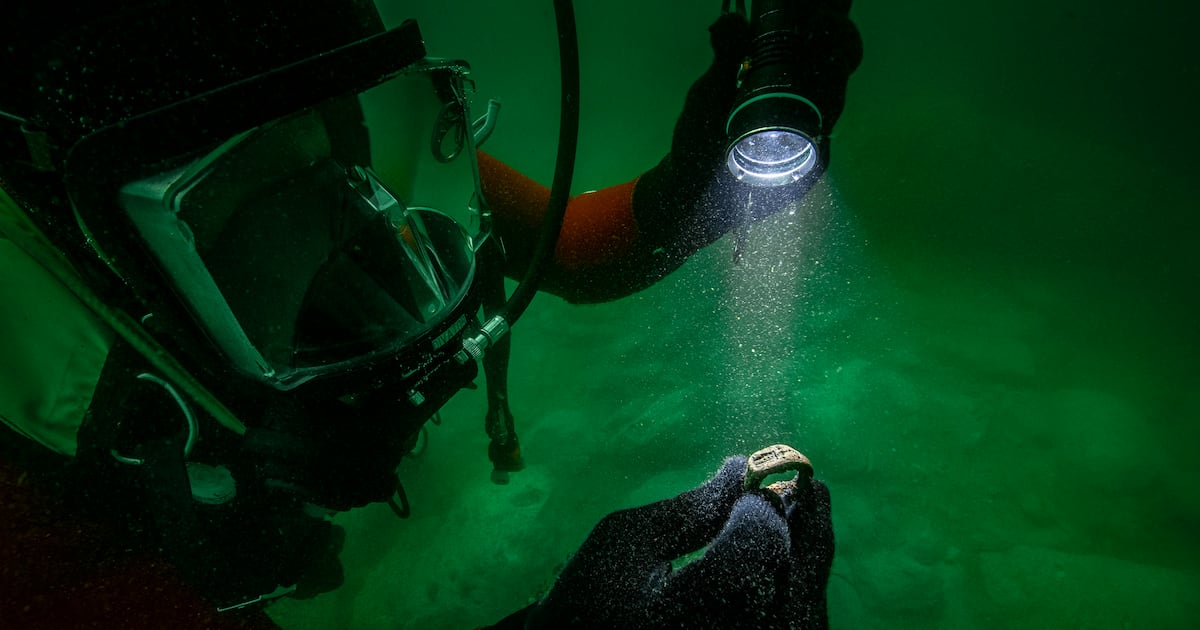
Underwater archaeologists have recovered a bronze signet ring engraved with the Lighthouse of Alexandria from the sunken island of Antirhodos. Egyptian officials call it the first such depiction on a seal ring.

1 / 2
The story, neutrally told
Centre · 2Underwater archaeologists have found a bronze signet ring engraved with an image of the Lighthouse of Alexandria on Antirhodos, a submerged island that was part of the royal quarter of Alexandria's Portus Magnus (Great Harbour). The NationalN “The ring was found on Antirhodos, an island once part of the royal quarters in Alexandria’s Portus Magnus, or Great Harbour.” Read at The National ↗ Gulf NewsN “Underwater archaeologists have recovered a bronze signet ring from the sunken island of Antirhodos” Read at Gulf News ↗ Centre · 2The European Institute for Underwater Archaeology (IEASM) made the find public on Wednesday 7 October. The NationalN “The European Institute for Underwater Archaeology announced the discovery on Wednesday.” Read at The National ↗ Gulf NewsN “The institute made the find public on Wednesday.” Read at Gulf News ↗ Centre · 2Egyptian authorities describe it as a first: The National cites the Tourism and Antiquities Ministry as calling it the first known depiction of the lighthouse on a signet ring, and Gulf News says the Supreme Council of Antiquities knows of no earlier seal ring with the lighthouse engraved on it. The council's secretary-general, Hisham El-Leithy, called the discovery exceptional. The NationalN “Egypt’s Tourism and Antiquities Ministry described the find as the first known depiction of the lighthouse engraved on a signet ring.” Read at The National ↗ Gulf NewsN “The Supreme Council of Antiquities says no seal ring carrying an engraved image of the lighthouse had ever been found before.” Read at Gulf News ↗
Centre · 2The engraving resembles the lighthouse as it appears on coins from the second century AD. Gulf News says this suggests the ring likely dates to around then, while The National says the institute gave no firm date for the ring or details of who might have owned it. The NationalN “although the institute did not give a firm date for the ring or details on who might have owned it” Read at The National ↗ Gulf NewsN “which suggests the ring likely dates to around that period” Read at Gulf News ↗ Centre · 2The excavations are led by French underwater archaeologist Franck Goddio, who said the find is more important because it came from the legendary palace on Antirhodos, once a centre of power. He and his team suggest the palace may have housed administrative offices, including functions connected to the lighthouse, and Gulf News reports the team believes it may still have been used for official business into the second century AD. The NationalN “He said it suggested the palace had housed administrative offices, including functions connected to the lighthouse.” Read at The National ↗ Gulf NewsN “possibly including duties connected to the administration of the lighthouse” Read at Gulf News ↗ Centre · 2The lighthouse was built on the island of Pharos in the early third century BC (The National says it was completed around 280BC under Ptolemy II) and is thought to have stood more than 100 metres tall. Earthquakes brought it down, and in the late 15th century the Mamluk sultan Qaitbay built a fortress on the site using its stone. The NationalN “The Lighthouse of Alexandria was completed around 280BC during the reign of Ptolemy II.”“In the late 15th century, the Mamluk sultan Qaitbay built a fortress on its site, incorporating stone from the fallen lighthouse.” Read at The National ↗ Gulf NewsN “Built in the early 3rd century BC on the island of Pharos” Read at Gulf News ↗
Centre · 2This season's joint mission with Egyptian antiquities authorities is working at four sites in the Eastern Harbour: a temple of Isis, the palace and western mound or platform on Antirhodos, a further site (an obelisk's remains in The National, a monumental sarcophagus in Gulf News), and the Timonium, a palace associated with Mark Antony. The NationalN “the temple of Isis, the palace and western mound on Antirhodos, remains of an obelisk, and the Timonium, a palace associated with Mark Antony” Read at The National ↗ Gulf NewsN “the remains of a monumental sarcophagus, and the Timonium, a palace complex associated with Mark Antony” Read at Gulf News ↗ Centre · 1Gulf News adds that divers also recovered ceramics, including utensils, tableware and amphorae, spanning the fourth century BC to the fourth century AD, as well as fragments of ancient glassware. Gulf NewsN “spanning roughly eight centuries from the 4th century BC to the 4th century AD” Read at Gulf News ↗ Centre · 2Tourism and Antiquities Minister Sherif Fathy and his assistant Ahmed Rehema visited the team's research vessel on Monday to inspect the ring. The mission is supported by the Hilti Foundation, which has funded Goddio's work since 1996, and the team will move on to Abu Qir Bay, where it located the submerged city of Thonis-Heracleion in 2000. The NationalN “visited the team aboard its research vessel on Monday to observe the underwater excavations and inspect the ring”“supported by the Hilti Foundation, which has funded Mr Goddio’s work since 1996” Read at The National ↗ Gulf NewsN “the mission is expected to continue its underwater investigations in Abu Qir Bay” Read at Gulf News ↗
Centre · 1Gulf News also notes that a separate project, PHAROS, lifted 22 large blocks of the lighthouse from the seabed near the Qaitbay Citadel in 2025 to help reconstruct the monument digitally. Gulf NewsN “a separate project, known as PHAROS, lifted 22 large blocks from the site in 2025 to help reconstruct the monument digitally” Read at Gulf News ↗
Every sentence links to the reporting it rests on. The pill in front of each says where its sources sit: Left, Centre or Right when one side supplies at least half of them, Mixed when they are evenly split. The number is how many outlets it cites.
Left0 outlets
No left outlet in our sources has covered this story yet.
Centre2 outlets
- Framing
- Both Gulf outlets present the ring as an important, celebratory archaeological discovery, relying on the institute, Goddio and Egyptian officials. The National places the find within Goddio's wider record of sunken-city discoveries; Gulf News leads with the idea that the lighthouse image now 'fits on a finger' and explains what a signet ring was used for.
- Emphasis
- The 'first' claim from Egyptian officials, the palace's role as a centre of power, and the second-century coin parallel.
- Leaves out or plays down
- Neither independently verifies the claim that it is the first such depiction, and neither gives a firm date or owner. They differ on the fourth work site (obelisk versus sarcophagus) and on which Egyptian body made the 'first' claim.
- Charged language
- “hailed as an important find”“legendary palace”“Nothing like it before”
- For example
-
“in what has been hailed as an important find” — The National
“Now a new image of the ancient beacon has emerged, and it fits on a finger.” — Gulf News
Right0 outlets
No right outlet in our sources has covered this story yet.
What every side reports
- A bronze signet ring depicting the Lighthouse of Alexandria was found on the sunken island of Antirhodos in Alexandria's Great Harbour.
- The European Institute for Underwater Archaeology announced it on Wednesday 7 October 2026; Franck Goddio leads the excavation.
- The image resembles the lighthouse on second-century AD Alexandrian coins.
- Egyptian officials say no earlier signet or seal ring is known to show the lighthouse.
- The team will go on to Abu Qir Bay after the Eastern Harbour work.
Where accounts differ
-
Which Egyptian body made the 'first' claim and what the fourth Eastern Harbour site is
- Centre
- The National attributes the claim to the Tourism and Antiquities Ministry and lists remains of an obelisk; Gulf News attributes it to the Supreme Council of Antiquities and lists a monumental sarcophagus.
European Institute for Underwater Archaeology organisation
The institute announced the find and, through Franck Goddio, stresses its importance as coming from a historic centre of power, suggesting the palace housed offices linked to the lighthouse.
““The discovery of the signet ring is even more important as it has been excavated in the legendary palace of the Island of Antirhodos, that once was a centre of power,” Mr Goddio said.” — The National
“engraved with a multi-tiered structure identified as the Pharos, according to the European Institute for Underwater Archaeology (IEASM)” — Gulf News
Left0 articles
No coverage yet.
Centre2 articles
-
New image of an ancient wonder: Divers find ring showing Lighthouse of Alexandria at sunken palace
Celebratory News report on the discovery with extensive background on Goddio's earlier finds at Thonis-Heracleion and Abu Qir Bay.
-
Bronze ring engraved with Lighthouse of Alexandria found in sunken royal palace
Celebratory Explanatory feature stressing the ring's rarity and its function as a tool of authority, with background on the lighthouse and the PHAROS project.
Right0 articles
No coverage yet.
- 7 Oct 12:28 First The NationalN New image of an ancient wonder: Divers find ring showing Lighthouse of Alexandria at sunken palace
- 8 Oct 08:05 +19h 38m Gulf NewsN Bronze ring engraved with Lighthouse of Alexandria found in sunken royal palace
Times are when each article was published, or when we first saw it if the outlet gave no time.