Divers find 2,100-year-old Roman shipwreck off Turkey with ceramics tied to Cicero's Rhosus
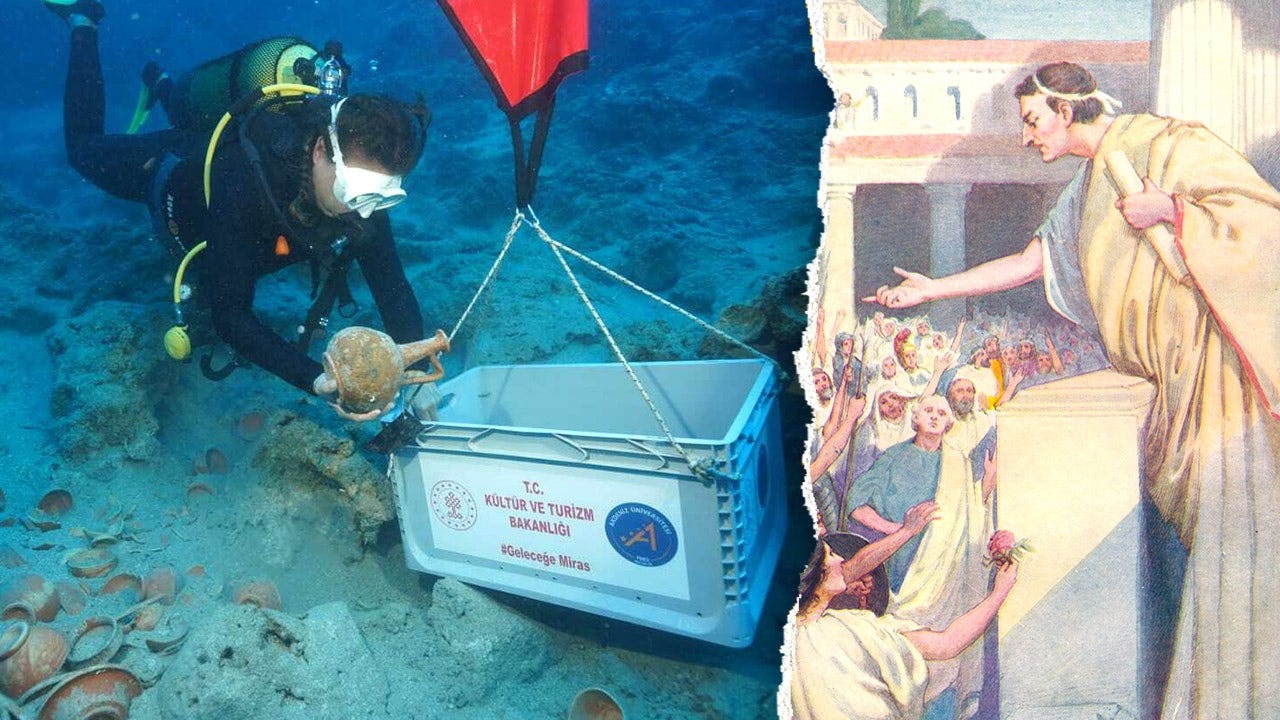
Turkish officials announced a 2,100-year-old Roman wreck off Turkey carrying well-preserved luxury ceramics from Rhosus, a pottery centre Cicero mentioned in his writings. A Northwestern classicist called the combination of evidence rare.
1 / 2
The story, neutrally told
Right · 2Turkish officials have announced the discovery of a roughly 2,100-year-old Roman shipwreck off the coast of Turkey carrying large quantities of luxury ceramics, with the state-run Anadolu Agency reporting it on 28 September. Fox NewsR “The recovery was recently announced by Turkish officials, the state-run Anadolu Agency (AA) reported Sept. 28.” Read at Fox News ↗ BreitbartR “Turkish officials announced recently that divers investigating a shipwreck off the coast of Turkey in the Mediterranean Sea found a treasure trove of well-preserved dishes” Read at Breitbart ↗ Right · 1According to Fox News, citing Anadolu, the artifacts include 122 different forms and sizes of plates, bowls and trays, among them dishes for nuts, soup and fish; the wreck lies about 138 to 180 feet below the surface. Fox NewsR “The artifacts include 122 different forms and sizes of plates, bowls and trays, including dishes used for nuts, soup and fish.”“The wreck lies about 138 to 180 feet below the surface.” Read at Fox News ↗ Right · 2Researchers believe the ship was sailing from Rhosus to Rome when it hit a shallow area during a storm and sank. Fox NewsR “Researchers believe the ship was traveling from Rhosus to Rome when it struck a shallow area during a storm and sank, according to AA.” Read at Fox News ↗ BreitbartR “The vessel is believed to have sunk during a storm while journeying from Rhosus to Rome.” Read at Breitbart ↗
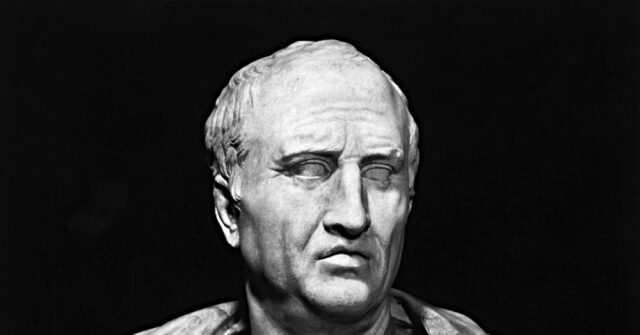
Right · 1The link to Cicero is that the ceramics are believed to come from Rhosus, a production centre he mentioned; Fox reports that in a letter to Atticus in 50 B.C. he wrote that he had ordered ceramic vessels from there. There is no evidence the recovered dishes belonged to Cicero himself. Fox NewsR “though there's no evidence that the recovered dishes belonged to Cicero himself”“In a letter to his friend Atticus in 50 B.C., the statesman wrote that he had ordered ceramic vessels from Rhosus for him, according to AA.” Read at Fox News ↗ Right · 2Turkey's Culture and Tourism Minister Mehmet Nuri Ersoy said the pieces survived in good condition because clay was placed between them when they were packed into crates; Breitbart attributes his quote to Smithsonian Magazine. BreitbartR “These artifacts, which have survived in good condition to the present day because of the clay placed between them when they were packed into crates” Read at Breitbart ↗ Fox NewsR “Turkish Culture and Tourism Minister Mehmet Nuri Ersoy said the ceramics were remarkably well preserved because clay had been packed between them” Read at Fox News ↗ Right · 1Taco Terpstra, a professor of classics and history at Northwestern University, told Fox News Digital the ceramics were a high-end product, 'the equivalent of fine china', not ordinary Roman tableware. He said coins aboard help date the wreck and the pottery can be traced to a production region in what is now southern Turkey and northern Syria. Fox NewsR “Terpstra also described the ceramics as "the equivalent of fine china" today.”“coins found aboard the ship help researchers date the wreck, while the pottery can be traced to a production region in what is now southern Turkey and northern Syria” Read at Fox News ↗
Right · 1Terpstra said Roman shipwrecks in the Mediterranean are quite common, but it is rare for monetary, archaeological and literary evidence to come together as here. He suggested the protective material may have been unfired soft clay, while noting the report did not specify its form. Fox NewsR “"It's quite rare for all of it … [all] the lines of evidence to come together, like monetary, archeological, literary," Terpstra said.”“The historian suggested the material may have been unfired clay, although he noted that the report did not specify its exact form.” Read at Fox News ↗ Right · 1Both outlets add that Cicero influenced America's Founding Fathers, especially Thomas Jefferson and John Adams, and Breitbart adds comments from Arizona State University's Colleen Sheehan on his ideas of republican citizenship. BreitbartR “Cicero, one of ancient Rome's most celebrated orators and politicians, significantly influenced the U.S.' Founding Fathers, especially Thomas Jefferson and John Adams.”“Arizona State University’s Colleen Sheehan said Cicero spoke about what it meant to have a republic and what people owed one another.” Read at Breitbart ↗
Every sentence links to the reporting it rests on. The pill in front of each says where its sources sit: Left, Centre or Right when one side supplies at least half of them, Mixed when they are evenly split. The number is how many outlets it cites.
Left0 outlets
No left outlet in our sources has covered this story yet.
Centre0 outlets
No centre outlet in our sources has covered this story yet.
Right2 outlets
- Framing
- Both outlets frame the find through Cicero's influence on America's Founding Fathers, treating the shipwreck as a human-interest history story with a US hook. Breitbart's piece is largely a rewrite of Fox's.
- Emphasis
- Cicero's link to Jefferson and Adams, the 'high-end' quality of the ceramics, and Terpstra's expert comments; Fox adds details on forms, depth and preservation, Breitbart adds photos and a Founders-related quote.
- Leaves out or plays down
- Neither gives independent archaeological detail beyond Turkish officials and Anadolu; Breitbart omits the depth, the 122 forms, the Atticus letter and the coin dating. Fox says there is no evidence the dishes were Cicero's; Breitbart does not say so.
- Charged language
- “treasures”“Roman giant”“treasure trove”
What every side reports
- A roughly 2,100-year-old Roman shipwreck off Turkey yielded well-preserved luxury dishes.
- The ship is believed to have sunk in a storm while travelling from Rhosus to Rome.
- Cicero mentioned Rhosus in his writings.
- Northwestern's Taco Terpstra called the ceramics high-end and the combination of evidence rare.
Cicero person
Cicero is presented as the Roman statesman whose writings mention Rhosus ceramics and who influenced the Founding Fathers; the coverage says there is no evidence the recovered dishes were his.
“there's no evidence that the recovered dishes belonged to Cicero himself” — Fox News
“Rhosus was linked to the Roman statesman, Cicero, because he mentioned it in his writings, per the Fox article.” — Breitbart
Left0 articles
No coverage yet.
Centre0 articles
No coverage yet.
Right2 articles
-
Divers uncover ancient treasures linked to Roman giant who helped shape American history
Celebratory Expert-led feature on the rare find, with Cicero and the Founding Fathers as the hook, while noting no proof the dishes were Cicero's.
-
Celebratory Photo-led rewrite of Fox's report that stresses Cicero's influence on the Founders and adds outside quotes on his political thought.
- 9 Oct 13:00 First Fox NewsR Divers uncover ancient treasures linked to Roman giant who helped shape American history
- 9 Oct 16:36 +3h 36m BreitbartR PHOTOS: Divers Find 'High-End' Treasures Linked to Roman Statesman Cicero Who Inspired America's Founding Fathers
Times are when each article was published, or when we first saw it if the outlet gave no time.