Egypt announces find of fragments of two colossal Ramses II statues in Gharbia
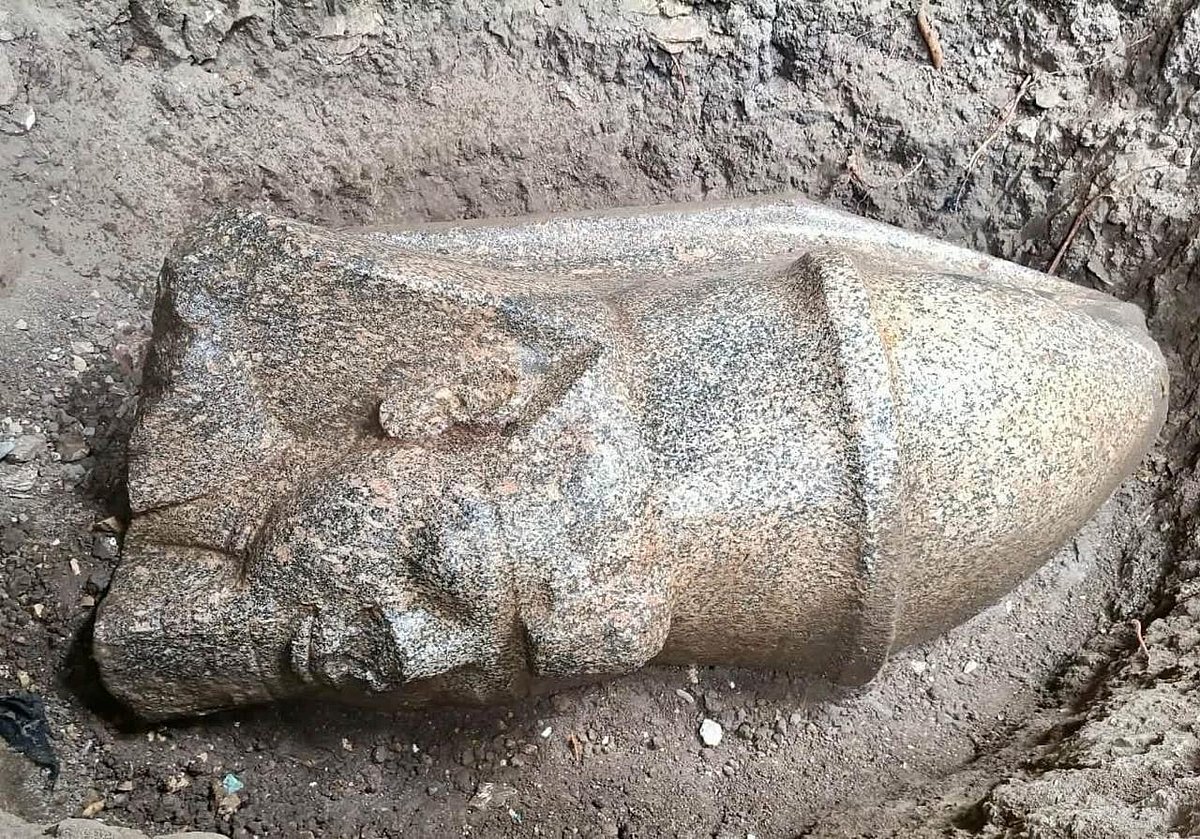
Egypt's Ministry of Tourism and Antiquities says rescue excavations at Bahbit al-Higara in Gharbia Governorate uncovered remains of two huge royal statues, one identified as Ramses II and the other probably him too.

1 / 2
The story, neutrally told
Mixed · 2Egypt's Ministry of Tourism and Antiquities announced the discovery of fragments of two colossal royal statues in the village of Bahbit al-Higara (also spelled Behbeit el-Hagar) in Gharbia Governorate, in the Nile Delta. Gulf NewsN “Egypt's Ministry of Tourism and Antiquities has announced the discovery of fragments of two colossal royal statues in Bahbit Al-Higara village in Gharbia Governorate” Read at Gulf News ↗ Daily MailR “The remarkable discovery was made in Behbeit el-Hagar, a village in Egypt's Nile Delta about 60 miles (100km) north of Cairo” Read at Daily Mail ↗ Mixed · 2One statue is identified as King Ramses II and the other is thought likely to depict him as well. Gulf NewsN “one identified as King Ramses II and the other also thought to depict him” Read at Gulf News ↗ Daily MailR “One of them [is] King Ramses II, while the other is [also] likely to belong to the king.” Read at Daily Mail ↗ Centre · 1The finds were made during rescue excavations by a mission from the Supreme Council of Antiquities. Gulf NewsN “rescue excavations conducted by a mission from the Supreme Council of Antiquities” Read at Gulf News ↗
Mixed · 2The first find is a 1.60-metre head of Ramses II wearing the Double Crown, symbolising the unification of Upper and Lower Egypt, with part of a back pillar bearing his Horus name; the original statue, including its base, is estimated to have stood about 8.5 metres high. Gulf NewsN “a 1.60-metre-tall head of Ramses II wearing the Double Crown, representing the unification of Upper and Lower Egypt, together with part of a back pillar bearing his Horus name” Read at Gulf News ↗ Daily MailR “Experts estimate the complete monument may originally have stood around 28ft (8.5m) high, including its base.” Read at Daily Mail ↗ Mixed · 2The surviving part of the second statue measures 2.40 metres, with its legs and base missing; its well-preserved head shows distinct facial features and the king's traditional nemes headdress. Gulf NewsN “The second statue's surviving portion measures 2.40 metres, with its legs and base missing.” Read at Gulf News ↗ Daily MailR “although it is missing its legs and lower section” Read at Daily Mail ↗ Centre · 1A separate 1.30-metre pink granite block carries two hieroglyphic inscriptions naming Ramses II by his titles Nesu-Bity (King of Upper and Lower Egypt) and Sa-Ra (Son of Ra). Gulf NewsN “A separate pink granite block, measuring 1.30 metres, carries two hieroglyphic inscriptions identifying Ramses II by his royal titles” Read at Gulf News ↗
Right · 1The Daily Mail reports that a farmer spotted a stone block in his field and alerted the authorities, who sent archaeologists, and that officials praised the farmer; Gulf News does not mention this. Daily MailR “Suspecting it might be ancient, he alerted authorities, who quickly dispatched archaeologists to inspect the site.”“Officials praised the farmer whose quick thinking led to the discovery” Read at Daily Mail ↗ Mixed · 2The ministry said excavations and studies will continue to determine the nature of the finds, how they relate to one another and the site's history and architectural development. Gulf NewsN “archaeological excavations and studies would continue to determine the nature of the finds and how they relate to one another” Read at Gulf News ↗ Daily MailR “Excavations at the site are continuing in the hope that more treasures remain hidden beneath the village.” Read at Daily Mail ↗ Right · 1The Daily Mail adds that Behbeit el-Hagar is known for the remains of a granite Temple of Isis from the Late Period and Ptolemaic era, and says the finds may shed light on a temple complex from Ramses II's reign. Daily MailR “best known for the monumental remains of an ancient Temple of Isis”“the ancient temple complex that once stood in the area and the role it played during the reign of Ramses II” Read at Daily Mail ↗
Every sentence links to the reporting it rests on. The pill in front of each says where its sources sit: Left, Centre or Right when one side supplies at least half of them, Mixed when they are evenly split. The number is how many outlets it cites.
Left0 outlets
No left outlet in our sources has covered this story yet.
Centre1 outlet
- Framing
- Straightforward relay of the ministry announcement, with measurements, titles and next steps.
- Emphasis
- Dimensions, inscriptions and royal titles; the ministry's plan for further study.
- Leaves out or plays down
- The farmer's role and the site's history as a temple location.
- Charged language
- “historic discovery”
- For example
-
“Egypt unveils colossal Ramses II statue fragments in historic discovery” — Gulf News
Right1 outlet
- Framing
- Human-interest, discovery-story angle led by a farmer spotting a stone block and a 3,000-year-hidden mystery.
- Emphasis
- The farmer, the mystery, imperial-unit conversions, the site's temple background and hopes of more treasures.
- Leaves out or plays down
- Does not mention the Supreme Council of Antiquities mission or the Sa-Ra and Nesu-Bity titles by name; calls the second statue 'larger' while giving a smaller figure.
- Charged language
- “Hidden for 3,000 years”“mysterious stone block”“remarkable discovery”“far more impressive than anyone expected”
- For example
-
“And what they uncovered was far more impressive than anyone expected.” — Daily Mail
“Hidden for 3,000 years: Giant statues of Ramses II emerge from Egyptian village after farmer spots mysterious stone block in his field” — Daily Mail
What every side reports
- Egypt's Ministry of Tourism and Antiquities announced remains of two colossal royal statues found in Gharbia Governorate.
- One statue is Ramses II; the other is likely him too.
- The first head is 1.6 m, the complete statue is estimated at 8.5 m, and the second statue's surviving part is 2.4 m.
- A pink granite block with hieroglyphic royal titles was also found.
- Excavations are continuing.
Where accounts differ
-
Size of the second statue
- Centre
- Gulf News says the surviving portion measures 2.40 metres, with legs and base missing.
- Right
- The Daily Mail says the second statue is 'even larger' than the first, about 8ft (2.4m) in length, though missing its lower section.
Egypt place
Through its Ministry of Tourism and Antiquities, Egypt presents the find as the result of successful rescue excavations and says studies will continue.
“The ministry said archaeological excavations and studies would continue” — Gulf News
“The Egyptian archaeological mission succeeded in the rescue operations” — Daily Mail
Left0 articles
No coverage yet.
Centre1 article
-
Egypt discovers fragments of two colossal Ramses II statues
Neutral Ministry-sourced report listing measurements, inscriptions and plans for further excavation.
Right1 article
-
Celebratory Dramatic discovery narrative centred on a farmer and a 3,000-year secret.
- 14 Oct 01:06 First Gulf NewsN Egypt discovers fragments of two colossal Ramses II statues
- 14 Oct 09:52 +8h 46m Daily MailR Hidden for 3,000 years: Giant statues of Ramses II emerge from Egyptian village after farmer spots mysterious stone block in his field
Times are when each article was published, or when we first saw it if the outlet gave no time.
Ask about this story
Loading…