EU Commission proposes major expansion of Frontex powers, including action beyond EU territory
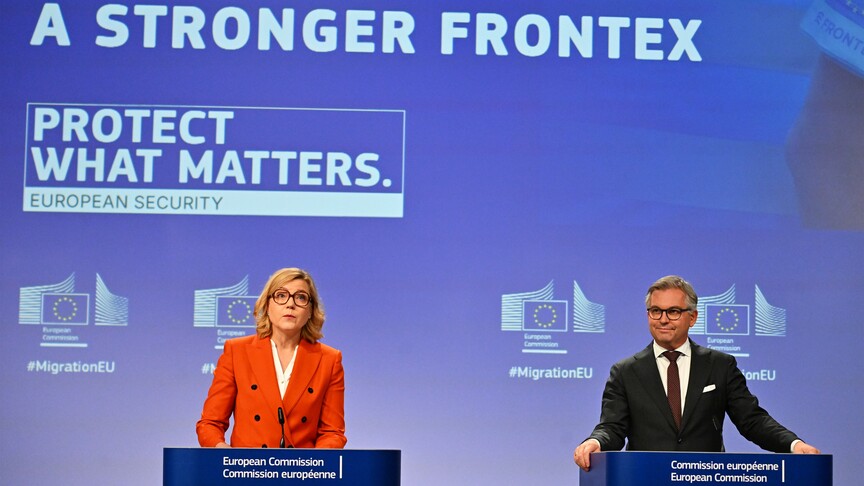
The European Commission proposed widening Frontex's mandate to lead on returns, work with non-EU countries and field a larger standing corps. Rights groups and some MEPs criticised the plan.

1 / 2
The story, neutrally told
Mixed · 2On 27 October 2026 the European Commission proposed a major expansion of the powers of the EU border agency Frontex, including the capacity to act beyond EU territory. The Straits TimesRC “The European Commission proposed a major expansion of the powers of the EU border agency Frontex on Tuesday, including giving it the capacity to act beyond EU te” Read at The Straits Times ↗ Anadolu AgencyN “The European Commission proposed Tuesday expanding the mandate of the EU border agency Frontex” Read at Anadolu Agency ↗ Centre · 1Under the plan Frontex could give technical and operational help to non-EU countries, including organising and carrying out returns of migrants from one non-EU country to another. Anadolu AgencyN “help organize and carry out return operations from one non-EU country to another.” Read at Anadolu Agency ↗ Centre · 1According to the Commission, the new mandate would depend on an agreement with the non-EU country concerned and would have to comply with fundamental rights and international standards. Anadolu AgencyN “The new mandate would be subject to an agreement with the third country concerned and would have to comply with fundamental rights and international standards, according to the commission.” Read at Anadolu Agency ↗
Centre · 1Migration Commissioner Magnus Brunner said Frontex's main objective would remain increasing returns from member states, and that support to non-EU countries would only be possible with an international agreement and where it is in the EU's interest. Anadolu AgencyN ““This will only be possible if there is an international agreement and where this is in the interest of the EU,” he added.” Read at Anadolu Agency ↗ Right · 1Brunner said: "Today we propose that Frontex becomes the central EU actor on returns," adding that a quick reaction force able to deploy within 24 hours would let it act faster and spot risks early. The Straits TimesRC “"Today we propose that Frontex becomes the central EU actor on returns," Magnus Brunner, commissioner for internal affairs and migration, told reporters.”“It will be able to act faster, with a quick reaction force that can deploy within 24 hours and spot risks early, before an event becomes a crisis” Read at The Straits Times ↗ Mixed · 2The Commission proposes gradually growing Frontex's standing corps to 30,000 officers by creating a new European Border and Return Reserve of 17,000 officers, available to member states when needed. The Straits TimesRC “gradually expanding Frontex's standing corps to 30,000 officers by creating a new "European border and return reserve" of 17,000 officers” Read at The Straits Times ↗ Anadolu AgencyN “through the creation of a new European Border and Return Reserve comprising 17,000 officers who could be deployed to support member states when needed.” Read at Anadolu Agency ↗
Mixed · 2A new Return Coordination Centre within Frontex would cover the whole deportation process, from voluntary return counselling to organising returns and reintegration support, and a separate regulation would digitise return, readmission and reintegration procedures. The Straits TimesRC “The proposal would create a new EU Return Coordination Centre within Frontex and expand the agency's role across the entire deportation process” Read at The Straits Times ↗ Anadolu AgencyN “the commission proposed a separate regulation to digitize return, readmission and reintegration procedures across the EU.” Read at Anadolu Agency ↗ Right · 1Reuters also reported that the plan would create an online monitoring centre to track border-related developments on social media and support action against content linked to border security risks, and would narrow the scope of Frontex's internal rights watchdog, with complaints referred to national authorities. The Straits TimesRC “The proposal would also create a new online monitoring centre to track border-related developments on social media”“it would also narrow the scope of its internal rights watchdog, with complaints referred to national authorities to handle.” Read at The Straits Times ↗ Right · 1Reuters linked the proposal to the arrival of more than 72,000 people in the Spanish enclave of Ceuta from Morocco in late July, most of whom later left, which several member states cited as evidence for stronger tools. The Straits TimesRC “the arrival of more than 72,000 people in Ceuta from Morocco in late July, most of whom later left, reignited debate over the EU's migration rules” Read at The Straits Times ↗
Right · 1Rights groups and lawmakers criticised the proposal; Dutch Greens/EFA MEP Tineke Strik said the Commission "is pandering to populism and the far right on migration" and risks turning Frontex into "a European version of ICE". The Straits TimesRC “"The Commission is pandering to populism and the far right on migration," said Tineke Strik, a Dutch MEP from the Greens/EFA group.”“the Commission risks turning Frontex into a European version of ICE” Read at The Straits Times ↗ Centre · 1The proposals now go to the European Parliament and the European Council for consideration. Anadolu AgencyN “The proposals will now be submitted to the European Parliament and the European Council for consideration.” Read at Anadolu Agency ↗
Every sentence links to the reporting it rests on. The pill in front of each says where its sources sit: Left, Centre or Right when one side supplies at least half of them, Mixed when they are evenly split. The number is how many outlets it cites.
Left0 outlets
No left outlet in our sources has covered this story yet.
Centre1 outlet
- Framing
- Procedural, institutional account focused on the new mandate to support returns between non-EU countries and its safeguards.
- Emphasis
- Conditions on the mandate: agreement with the third country, fundamental-rights compliance, EU interest; next legislative steps.
- Leaves out or plays down
- Does not mention the Ceuta trigger, the narrowed rights watchdog, the social-media monitoring centre or the criticism.
- For example
-
“The new mandate would be subject to an agreement with the third country concerned and would have to comply with fundamental rights and international standards, according to the commission.” — Anadolu Agency
Right1 outlet
- Framing
- Reuters wire copy carried by the Straits Times: a major expansion of powers prompted by Ceuta, set against rights concerns.
- Emphasis
- Ceuta arrivals, quick reaction force, narrowed rights watchdog, social-media monitoring and MEP criticism.
- Leaves out or plays down
- Does not stress the agreement and fundamental-rights conditions on action in non-EU countries; does not mention the separate digitisation regulation. As wire copy it shows Reuters' framing, not the outlet's own.
- Charged language
- “major expansion”“tougher migration policies”
- For example
-
“as European governments push for tougher migration policies despite concerns from rights advocates over accountability.” — The Straits Times
What every side reports
- The Commission proposed expanding Frontex's mandate on 27 October 2026, with Commissioner Magnus Brunner presenting it in Brussels.
- The plan would grow the standing corps to 30,000 officers via a 17,000-strong European Border and Return Reserve.
- It would create a Return Coordination Centre within Frontex and a quick reaction force.
- Frontex could support non-EU countries on returns.
- The proposals go to the European Parliament and Council.
Where accounts differ
-
Whether the plan weakens rights oversight
- Centre
- Stresses that action in non-EU countries must comply with fundamental rights and international standards.
- Right
- Reuters says the proposal narrows the scope of the internal rights watchdog and quotes MEP Strik warning of 'a European version of ICE'.
European Commission organisation
Presents the plan as making Frontex the central EU actor on returns, faster to react, with safeguards for work in non-EU countries.
“"Today we propose that Frontex becomes the central EU actor on returns,"” — The Straits Times
““This will only be possible if there is an international agreement and where this is in the interest of the EU,” he added.” — Anadolu Agency
Frontex organisation
The subject of the proposal: it would gain a larger corps, a return coordination centre, a quick reaction force and a role in non-EU countries.
“The proposal also envisages establishing a dedicated “Return Coordination Centre” within Frontex” — Anadolu Agency
Left0 articles
No coverage yet.
Centre1 article
-
EU proposes giving Frontex power to carry out migrant returns between third countries
Neutral Anadolu's procedural report stressing the conditions on cooperation with non-EU countries and next steps.
Right1 article
-
The Straits TimesRC · · via Reuters
EU Commission proposes expanding powers of border police force
Mixed Reuters wire copy: reports the expansion as a response to Ceuta and notes rights criticism and the narrowed watchdog.
- 27 Oct 13:36 First The Straits TimesRC EU Commission proposes expanding powers of border police force via Reuters
- 27 Oct 14:14 +39m Anadolu AgencyN EU proposes giving Frontex power to carry out migrant returns between third countries
Times are when each article was published, or when we first saw it if the outlet gave no time.
Ask about this story
Loading…