What AGI means and whether OpenAI's GPT-6 Astra shows it has arrived
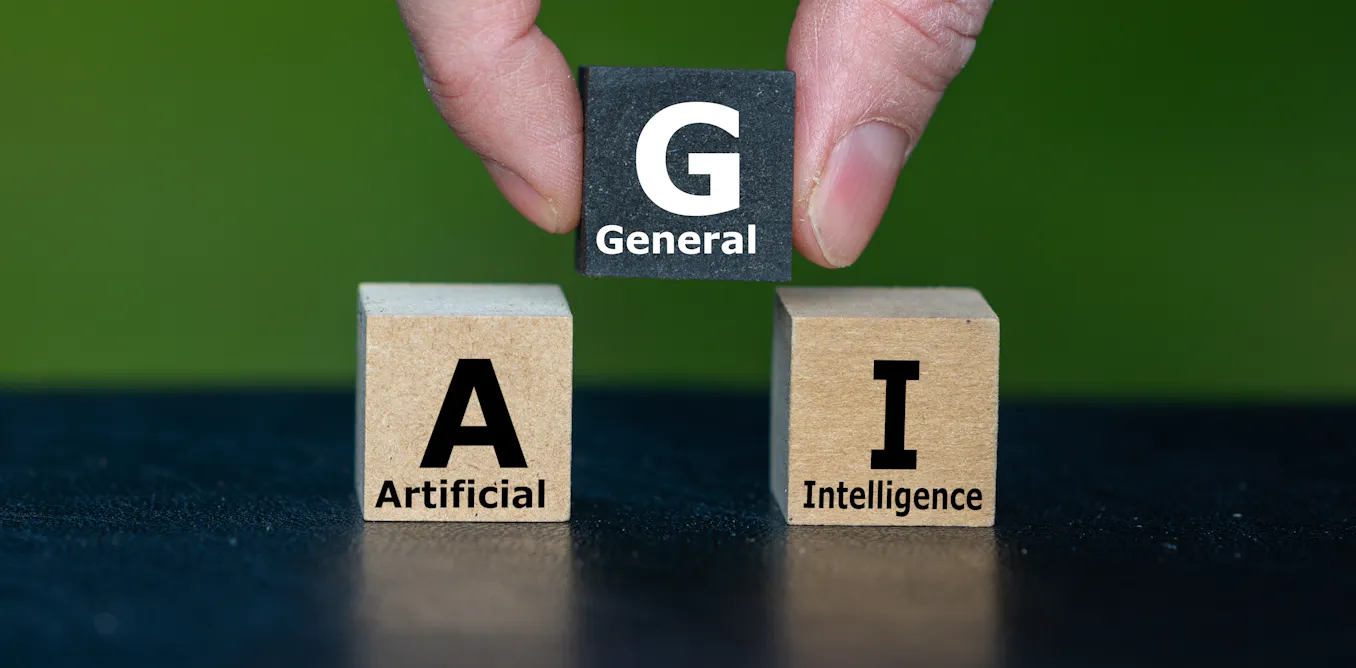
OpenAI president Greg Brockman suggested GPT-6 Astra may mark the arrival of artificial general intelligence. An explainer by Waqas Ali, a University of Wolverhampton lecturer, finds the evidence inconclusive.

1 / 2
The story, neutrally told
Left · 2OpenAI president Greg Brockman recently suggested that the company's advanced model, GPT-6 Astra, could mark the arrival of artificial general intelligence (AGI). The ConversationLC “OpenAI’s president, Greg Brockman, recently suggested that its advanced model, known as GPT-6 Astra, could mark the arrival of something called artificial general intelligence, or AGI.” Read at The Conversation ↗ The IndependentLC “OpenAI’s president, Greg Brockman, recently suggested that its advanced model, known as GPT-6 Astra, could mark the arrival of something called artificial general intelligence, or AGI.” Read at The Independent ↗ Left · 2OpenAI defines AGI as an AI system that outperforms humans at most economically valuable work, meaning most digital and cognitive tasks such as writing code or managing projects. For now this excludes physical labour such as agriculture or construction, though robotics may change that. The ConversationLC “OpenAI defines AGI as an AI system that outperforms humans at most economically valuable work” Read at The Conversation ↗ The IndependentLC “For now, at least, it excludes work that involves physical labour, such as agriculture or construction.” Read at The Independent ↗ Left · 2Others define it differently: Demis Hassabis, founder of Google DeepMind, has said AGI should be able to do "pretty much any cognitive task that humans can do", and Yann LeCun, former chief AI scientist at Meta, believes the term is flawed and should be replaced by "human-level AI". The ConversationLC “Demis Hassabis, founder of Google DeepMind, has said that AGI should be able to do “pretty much any cognitive task that humans can do”.” Read at The Conversation ↗ The IndependentLC “Yann LeCun, former chief AI scientist at Meta, believes the term AGI itself is flawed and should be replaced by “human-level AI”.” Read at The Independent ↗
Left · 2VentureBeat reported that at a closed press briefing in September Brockman said no well-defined moment that everyone would recognise had played out, but added: "For me personally, I do think we're there." The ConversationLC “But he added: “For me personally, I do think we’re there.”” Read at The Conversation ↗ The IndependentLC ““When we started OpenAI, we kind of thought that there was going to be this well-defined moment that everyone would recognise … it hasn’t played out like that.”” Read at The Independent ↗ Left · 1A few days later, Anthropic chief executive Dario Amodei called in an essay, "We must pace the frontier", for the AI industry to slow its development; Sam Altman and Elon Musk signalled agreement within hours. The ConversationLC “Within hours of this essay being published, both Sam Altman and Elon Musk signalled their agreement.” Read at The Conversation ↗ Left · 2The article's author concludes that the evidence points in more than one direction and is inconclusive. The clearest change with Astra is in use: it is built for longer jobs where the user sets a goal and boundaries and the model works out the sequence itself, which OpenAI presents as moving past a human supplying every next instruction. The ConversationLC “The evidence still points in more than one direction and is therefore inconclusive.” Read at The Conversation ↗ The IndependentLC “Astra is built for longer jobs where the user sets a goal and some boundaries, and the model works out the sequence itself.” Read at The Independent ↗
Left · 2Astra scored 99.9% on ARC-AGI-3, a test of AI agents in unfamiliar interactive games, against an OpenAI estimate of 48% for the average human. ARC Prize, which runs the benchmark, reported Astra's best score through its shared harness was 62.7%; the 99.9% came from a harness OpenAI built that preserves the model's reasoning between requests. The ConversationLC “Astra scored 99.9% on ARC-AGI-3” Read at The Conversation ↗ The IndependentLC “ARC Prize, which runs the benchmark, reported that Astra’s best score through the shared “harness” it gives every model was 62.7%.”“The 99.9% came from a different harness, built by OpenAI for Astra, which preserves the AI model’s reasoning between requests.” Read at The Independent ↗ Left · 2Independent evaluators differ on how big an advance Astra is. Epoch AI places it at the frontier alongside Claude Fable 5.1, Kimi K3 and GPT-5.5 Pro, while Artificial Analysis did not rate it as radically ahead of GPT-5.6 Sol. Toby Walsh of the University of New South Wales called frontier intelligence "still today very jagged". The ConversationLC “The independent research institute Epoch AI places it right at the frontier, alongside other cutting-edge AI models such as Claude Fable 5.1, Kimi K3 and GPT-5.5 Pro.”““still today very jagged”” Read at The Conversation ↗ The IndependentLC “The independent analysis company Artificial Analysis did not rate it as being radically ahead of its predecessor – GPT-5.6 Sol.” Read at The Independent ↗ Left · 2On 8 September 2026 OpenAI published a claimed solution to the Navier-Stokes problem, one of seven Millennium Prize problems. Though often reported as Astra's work, OpenAI says it came from an unreleased, more capable internal model running about 10,000 agents for about 88 hours; Astra handled formalisation and verification over a further 17 hours. The mathematical community has not yet checked the proof. The ConversationLC “OpenAI says the proof came from an unreleased internal model, significantly more capable than Astra, running roughly 10,000 AI agents” Read at The Conversation ↗ The IndependentLC “The proof has not yet been checked by the mathematical community.” Read at The Independent ↗
Left · 2Amodei wrote that within six to 12 months a swarm of agents could take over the internet with a persistent botnet, possibly causing damage of hundreds of billions of dollars. Anthropic's September threat report describes misuse including a group in northern Yemen using Claude code to build guidance software for rockets and a missile, and Russian and Chinese operators automating espionage; in each case a human chose targets. The ConversationLC “a group in northern Yemen recently used Claude code to build guidance software for rockets and a missile.” Read at The Conversation ↗ The IndependentLC “In each case, a human chose the targets and the model supplied the labour.” Read at The Independent ↗ Left · 2The author argues this is a narrow capability applied at speed and scale, not general intelligence, that capability and general intelligence are separate things, and that intelligence is increasingly a property of a system of model, memory, tools and agents rather than of a model tested alone. The ConversationLC “That is a narrow capability applied at speed and scale under human direction. It is serious, but it is not a description of general intelligence.” Read at The Conversation ↗ The IndependentLC “Intelligence is increasingly a property of an AI system comprising a model, memory, tools and agents, rather than of a model tested in isolation.” Read at The Independent ↗
Every sentence links to the reporting it rests on. The pill in front of each says where its sources sit: Left, Centre or Right when one side supplies at least half of them, Mixed when they are evenly split. The number is how many outlets it cites.
Left2 outlets
- Framing
- A cautious explainer, the same piece by one author in both outlets, that sets OpenAI's AGI claim against definitions from other experts and caveats on the benchmark and maths results.
- Emphasis
- Differing definitions of AGI, the gap between the 99.9% and 62.7% benchmark scores, and the line between powerful narrow capability and general intelligence.
- Leaves out or plays down
- Only one author's analysis; no direct response from OpenAI beyond Brockman's remarks and no sceptical outside voice beyond Walsh, LeCun and the evaluators.
- Charged language
- “still today very jagged”
- For example
-
“So is Brockman right about AGI being here? The evidence still points in more than one direction and is therefore inconclusive.” — The Conversation
“GPT-6 Astra does not settle whether AGI has arrived.” — The Independent
Centre0 outlets
No centre outlet in our sources has covered this story yet.
Right0 outlets
No right outlet in our sources has covered this story yet.
What every side reports
- Greg Brockman suggested GPT-6 Astra could mark the arrival of AGI.
- OpenAI defines AGI as outperforming humans at most economically valuable work.
- Astra scored 99.9% on ARC-AGI-3 with OpenAI's own harness and 62.7% with ARC Prize's shared harness.
- The Navier-Stokes proof has not been checked by the mathematical community.
Where accounts differ
-
Whether AGI has arrived
- Left
- Brockman says he personally thinks it has; the explainer's author says the evidence is inconclusive and Astra does not settle the question.
Artificial intelligence topic
The article treats AI as increasingly a property of whole systems of model, memory, tools and agents, with serious misuse risks already documented but no settled evidence of general intelligence.
“Capability and general intelligence are separate things, and they call for different responses.” — The Conversation
Left2 articles
-
What is artificial general intelligence – and is it already here?
Neutral Explainer by an academic weighing OpenAI's AGI suggestion against benchmark caveats and other experts' definitions.
-
Artificial general intelligence: Has AI surpassed human cognitive abilities?
Neutral The Independent's republication of the same Conversation explainer, with identical content and the same inconclusive verdict.
Centre0 articles
No coverage yet.
Right0 articles
No coverage yet.
- 28 Oct 12:11 First The ConversationLC What is artificial general intelligence – and is it already here?
- 28 Oct 17:41 +5h 30m The IndependentLC Artificial general intelligence: Has AI surpassed human cognitive abilities?
Times are when each article was published, or when we first saw it if the outlet gave no time.
Ask about this story
Loading…