Bering Sea pollock trawl bycatch fuels dispute over western Alaska salmon collapse
An Associated Press report, carried by The Independent and CBC News, examines the Bering Sea pollock fishery (source of McDonald's Filet-O-Fish fish) and its salmon bycatch, as Yukon River communities face fishing bans. Scientists blame warming seas more than trawling, while critics say bycatch is one factor managers can control.
1 / 1
The story, neutrally told
Left · 2Alaska pollock, the second-largest fishery on Earth, supplies the fish in U.S. McDonald's Filet-O-Fish sandwiches, fish sticks and imitation crab, and its trawl nets also catch other marine life, including salmon. CBC NewsLC “Alaska pollock is the second-largest fishery on Earth. It is the fish inside U.S. McDonald's Filet-O-Fish sandwiches and is also turned into fish sticks and imitation crab.” Read at CBC News ↗ The IndependentLC “Alaska pollock represents Earth's second-largest fishery.” Read at The Independent ↗ Left · 2Bycatch makes up 2% of the fishery's total catch, but at that scale it can mean hundreds of thousands of salmon; over the last 10 years, Bering Sea pollock trawlers caught an average of about 18,000 Chinook and 288,000 other salmon a year, nearly all of them chum. CBC NewsLC “Over the last 10 years, Bering Sea pollock trawlers caught an average of about 18,000 Chinook and 288,000 other salmon a year, nearly all of them chum.” Read at CBC News ↗ The IndependentLC “Unintentional capture, known as bycatch, accounts for 2% of the pollock fishery's overall haul.” Read at The Independent ↗ Left · 2Those catches have become contentious because salmon runs have collapsed across western Alaska, where dozens of Indigenous communities have relied on salmon for generations, and trawling and bycatch have become issues in Alaska's midterm elections for governor and U.S. Senate. CBC NewsLC “And trawling and bycatch have become prominent issues in Alaska's midterm elections, with candidates for governor and in the state's closely watched U.S. Senate contest sparring over how aggressively to restrict the industry.” Read at CBC News ↗ The IndependentLC “These incidental catches have stirred intense anger as salmon populations have plummeted throughout western Alaska” Read at The Independent ↗
Left · 1In 2024, Alaska and Canada imposed a seven-year ban on Chinook fishing along the Yukon River, equal to one full salmon life cycle, and the Kuskokwim River has faced repeated Chinook and chum closures. CBC NewsLC “In 2024, Alaska and Canada instated a seven-year ban on Chinook fishing along the Yukon River — one full salmon life cycle — to give depleted populations a chance to rebuild.” Read at CBC News ↗ Left · 2Scientists point to warming waters and changing ocean conditions, not trawl bycatch, as the primary cause of the declines, and a 2025 study found warmer oceans can raise bycatch risk by changing where salmon and pollock overlap; critics counter that bycatch is one of the few sources of mortality managers can directly control. CBC NewsLC “Scientists point to warming waters and changing ocean conditions, not trawl bycatch, as the primary causes of the declines.” Read at CBC News ↗ The IndependentLC “Yet critics stress that bycatch represents one of the few human-caused mortality factors that managers can directly regulate” Read at The Independent ↗ Left · 1Andrew Seitz, a University of Alaska Fairbanks fisheries professor, said every fish is critical to Yukon River communities, who he said bear the brunt of conservation measures. CBC NewsLC “"Each fish is critical to communities along the Yukon River," said Andrew Seitz, professor of fisheries at the University of Alaska Fairbanks.” Read at CBC News ↗
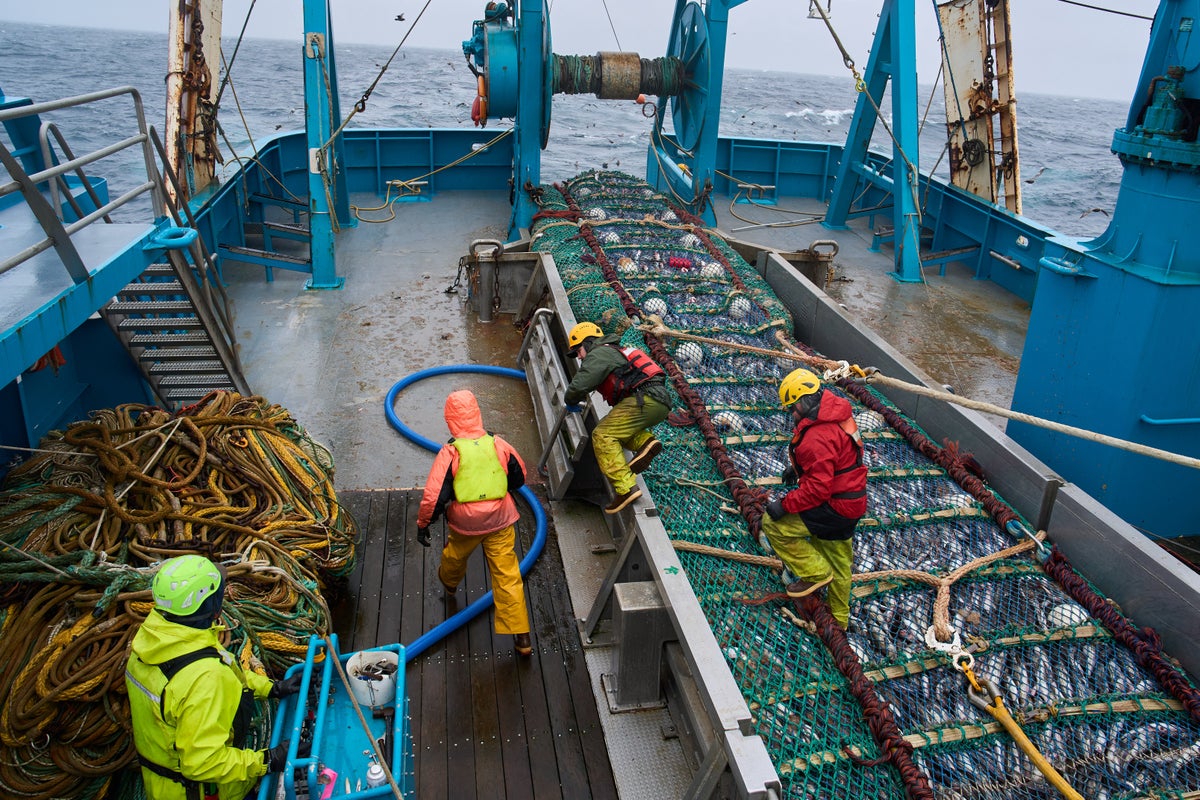
Left · 2Aboard the F/V Progress, the AP reporter saw about 210 chum caught in four days; captain Maverick Blake, a 13-year industry veteran, said avoiding salmon is central to his job and that moving to find fewer salmon burned nearly 11,360 litres (about 3,000 gallons) of fuel. CBC NewsLC “During the four days The Associated Press was on the F/V Progress, the vessel caught some 210 chum salmon.” Read at CBC News ↗ The IndependentLC “Relocating to areas with lower salmon counts consumed nearly 3,000 gallons (11,360 liters) of fuel.” Read at The Independent ↗ Left · 1Blake and industry representatives call it one of the best-managed fisheries in the world, citing vessel-to-vessel salmon information sharing, weekly closure areas, salmon excluders, and counting of every salmon by observers or cameras; Matt Tinning, CEO of the At-Sea Processors Association, which represents five pollock companies, said the system is designed to incentivise salmon avoidance. CBC NewsLC “Still, Blake and industry representatives call it one of the best managed fisheries in the world.”“"The system is designed to really incentivize salmon avoidance every day, all the time."” Read at CBC News ↗ Left · 2In Rampart, a Yukon River village, Brooke Woods, a Koyukon Alaska Native and commissioner of the Yukon River Inter-Tribal Fish Commission, said her community has a "big void" and that no generation has gone without learning to fish before now; her mother, Janet Woods, asked why locals are the only ones bearing the burden. The IndependentLC “"We have this big void in our lives right now," said Brooke Woods, a Koyukon Alaska Native, mother of six and commissioner for the Yukon River Inter-Tribal Fish Commission.” Read at The Independent ↗ CBC NewsLC “"You really get angry. Why are we the only ones that have to take the burden?" said Brooke's mother, Janet Woods.” Read at CBC News ↗
Left · 2Because Pacific salmon mix in the Bering Sea, bycatch can come from western Alaska, the Pacific Northwest, Russia or Japan; genetic data show western Alaska fish averaged about 17% of chum bycatch and half of Chinook bycatch in recent years, which supports an industry argument, though in 2021 a 9% share still meant more than 51,000 salmon, according to NOAA. CBC NewsLC “In recent years, western Alaska fish made up an average of about 17 per cent of chum and half of Chinook bycatch.” Read at CBC News ↗ The IndependentLC “in 2021, western Alaska salmon accounted for 9% of chum bycatch, totaling over 51,000 salmon, according to NOAA records.” Read at The Independent ↗ Left · 1In February, after hearing testimony from more than 170 people, the North Pacific Fishery Management Council recommended a cap of 45,000 western Alaska chum bycatch, which critics said was too high. CBC NewsLC “recommended a cap of 45,000 western Alaska chum bycatch. Critics said the limit was too high.” Read at CBC News ↗ Left · 1Pollock landings from the Bering Sea and Gulf of Alaska exceeded 1.36 billion kilograms in 2024, worth about $432 million according to NOAA, and critics note most of the economic benefit flows outside Alaska, with many large vessels owned by Seattle-area companies. CBC NewsLC “critics note most of the economic benefit flows outside the state, with many of the largest vessels owned by Seattle-area companies.” Read at CBC News ↗
Every sentence links to the reporting it rests on. The pill in front of each says where its sources sit: Left, Centre or Right when one side supplies at least half of them, Mixed when they are evenly split. The number is how many outlets it cites.
Left2 outlets
- Framing
- Both outlets run the same Associated Press feature by Annika Hammerschlag, opening on a trawler deck and moving to a Yukon River family. The Independent's headline casts the pollock company as the cause of harm; CBC's headline frames a fight over trawling.
- Emphasis
- Indigenous subsistence losses, bycatch figures, the scientific caveat that ocean warming is the main driver, and industry defences. CBC adds the council's 45,000-chum cap recommendation, pollock's economic value and Seattle ownership.
- Leaves out or plays down
- The Independent's copy omits the North Pacific Fishery Management Council cap and the economic and ownership details that CBC includes. Neither names a single company 'behind' the Filet-o-Fish, despite the Independent's headline.
- Charged language
- “devastates”“fueling a fight”
- For example
-
“Fishing company behind McDonald’s Filet-o-Fish devastates Alaska salmon and Native communities” — The Independent
“Fish in American fish sticks is fueling a fight over trawling in Alaska” — CBC News
Centre0 outlets
No centre outlet in our sources has covered this story yet.
Right0 outlets
No right outlet in our sources has covered this story yet.
What every side reports
- Bering Sea pollock trawlers catch about 18,000 Chinook and 288,000 other salmon a year on average, mostly chum.
- Scientists cite warming seas rather than bycatch as the main cause of western Alaska salmon declines.
- A seven-year Chinook fishing ban took effect on the Yukon River in 2024.
- Western Alaska fish average about 17% of chum bycatch and half of Chinook bycatch.
Where accounts differ
-
Whether the pollock fleet is a major cause of the salmon decline
- Left
- Both outlets report scientists blame ocean warming, not bycatch, while critics say bycatch is a controllable loss that matters when runs are depleted; the Independent's headline says the company 'devastates' salmon and Native communities.
-
Whether the fishery's bycatch controls are adequate
- Left
- Industry says the fishery is among the world's best managed; critics, including Yukon River residents, say the fleet fishes freely while locals bear restrictions, and called the proposed 45,000-chum cap too high (CBC).
Yukon River Inter-Tribal Fish Commission organisation
Its commissioner Brooke Woods describes the loss of salmon fishing as a 'big void' for Yukon River families and the next generation.
“"We have this big void in our lives right now,"” — The Independent
Bering Sea pollock trawling topic
Industry representatives, including captain Maverick Blake and At-Sea Processors Association CEO Matt Tinning, say the fishery is well managed and built to avoid salmon, while acknowledging subsistence users' frustration.
“"The amount of science and management effort that goes into improving it is basically unprecedented anywhere," said Matt Tinning” — CBC News
UK and Ireland1 outlet
The Independent runs the AP piece under a headline that assigns blame to the fishing company.
“Fishing company behind McDonald’s Filet-o-Fish devastates Alaska salmon and Native communities” — The Independent
The Independent
North America1 outlet
CBC runs the AP piece with a headline describing a contested trawling fight and includes the council's cap recommendation.
“recommended a cap of 45,000 western Alaska chum bycatch” — CBC News
CBC News
Left2 articles
-
Fishing company behind McDonald’s Filet-o-Fish devastates Alaska salmon and Native communities
Sympathetic AP feature with a headline blaming the company for devastating salmon and Native communities, although the text says scientists see ocean warming as the main driver.
-
Fish in American fish sticks is fueling a fight over trawling in Alaska
Mixed Same AP feature under a more measured headline about a trawling dispute, with added detail on the proposed cap and economics.
Centre0 articles
No coverage yet.
Right0 articles
No coverage yet.
- 9 Oct 15:56 First The IndependentLC Fishing company behind McDonald’s Filet-o-Fish devastates Alaska salmon and Native communities
- 9 Oct 21:59 +6h 3m CBC NewsLC Fish in American fish sticks is fueling a fight over trawling in Alaska
Times are when each article was published, or when we first saw it if the outlet gave no time.