Jurassic bird fossil from China suggests some early birds were ground-dwellers
Researchers led by Min Wang describe Yuezhuornis yangyuanensis, a crow-sized bird from about 150 million years ago in Fujian, China, with short forelimbs, serrated teeth and a sickle-shaped claw. They say it challenges the idea that flight drove early bird evolution.

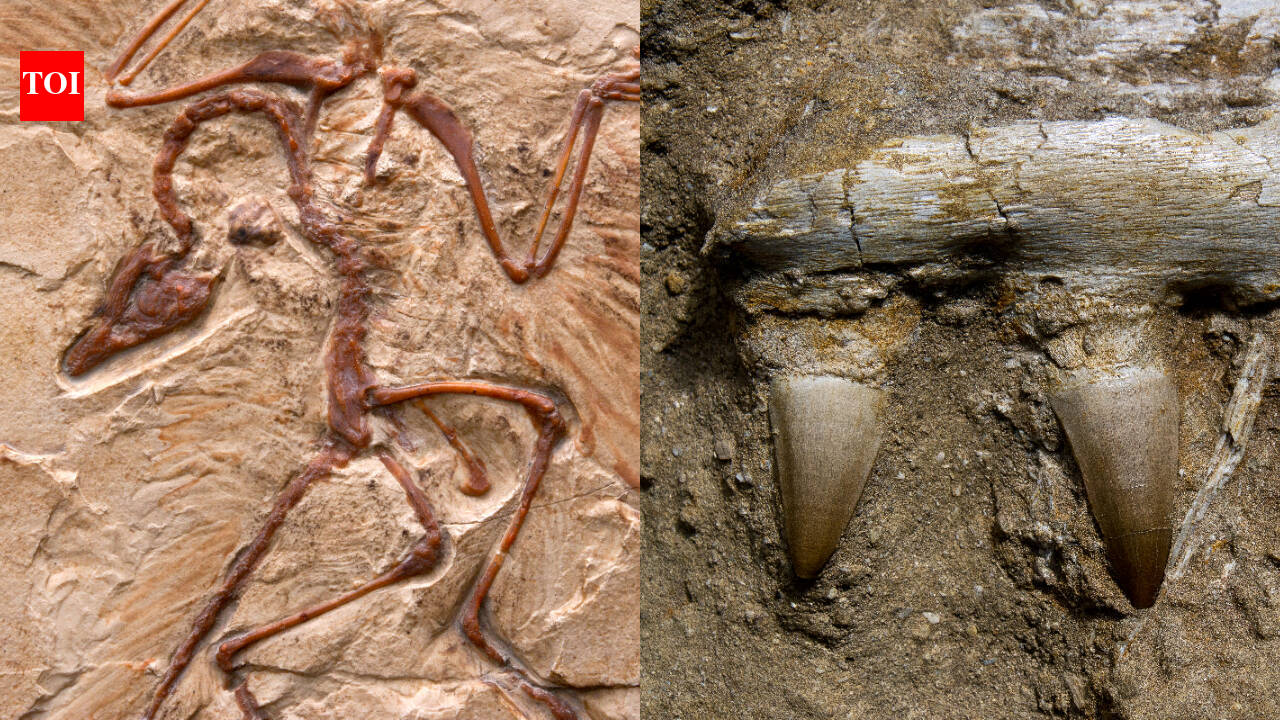
1 / 2
The story, neutrally told
Centre · 2Researchers have described a nearly complete fossil of a new Jurassic bird species, Yuezhuornis yangyuanensis, found in Fujian Province, south-eastern China. New ScientistN “The almost-complete new fossil, which is about 148 million to 150 million years old, was discovered in August 2024 near Yangyuang village, Fujian Province” Read at New Scientist ↗ The Times of IndiaN “The fossil, which is almost complete, was discovered in Fujian Province in south-eastern China.” Read at The Times of India ↗ Centre · 1The fossil is about 148 million to 150 million years old. It was found in August 2024 and named by Min Wang of the Chinese Academy of Sciences and colleagues after Yuezhuo, a mythological Chinese bird. New ScientistN “has been named by Wang and his colleagues after Yuezhuo, a mythological Chinese bird.” Read at New Scientist ↗ Centre · 2The animal was about half a metre tall and weighed just over 800 grams (1.8 pounds), roughly the size of a large crow. Wang suspects it lived in a swampy environment and was probably a good runner. New ScientistN “Y. yangyuanensis was around half a metre tall, weighing just over 800 grams” Read at New Scientist ↗ The Times of IndiaN “The animal is thought to have weighed about 800 grams, or 1.8 pounds.” Read at The Times of India ↗
Centre · 2Its forelimbs were shorter than its hindlimbs, as in modern ground-dwelling birds such as pheasants. The researchers compared its anatomy with nearly 400 living birds (377 species, according to The Times of India) and found it most similar to terrestrial species. New ScientistN “After comparing the ancient bird's anatomy with nearly 400 living birds” Read at New Scientist ↗ The Times of IndiaN “in comparison to 377 extant bird species” Read at The Times of India ↗ Centre · 2It had dinosaur-like features: closely packed, serrated teeth like those of deinonychosaur dinosaurs, a long tail like that of Archaeopteryx, and a sickle-shaped claw on its second toe. Wang calls the claw "highly functional" and says it was probably used to catch prey. It resembles the claws of relatives such as Velociraptor, which modern birds have lost. New ScientistN “had a distinctive sickle-shaped claw on its second toe that was “highly functional”” Read at New Scientist ↗ The Times of IndiaN “like the deadly claws of meat-eating dinosaurs such as Velociraptor and Deinonychus” Read at The Times of India ↗ Centre · 1Other features, including its hip bones and fibula, resemble those of later Cretaceous birds. Wang describes the result as a "mosaic" of primitive and derived features. New ScientistN “Its hip bones and fibula – one of the lower leg bones – closely mirror those of later Cretaceous birds”“exhibits a striking ‘mosaic’ of primitive and derived features” Read at New Scientist ↗
Centre · 2Archaeopteryx, from roughly the same period, has forelimbs longer than its hindlimbs and probably flew better. New Scientist reports that the researchers' analysis places Archaeopteryx as more primitive than Y. yangyuanensis. New ScientistN “their analysis suggests Archaeopteryx, a stronger flier, was actually more primitive than Y. yangyuanensis” Read at New Scientist ↗ The Times of IndiaN “the better proportioned wings suggest a larger capacity for flight than those of Yuezhuornis” Read at The Times of India ↗ Centre · 1The researchers argue that bird evolution was more complex and rapid than thought, with early species quickly exploring different niches, including lifestyles without flight. Wang says this challenges the idea that selection for flight almost exclusively drove the early avian body plan. New ScientistN “This challenges the notion that the early evolution of the avian body plan was driven almost exclusively by the selective pressures of flight, Wang says.” Read at New Scientist ↗ Centre · 2The coverage differs on flight ability. New Scientist calls the species flightless and says it may have never flown or abandoned flight almost immediately after evolving it. The Times of India, citing Reuters, says it had fully developed wings but probably could not sustain powerful flight and likely flew only when it had to. It adds that the wing was about a third shorter than the legs. New ScientistN “some of the earliest bird species never took wing or abandoned flight almost immediately after they had evolved the ability” Read at New Scientist ↗ The Times of IndiaN “It had fully developed wings but the size of the wings compared to the size of the body suggests it might not have been able to engage in prolonged powerful flight.” Read at The Times of India ↗
Centre · 2The Times of India says the fossil does not settle how flight evolved. Other early birds may have had different survival strategies, or may have descended from flying ancestors and become more ground-dependent. New Scientist adds that recent finds, including a bird-like dinosaur from China that evolved flight from a different lineage, are disrupting the view of a straight-line path to flight. The Times of IndiaN “doesn't answer exactly how flight evolved, but it challenges the assumption that the earliest birds were shaped largely by the demands of flying” Read at The Times of India ↗ New ScientistN “Recent discoveries are disrupting the view that the evolution of birds and flight proceeded in a straight line” Read at New Scientist ↗
Every sentence links to the reporting it rests on. The pill in front of each says where its sources sit: Left, Centre or Right when one side supplies at least half of them, Mixed when they are evenly split. The number is how many outlets it cites.
Left0 outlets
No left outlet in our sources has covered this story yet.
Centre2 outlets
- Framing
- Both outlets present a science-discovery story that complicates the view of flight as the driver of early bird evolution. New Scientist leads with the 'flightless' bird and quotes Wang. The Times of India leads with the small wings and dinosaur-like teeth, relying on a Reuters report.
- Emphasis
- Mix of bird and dinosaur traits, ground-dwelling lifestyle, comparison with Archaeopteryx and pheasants, and non-linear bird evolution.
- Leaves out or plays down
- The Times of India names no researchers and does not quote Wang. New Scientist does not mention the fully developed wings or give the wing-to-leg ratio.
- Charged language
- “remarkable fossil”“fearsome hunters”“deadly claws”
- For example
-
“A remarkable fossil found in China raises the possibility that some of the earliest bird species never took wing” — New Scientist
“Some may have been clumsy fliers, efficient runners and fearsome hunters” — The Times of India
Right0 outlets
No right outlet in our sources has covered this story yet.
What every side reports
- The fossil is of a crow-sized Jurassic bird, Yuezhuornis yangyuanensis, from Fujian Province, China, weighing about 800 grams.
- It had short forelimbs relative to its legs, similar to ground-dwelling birds such as pheasants.
- It had serrated, closely packed teeth, a long tail and a sickle-shaped second-toe claw like those of Velociraptor.
- It challenges the assumption that flight drove the early evolution of birds.
Where accounts differ
-
Whether the bird could fly
- Centre
- New Scientist calls it flightless and says it may never have flown. The Times of India, citing Reuters, says it had fully developed wings but probably could not sustain powerful flight and flew only when necessary.
-
Relationship to Archaeopteryx
- Centre
- New Scientist says the researchers' analysis places Archaeopteryx as more primitive. The Times of India says the two may have shared a common ancestor earlier in the Jurassic, or that Yuezhuornis may be its own evolutionary experiment.
UK and Ireland1 outlet
New Scientist presents the bird as flightless and centres on Wang's interpretation of a 'mosaic' anatomy.
““This new fossil changes our assumption about what a Jurassic bird looked like,” says Wang.” — New Scientist
New Scientist
South Asia1 outlet
The Times of India retells the Reuters report in a more narrative style, saying the bird had full wings but probably preferred to run.
“some of the earliest birds may have preferred to keep their feet on the ground” — The Times of India
The Times of India
Left0 articles
No coverage yet.
Centre2 articles
-
Flightless ancient bird complicates our picture of wing evolution
Neutral Researcher-led explanation of a flightless Jurassic bird that disrupts the straight-line view of flight evolution, with quotes from Min Wang.
-
150-million-year-old bird had tiny wings and dinosaur-like teeth
Mixed Popular-science retelling of a Reuters report, emphasising a running, hunting bird with tiny wings and dinosaur-like teeth.
Right0 articles
No coverage yet.
- 14 Oct 16:00 First New ScientistN Flightless ancient bird complicates our picture of wing evolution
- 15 Oct 18:27 +26h 27m The Times of IndiaN 150-million-year-old bird had tiny wings and dinosaur-like teeth
Times are when each article was published, or when we first saw it if the outlet gave no time.
Ask about this story
Loading…