Gaza olive harvest sharply reduced as groves are destroyed or cut off by the "yellow line"
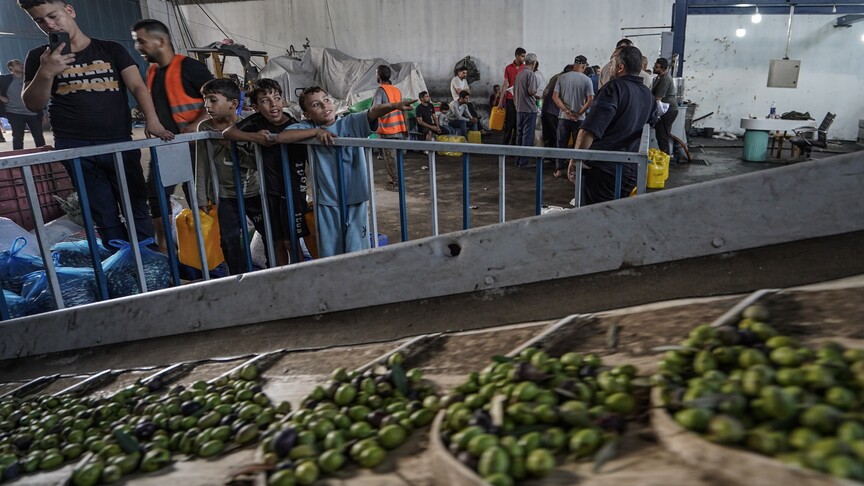
Two reports on Gaza's olive season say output has fallen steeply because trees have been destroyed and many groves lie in areas under Israeli army control. Farmers also describe higher costs and few working presses.

1 / 2
The story, neutrally told
Mixed · 2Gaza's olive harvest this year is much smaller than before the war, with farmers reporting destroyed trees, inaccessible land and higher costs. Anadolu AgencyN “Palestinian farmers in Gaza are facing a difficult olive harvest this year as production declines” Read at Anadolu Agency ↗ The Straits TimesRC “But a year after a ceasefire ended major fighting, almost all of the once-proud orchards are bulldozed under.” Read at The Straits Times ↗ Centre · 1Many groves lie east of the "yellow line", the notional line to which the Israeli army withdrew under the first phase of US President Donald Trump's plan, in effect since a ceasefire on Oct. 10, 2025. Areas east of the line remain under Israeli army control, and Palestinians are allowed to move only west of it. Anadolu AgencyN “It separates areas in eastern Gaza that remain under Israeli army control from areas west of the line where Palestinians are allowed to move.” Read at Anadolu Agency ↗ Right · 1Reuters, carried by the Straits Times, reported that the line is guarded by Israeli troops who bar Palestinians from entering two-thirds of the Strip. The Straits TimesRC “"yellow line" guarded by Israeli troops who bar Palestinians from even entering two-thirds of the Gaza Strip” Read at The Straits Times ↗
Right · 1Farmer Haidar Abu Middain, 60, told Reuters that nearly half of his family's 900-dunum (220-acre) orchard in central Gaza lies beyond the line, and the accessible half has mostly been bulldozed. He said only 20 or 30 trees remain, which he expects to yield two drums of oil. The Straits TimesRC “nearly half of the orchard lies beyond the "yellow line" guarded by Israeli troops”“Abu Middain reckons they will produce just two drums of oil, not even enough for his own family.” Read at The Straits Times ↗ Centre · 1Kamel Baraka, a farmer from Deir al-Balah, told Anadolu that a tree that once gave about 100 kg of olives now gives 20 to 30 kg, a fall of 70% to 80%. He said farmers in Deir al-Balah, Bureij and Maghazi struggle to reach groves east of Salah al-Din Street and near the yellow line. Anadolu AgencyN ““A tree that produced around 100 kilograms (220.4 pounds) of olives before the war now produces no more than 20 (44 pounds) to 30 kilograms (66 pounds),””““Farmers in Deir al-Balah, Bureij and Maghazi face difficulty reaching agricultural land that had been a major source of olive production,”” Read at Anadolu Agency ↗ Right · 1Gaza's agriculture authorities, according to Reuters, estimate that only about 150,000 of 2 million olive trees are still standing. They expect about 5,000 tons of olives instead of the usual 40,000, and 700 tons of oil instead of 5,000. The Straits TimesRC “of 2 million olive trees, barely 150,000 are still standing. They anticipate a harvest of about 5,000 tons of olives instead of the usual 40,000, producing only 700 tons of oil instead of 5,000.” Read at The Straits Times ↗
Mixed · 2Costs have risen. Baraka said pressing now costs about three times its pre-war level, and farmers face shortages of fertilizer, irrigation water, labour and storage containers. Reuters reported that oil sells at about triple the pre-war price, nearly $500 a drum, which shopper Imad al-Ajrami said families cannot afford. Anadolu AgencyN ““The cost of pressing olives has risen to around three times what it was before the war,”” Read at Anadolu Agency ↗ The Straits TimesRC “sells at around triple the pre-war price, nearly $500 a drum, well beyond what Gazan families can afford” Read at The Straits Times ↗ Right · 1Authorities say only seven olive presses are operating, down from about 40 before the war. Press owner Fawaz Zidan said they are barely functioning. The Straits TimesRC “Authorities say only seven olive oil presses are still operating, down from about 40 before the war.” Read at The Straits Times ↗ Right · 1Some harvesting continues in Deir al-Balah, which Israeli forces declared a safe zone during the war. There, the Khalil Mansi family picked olives, and labourer Ahmed Khader said he was grateful for a day's pay where the season once gave two or three months of work. The Straits TimesRC “In Deir al-Balah, a tiny part of central Gaza that Israeli forces declared a safe zone and held off from storming during the war”“Now he was grateful for a day's pay.” Read at The Straits Times ↗
Centre · 1On the wider damage, Gaza's Agriculture Ministry estimated on July 13 that the war caused agricultural losses of more than $3 billion. It said 158,909 of 182,247 dunams of farmland (about 87%) were damaged. Anadolu also cited Palestinian figures of more than 74,000 Palestinians killed and over 175,000 injured. Anadolu AgencyN “estimated losses to the agricultural sector from Israel’s genocidal war, which began on Oct. 8, 2023, at more than $3 billion”“158,909 dunams (39,267 acres) of agricultural land have been damaged out of a total 182,247 dunams (45,033 acres), or around 87%” Read at Anadolu Agency ↗
Every sentence links to the reporting it rests on. The pill in front of each says where its sources sit: Left, Centre or Right when one side supplies at least half of them, Mixed when they are evenly split. The number is how many outlets it cites.
Left0 outlets
No left outlet in our sources has covered this story yet.
Centre1 outlet
- Framing
- Anadolu, a Turkish state news agency, reports a farmer's account of falling yields and inaccessible land, alongside Agriculture Ministry loss figures.
- Emphasis
- Cost and supply shortages, restricted access near the yellow line, and war-wide casualty and damage figures.
- Leaves out or plays down
- No overall harvest forecast, tree count or press count.
- Charged language
- “Israel’s genocidal war”
- For example
-
“losses to the agricultural sector from Israel’s genocidal war” — Anadolu Agency
“The pressures have left many families unable to store their usual annual supplies of olive oil and olives.” — Anadolu Agency
Right1 outlet
- Framing
- Reuters copy in the Straits Times is a narrative feature about the destruction of once-prosperous groves, with the Israeli-guarded line and bulldozing in the headline.
- Emphasis
- Scale of tree loss, official harvest forecasts, closed presses, prices and personal scenes of loss and of harvest.
- Leaves out or plays down
- No Israeli response or explanation for the bulldozing or access limits is included.
- Charged language
- “bulldozed and cut off by Israel”“once-proud orchards”
- For example
-
“Gazans harvest dregs of olive groves bulldozed and cut off by Israel” — The Straits Times
“almost all of the once-proud orchards are bulldozed under” — The Straits Times
What every side reports
- Gaza's olive production has fallen sharply compared with before the war.
- Many groves lie beyond the "yellow line" in areas held by Israeli forces.
- Pressing costs and oil prices have roughly tripled.
- Farmland damage is widespread.
Where accounts differ
-
How the loss of farmland is described
- Centre
- Anadolu stresses damage and inaccessibility, and calls the conflict "Israel's genocidal war" in its own voice.
- Right
- Reuters via the Straits Times says groves were "bulldozed" and "cut off by Israel", and does not name those responsible for the bulldozing in the text.
Gaza place
Gaza farmers and the agriculture authorities describe a collapsed harvest, destroyed trees and costs they cannot meet.
“They anticipate a harvest of about 5,000 tons of olives instead of the usual 40,000” — The Straits Times
““The olive season, once an opportunity for farmers to improve their livelihoods and secure food supplies for the year, has become an exhausting season” — Anadolu Agency
Israel place
Israeli forces are described as holding the land east of the yellow line and barring Palestinians from it. Neither article gives an Israeli statement.
“guarded by Israeli troops who bar Palestinians from even entering two-thirds of the Gaza Strip” — The Straits Times
Middle East1 outlet
Anadolu frames the harvest within the war's economic toll on Gaza's agriculture.
“Since Israel’s genocidal war began on Oct. 8, 2023, Gaza’s agricultural sector has sustained widespread damage” — Anadolu Agency
Anadolu Agency
East and Southeast Asia1 outlet
The Straits Times carries Reuters copy centred on the loss of the groves and on individual Gazans.
“Before the war, olives were the jewels of Gaza agriculture” — The Straits Times
The Straits Times
Left0 articles
No coverage yet.
Centre1 article
-
Gaza olive harvest battered by war as production plunges, farmland becomes inaccessible
Sympathetic Farmer-sourced report on falling yields, costs and blocked access, using Palestinian ministry figures and describing the war as genocidal.
Right1 article
-
The Straits TimesRC · · via Reuters
Gazans harvest dregs of olive groves bulldozed and cut off by Israel
Sympathetic Reuters feature on lost groves, using scenes and official estimates, and attributing the closure of land to Israeli troops.
- 12 Oct 08:29 First Anadolu AgencyN Gaza olive harvest battered by war as production plunges, farmland becomes inaccessible
- 14 Oct 09:05 +48h 36m The Straits TimesRC Gazans harvest dregs of olive groves bulldozed and cut off by Israel via Reuters
Times are when each article was published, or when we first saw it if the outlet gave no time.
Ask about this story
Loading…