Shares steady and bond selloff eases ahead of US jobs data amid Iran-war energy shock
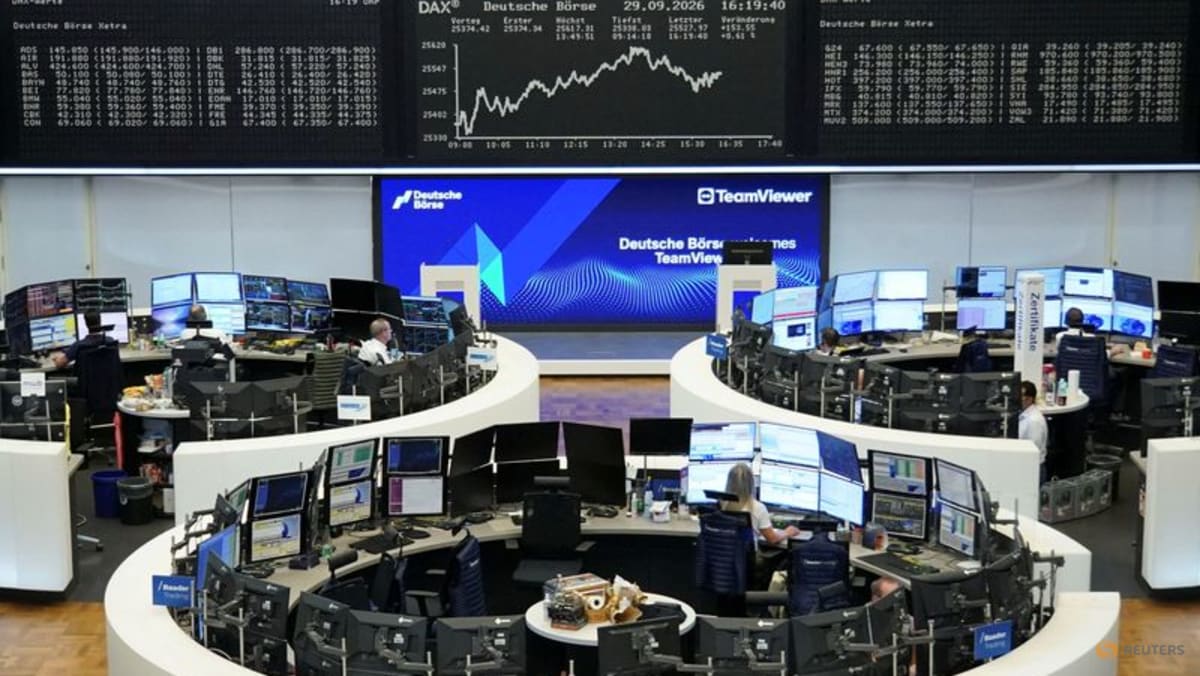
European shares rose on Friday 2 October as volatility in bond and currency markets eased, ahead of the US September jobs report. Yields remain near multi-year highs, with the Iran war and energy prices driving inflation and fiscal worries.

1 / 2
The story, neutrally told
European shares rose in early trade on Friday 2 October as turbulence in bond and currency markets eased ahead of the US September jobs report. CNAN “Global shares rose on Friday as wild volatility in bond and currency markets eased ahead of key US jobs data” Read at CNA ↗ The HinduLC “European shares edged higher on Friday (October 2, 2026) after a global bond sell-off deepened” Read at The Hindu ↗ CNA reported the pan-European STOXX 600 up 0.8 per cent, though still heading for a weekly drop of about 1 per cent. The Hindu reported early gains of 0.5% for the FTSE 100, 0.6% for the CAC 40 and 0.8% for the DAX. CNAN “the pan-regional STOXX 600 index up 0.8 per cent, although it is still heading for a weekly drop of about 1 per cent” Read at CNA ↗ The HinduLC “Britain's FTSE 100 climbed 0.5% to 10,485.00. France's CAC 40 rose 0.6% to 7,883.49, while Germany's DAX was up 0.8% to 25,129.78.” Read at The Hindu ↗ Asian markets were weaker. Japan's Nikkei fell 0.9%, and Hong Kong's Hang Seng dropped about 2.6–2.7%, its lowest level since July by The Hindu's account. Mainland Chinese markets were closed for a holiday. South Korea's Kospi rose 0.5% and Australia's S&P/ASX 200 gained 0.8%. CNAN “Hong Kong's Hang Seng index slid 2.7 per cent on Friday after returning from a holiday.” Read at CNA ↗ The HinduLC “Hong Kong's Hang Seng lost 2.6% to 23,972.29, hitting the lowest level since July.”“South Korea's Kospi added 0.5% to 7,003.74.” Read at The Hindu ↗
US stock futures edged up: CNA reported Nasdaq futures up 0.7% and S&P 500 futures up 0.4%, while The Hindu said Treasury yields held steadier early on Friday. CNAN “Nasdaq futures were up 0.7 per cent and S&P 500 futures gained 0.4 per cent.” Read at CNA ↗ The HinduLC “U.S. futures edged up after U.S. Treasury yields held steadier early Friday” Read at The Hindu ↗ In Europe, longer-dated government bond prices rose, but those of more indebted countries such as France and Italy lagged Germany's. The German 10-year yield fell 6.5 basis points and the French 10-year yield fell 4 bp to 4.892 per cent. The gap between the two reached 149 bp, the widest since the 2012 euro zone debt crisis. CNAN “The German 10-year yield, the euro zone benchmark, was down 6.5 basis points on Friday”“pushing the gap between the German and French 10-year yields as wide as 149 bps, the widest level since the euro zone debt crisis in 2012.” Read at CNA ↗ George Lagarias, chief economist at Forvis Mazars, said he would not call it a crisis yet but that it had the potential to become one if it continued for a couple more weeks. CNAN “"I wouldn't call it a crisis yet, but it looks like it has the potential to be one," said George Lagarias” Read at CNA ↗
The US 10-year Treasury yield was around 5.24% on Friday, after reaching 5.34% on Thursday, the highest since 2002 according to The Hindu (CNA called it a 24-year high). Japan's long-term bond yields hit multi-decade highs on Friday. The HinduLC “the yield on the 10-year U.S. Treasury was at around 5.24%, after it reached 5.34% on Thursday (October 1, 2026), the highest since 2002.” Read at The Hindu ↗ CNAN “Japan's long-term bond yields hit multi-decade highs on Friday” Read at CNA ↗ Both outlets link the bond selloff to the Iran war: CNA cites higher energy prices complicating the inflation outlook and straining public finances, and The Hindu cites inflation pressure from the energy shock plus rising US government debt. T. Rowe Price's David Clewell said a rise toward 5.5% to 6% was a credible possibility and that 5% had been an important psychological threshold. CNAN “the US-Israeli war with Iran pushed up energy prices again, complicating the inflation outlook and further straining already stretched public finances.” Read at CNA ↗ The HinduLC “credible" likelihood that the U.S. 10-year Treasury yield can rise toward 5.5% to 6%” Read at The Hindu ↗ Forecasts centre on a gain of 90,000 nonfarm payrolls in September with unemployment steady at 4.1 per cent. CNA said a hot print could revive bets on a second Federal Reserve rate rise this month, currently priced at 25 per cent, with a December move fully priced in. The Hindu noted the Fed raised rates in September for the first time in three years. CNAN “Forecasts are centred on a gain of 90,000 nonfarm payrolls in September, while the unemployment rate is expected to be steady at 4.1 per cent.”“currently priced at just 25 per cent after two top policymakers said this week they wanted more data” Read at CNA ↗ The HinduLC “after the Fed raised rates in September for the first time in three years” Read at The Hindu ↗
Chris Weston of Pepperstone said a hot wages print could be particularly influential for US rates, Treasuries and the dollar, and that a sustained rise in term premium could be far more problematic for risk assets. CNAN “a hot wages print could prove particularly influential for US rates, Treasuries and the USD” Read at CNA ↗ In currencies, the euro was around $1.1255–1.1257 after hitting its lowest since May 2025 on Thursday, and the dollar index was at 101.89, set for a third weekly gain. The yen firmed to about 157.6 per dollar after Tokyo underlying inflation accelerated to 2.7% in September. CNA suggested the European bond rout may have driven safe-haven flows to Treasuries, the dollar and the Swiss franc. CNAN “The euro was nursing losses at $1.1257, having weakened 0.8 per cent on Thursday to hit the lowest level since May 2025.”“underlying inflation in Japan's capital accelerated to an annual rate of 2.7 per cent in September” Read at CNA ↗ The HinduLC “The euro was trading at $1.1255, up from $1.1244.” Read at The Hindu ↗ Oil fell: Brent was down 2.3% at about $100 a barrel (The Hindu: $99.95, versus about $72 in late February before the war) and US West Texas Intermediate fell 3.4% to $89.69. CNA attributed the drop to signs of recovering Middle East supplies and EU talks on releasing diesel stockpiles; The Hindu pointed to uncertainty over a US-Iran de-escalation. CNAN “US West Texas Intermediate crude futures slipped 3.4 per cent to $89.69 a barrel.”“as EU countries discussed a proposal to release additional diesel stockpiles” Read at CNA ↗ The HinduLC “That's still well above the approximately $72 per barrel level in late February before the war.” Read at The Hindu ↗
The Hindu added that the US is sending thousands of troops and a third aircraft carrier to the West Asia, according to a US official, after President Donald Trump on Wednesday threatened to "blow them up" or make a deal, referring to Iran. The HinduLC “The US military is deploying thousands of troops aboard a group of ships, including a third aircraft carrier, to the West Asia” Read at The Hindu ↗
Every sentence links to the reporting it rests on.
Left1 outlet
- Framing
- Leads on mixed global stocks and a deepening bond sell-off, placing oil and US military escalation against Iran in the opening lines.
- Emphasis
- Geopolitics: aircraft carrier and troop deployment, Trump's threats; index levels and Treasury yield thresholds.
- Leaves out or plays down
- Omits European sovereign spreads, the French-German yield gap and the payroll forecasts.
- Charged language
- “blow them up”
- For example
-
“as President Donald Trump threatened more possible escalations against Iran” — The Hindu
Centre1 outlet
- Framing
- Market-wire style report leading on easing volatility in bonds and currencies, with a focus on European sovereign spreads and Fed rate expectations.
- Emphasis
- French-German yield gap, analyst warnings of a possible bond crisis, Fed pricing and payroll forecasts.
- Leaves out or plays down
- Does not mention US military deployments or Trump's threats toward Iran; gives no individual European index levels.
- Charged language
- “wild volatility”“relentless selloff”
- For example
-
“Global bond markets have been under a relentless selloff in recent weeks” — CNA
Right0 outlets
No right outlet in our sources has covered this story yet.
What every side reports
- Shares in Europe rose in early trade on Friday 2 October ahead of the US September jobs report.
- Hong Kong's Hang Seng fell about 2.6–2.7% and Japan's Nikkei fell 0.9%; mainland China was closed for a holiday.
- Bond yields have surged amid the Iran war's energy shock, with the US 10-year yield at its highest in over two decades on Thursday.
- Brent crude fell 2.3% to about $100 a barrel.
Where accounts differ
-
Overall market direction
- Left
- Global stocks were mixed, with European shares edging higher after the bond sell-off deepened.
- Centre
- Global shares rose as bond and currency volatility eased.
-
Why oil fell
- Left
- Uncertainty over de-escalation between the US and Iran dragged on, even as the US sent more forces to the region.
- Centre
- Market refocused on signs of recovering Middle East supplies and EU talks on releasing diesel stockpiles.
Federal Reserve organisation
Per CNA, two top policymakers said this week they wanted more data before deciding on rates; The Hindu notes it raised rates in September for the first time in three years.
“two top policymakers said this week they wanted more data before deciding what to do next with interest rates” — CNA
“after the Fed raised rates in September for the first time in three years” — The Hindu
Donald Trump person
Trump threatened Iran on Wednesday, saying he would "blow them up" or make a deal, as the US sent more forces to the region.
“Mr. Trump on Wednesday (September 30, 2026) threatened to “blow them up” or make a deal” — The Hindu
East and Southeast Asia1 outlet
CNA's report centres on European bond spreads and Fed expectations.
“reflecting growing investor demand for protection against rising fiscal risks” — CNA
CNA
South Asia1 outlet
The Hindu's report gives more weight to the US-Iran escalation and Asian index levels.
“the U.S. sent another aircraft carrier and more troops to the West Asia” — The Hindu
The Hindu
Left1 article
-
World shares mixed after global bond sell-off deepens, ahead of U.S. jobs data
Neutral Markets report describing mixed stocks, with the Iran escalation and oil prominent.
Centre1 article
-
CNAN ·
Global shares rise as bond selloff eases before US jobs
Neutral Markets report stressing easing volatility, European bond spreads and Fed expectations.
Right0 articles
No coverage yet.
- 2 Oct 09:57 First CNAN Global shares rise as bond selloff eases before US jobs
- 2 Oct 11:58 +2h 1m The HinduLC World shares mixed after global bond sell-off deepens, ahead of U.S. jobs data
Times are when each article was published, or when we first saw it if the outlet gave no time.