Hand-drawn Mason-Dixon Line map goes to auction with $800,000–$1.2M estimate
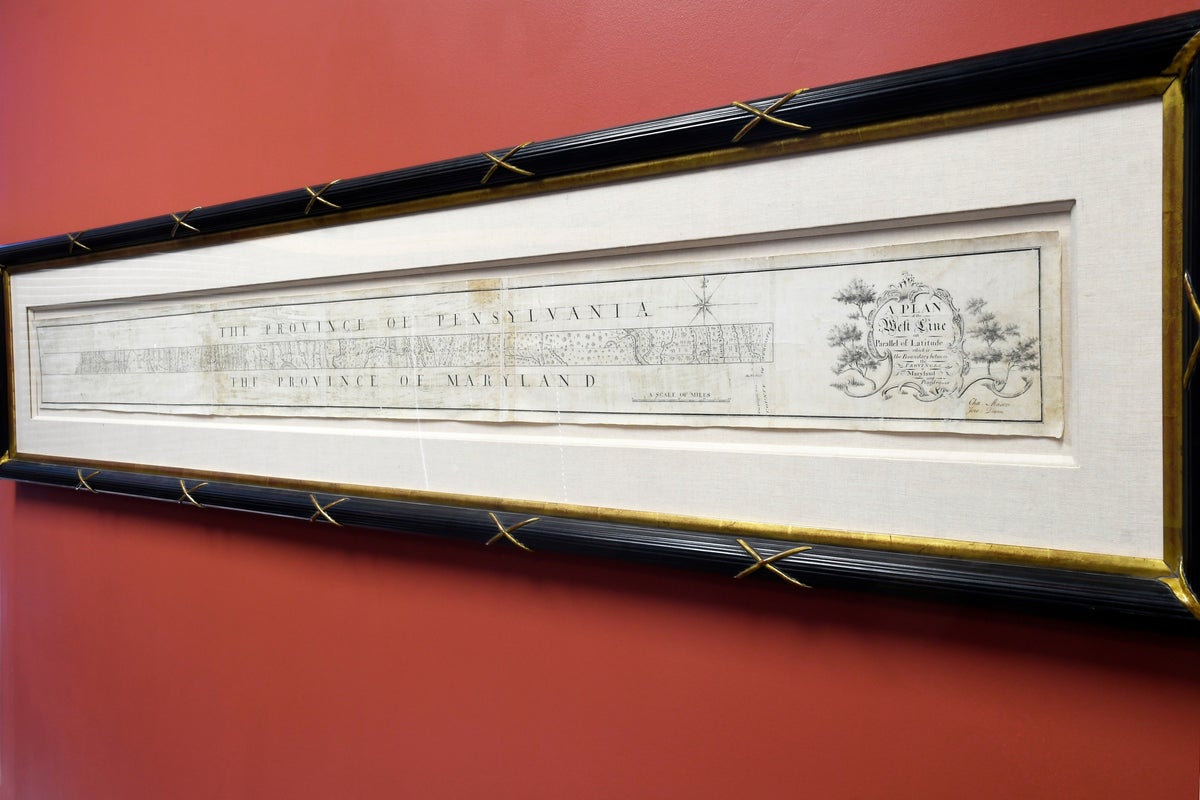
A hand-drawn chart of the Mason-Dixon Line is being auctioned on Thursday by Brunk Auctions. The Library of Congress told the auctioneer it could not afford to buy it.

1 / 2
The story, neutrally told
Mixed · 2A hand-drawn chart of the Mason-Dixon Line, the boundary that came to divide free states from slave states, goes up for auction on Thursday in a livestreamed sale. New York PostR “the document will go on sale Thursday in a livestreamed auction” Read at New York Post ↗ The IndependentLC “goes under the hammer on Thursday” Read at The Independent ↗ Mixed · 2Lauren Brunk, vice president of Brunk Auctions in Asheville, North Carolina, estimates it could fetch $800,000 to $1.2 million for an anonymous seller. New York PostR “Brunk estimates it could fetch anywhere from $800,000 to $1.2 million for the anonymous seller.” Read at New York Post ↗ The IndependentLC “expects it to fetch anywhere between $800,000 and $1.2 million” Read at The Independent ↗ Mixed · 2The map is a linen-backed strip of paper 76 inches (193 cm) long and 6.5 inches (16.5 cm) tall, now remounted on backing made of Japanese rice paper. New York PostR “76 inches (193 centimeters) long and 6.5 inches (16.5 centimeters) tall” Read at New York Post ↗ The IndependentLC “remounted on backing made of Japanese rice paper” Read at The Independent ↗
Mixed · 2It comes from the survey by Charles Mason and Jeremiah Dixon, which was originally meant to settle a border dispute between the colonies of Maryland and Pennsylvania. New York PostR “originally meant to settle a border dispute between the then-colonies of Maryland and Pennsylvania” Read at New York Post ↗ The IndependentLC “Their work was originally meant to settle a border dispute” Read at The Independent ↗ Mixed · 2The line later took on a different meaning when the 1820 Missouri Compromise used it to set the limits of slavery, and it became synonymous with the divisions that led to civil war about four decades later. Brunk noted that the line was not drawn for that reason. New York PostR “the line was not drawn for that reason” Read at New York Post ↗ The IndependentLC “the 1820 Missouri Compromise used the line to establish the limits of human bondage” Read at The Independent ↗ Mixed · 2Soon after it was drawn, the map was given to the family of attorney Benjamin Chew, who represented the descendants of Pennsylvania founder William Penn. The family kept it until 1982, when publisher Malcolm S. Forbes bought it for $360,000, outbidding the Library of Congress, in what was said to be the highest auction price then paid for an American map. New York PostR “late publisher Malcolm S. Forbes outbid the Library of Congress and bought it for $360,000” Read at New York Post ↗ The IndependentLC “the highest price ever paid at auction for an American map” Read at The Independent ↗
Mixed · 2The map changed hands again in 2002, and a vertical section showing the Delaware-Maryland border is held at Princeton University. New York PostR “The map changed hands again in 2002.” Read at New York Post ↗ The IndependentLC “is housed at Princeton University” Read at The Independent ↗ Mixed · 2Brunk said she contacted the Library of Congress to let it know the map was returning to market, and that officials said that, with budgets as they are, they were not in a position to buy it. She added that the library would be happy to have it if a donor bought it on its behalf. New York PostR “they were just not in a position to buy it” Read at New York Post ↗ The IndependentLC “they’d be happy to have it” Read at The Independent ↗ Mixed · 2A popular theory holds that the term "Dixie" comes from Dixon, though its true origin is disputed. New York PostR “the true origin is disputed” Read at New York Post ↗ The IndependentLC “the true origin is disputed” Read at The Independent ↗
Every sentence links to the reporting it rests on. The pill in front of each says where its sources sit: Left, Centre or Right when one side supplies at least half of them, Mixed when they are evenly split. The number is how many outlets it cites.
Left1 outlet
- Framing
- The Independent leads on the auction and puts the Library of Congress's refusal in the headline, as 'forced to turn it down'.
- Emphasis
- The Library of Congress's inability to buy the map; the history of the line.
- Leaves out or plays down
- The article says nothing about 'forced', which is the outlet's own wording; the library's quoted reason is only budgets.
- Charged language
- “forced to turn it down”
- For example
-
“goes up for auction after Library of Congress was forced to turn it down” — The Independent
Centre0 outlets
No centre outlet in our sources has covered this story yet.
Right1 outlet
- Framing
- The New York Post, running AP copy, leads on the map's historical significance and its possible price.
- Emphasis
- The map's significance and the sale price; the library's refusal comes at the end.
- Leaves out or plays down
- Does not put the Library of Congress's refusal in the headline.
- Charged language
- “most consequential map in American history”
- For example
-
“It’s perhaps the most consequential map in American history. And it could be yours.” — New York Post
What every side reports
- The map is being auctioned Thursday by Brunk Auctions, with an $800,000–$1.2 million estimate.
- Malcolm Forbes bought it in 1982 for $360,000, outbidding the Library of Congress.
- The Library of Congress told the auctioneer it was not in a position to buy it.
Where accounts differ
-
Why the Library of Congress did not bid
- Left
- The headline says the library was 'forced' to turn it down; the text quotes only budget constraints.
- Right
- Reports that the library said, because of budgets, it was not in a position to buy.
Left1 article
-
'Dixie' map that divided US goes up for auction after Library of Congress was forced to turn it down
Neutral Near-identical account that rewrites the headline around the Library of Congress being 'forced' to decline.
Centre0 articles
No coverage yet.
Right1 article
-
New York PostR · · via AP
‘Dixie’ map that divided US into North and South could fetch up to $1.2M at auction
Neutral AP copy run by the New York Post, with a headline on the price and a lede stressing the map's historical importance.
- 28 Oct 07:30 First New York PostR ‘Dixie’ map that divided US into North and South could fetch up to $1.2M at auction via AP
- 28 Oct 15:12 +7h 42m The IndependentLC 'Dixie' map that divided US goes up for auction after Library of Congress was forced to turn it down
Times are when each article was published, or when we first saw it if the outlet gave no time.
Ask about this story
Loading…