Hong Kong team develops yeast, gelatin and sand "living" material for Mars construction
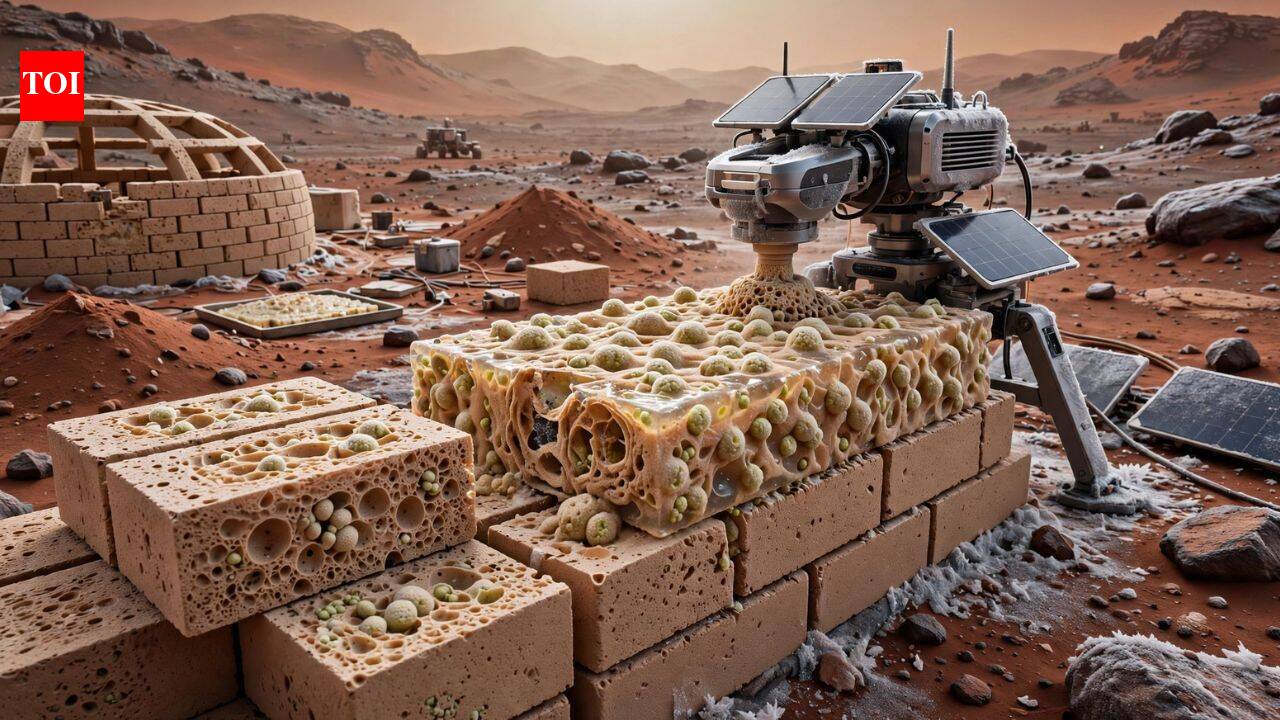
Researchers in Hong Kong report a 3D-printable material of engineered yeast, gelatin and sand that reached about 12 MPa compressive strength in simulated Martian conditions. It still relies on Earth-supplied gelatin and nutrients.

1 / 2
The story, neutrally told
Centre · 1Scientists in Hong Kong say they have developed a low-cost "living" building material made from genetically engineered yeast, gelatin and sand that can be 3D printed under conditions simulating Mars. South China Morning PostN “Scientists in Hong Kong say they have developed a quick and low-cost “living” building material made from genetically engineered yeast, gelatin and sand that can be 3D printed under conditions simulating the Martian environment.” Read at South China Morning Post ↗ Centre · 2The study was published last month in Chem Circularity, a Cell Press journal, under the title 'Engineered living building material for low-energy construction on Mars'. South China Morning PostN “Their study, published online last month in Chem Circularity, an international Cell Press journal” Read at South China Morning Post ↗ The Times of IndiaN “titled ‘Engineered living building material for low-energy construction on Mars’” Read at The Times of India ↗ Centre · 1The material was developed by Professor Qiu Jishen and his team at the Hong Kong University of Science and Technology, with scientists from Hong Kong Polytechnic University. South China Morning PostN “The material was developed by Professor Qiu Jishen and his team at the Hong Kong University of Science and Technology and scientists from Hong Kong Polytechnic University.” Read at South China Morning Post ↗
Centre · 2The material combines sand or other granular particles with a gelatin hydrogel and Saccharomyces cerevisiae yeast whose surface is modified to display adhesive proteins, including mussel foot proteins. South China Morning PostN “The team used proteins, including mussel foot proteins, to strengthen the links between the yeast cells, the gelatin binder and the aggregate particles” Read at South China Morning Post ↗ The Times of IndiaN “The engineered ‘Saccharomyces cerevisiae’ cells displayed adhesive proteins on their surfaces” Read at The Times of India ↗ Centre · 2It hardens during freeze-drying (at −55°C and 0.0001 atm for 48 hours in the tests), leaving a porous gelatin scaffold with yeast cells embedded in its walls. The Times of IndiaN “freeze-dried at −55°C and 0.0001 atm for 48 hours” Read at The Times of India ↗ South China Morning PostN “leaving behind a porous gelatin scaffold with yeast cells embedded in its walls” Read at South China Morning Post ↗ Centre · 2The optimised formulation, with 25% biological components in the added solids, had a compressive strength of about 12 MPa, around 170 per cent higher than the control, and a flexural strength of 6 MPa. South China Morning PostN “compressive strength of about 12 megapascals (MPa), around 170 per cent higher than that of the control formulation” Read at South China Morning Post ↗ The Times of IndiaN “contained 25% biological components in the total solid substances added to the hydrosol”“flexural strength of 6 MPa” Read at The Times of India ↗
Centre · 2The researchers printed a small beacon-like structure, 45mm high and 30mm in diameter, in a chamber at 0.01 atmospheres and minus 30 degrees. South China Morning PostN “The printed structure was 45mm (1.8 inches) high and 30mm in diameter.” Read at South China Morning Post ↗ The Times of IndiaN “A scaled-down beacon was successfully fabricated at 0.01 atm and −30°C” Read at The Times of India ↗ Centre · 2Processing is far less energy-intensive than sintering Martian soil at about 1,000°C: the team estimated that 1 cubic metre would need under an hour of solar-panel operation versus several days for sintering, and the paper puts the energy requirement several tens of times lower. The paper cautions this is a first-order estimate that excludes microbial cultivation, nutrient supply, bioreactor pressurisation and other operations. South China Morning PostN “would require less than an hour of solar-panel operation, compared with several days to sinter the same volume of Martian regolith into a solid block” Read at South China Morning Post ↗ The Times of IndiaN “this is only a first-order estimate of material-level processing energy rather than a complete process or mission energy budget” Read at The Times of India ↗ Centre · 2The material can be recycled: after crushing, rehydrating and gentle heating, fourth-generation samples kept a compressive strength of about 11.8 MPa, and the yeast stayed viable across repeated recycling. South China Morning PostN “fourth-generation samples retaining a compressive strength of about 11.8 MPa” Read at South China Morning Post ↗ The Times of IndiaN “kept the yeast cells viable across repeated recycling” Read at The Times of India ↗
Centre · 2The material still depends on Earth: it relies on porcine gelatin and externally supplied nutrients. Qiu said 1 cubic metre would need only tens of kilograms of Earth-supplied raw materials, 70 to 80 per cent of it gelatin, and that this could in theory fall to zero if Martian methane, carbon dioxide and water ice could be converted into gelatin or nutrients. South China Morning PostN “about 70 to 80 per cent of the mass consisting of gelatin and the remainder comprising nutrients for the yeast” Read at South China Morning Post ↗ The Times of IndiaN “relies on Earth-derived porcine gelatin and externally supplied microbial nutrients” Read at The Times of India ↗ Centre · 2Qiu's team describes the current material as a structural component rather than a complete habitat. Open questions include radiation tolerance, permeability, thermal conductivity, long-term durability, tensile behaviour and full-scale fabrication. Zhu Xiaohong of Beijing University of Technology, who was not involved, called it an important direction but said applications are not yet mature. The team also sees uses on Earth, such as Antarctic research stations. South China Morning PostN “Qiu and his team described the current material as a structural component rather than a complete habitat.”““I think its applications are certainly not mature yet, but the direction is worth studying” Read at South China Morning Post ↗ The Times of IndiaN “several properties still need to be assessed, including radiation tolerance, permeability, thermal conductivity, long-term durability, direct tensile behaviour, and performance during full-scale fabrication” Read at The Times of India ↗
Every sentence links to the reporting it rests on. The pill in front of each says where its sources sit: Left, Centre or Right when one side supplies at least half of them, Mixed when they are evenly split. The number is how many outlets it cites.
Left0 outlets
No left outlet in our sources has covered this story yet.
Centre2 outlets
- Framing
- Both outlets present the study as a promising, low-energy and recyclable construction approach, while noting limits. The SCMP leads on the Hong Kong team and the Earth-supply problem; the Times of India follows the paper's methods and caveats.
- Emphasis
- SCMP: named researchers, an independent expert comment, Antarctic use. Times of India: process details, strain, energy-estimate caveats, recycling.
- Leaves out or plays down
- The Times of India names neither the Hong Kong institutions nor Qiu and includes no outside expert. The SCMP gives fewer details on the energy-estimate limits and on untested properties.
- Charged language
- “living building material”“breakthrough”
- For example
-
“Future settlers on Mars would need houses, but they must either spend huge sums transporting construction materials from Earth” — South China Morning Post
“Researchers have developed an innovative living building material designed for potential use on Mars” — The Times of India
Right0 outlets
No right outlet in our sources has covered this story yet.
What every side reports
- The study appeared in Chem Circularity.
- The material uses sand, gelatin hydrogel and engineered yeast, and was printed under simulated Martian conditions (0.01 atm, −30°C).
- The best formulation reached about 12 MPa compressive strength.
- It uses far less processing energy than sintering regolith at over 1,000°C.
- It still depends on Earth-supplied gelatin and nutrients.
East and Southeast Asia1 outlet
The SCMP presents it as Hong Kong research, naming the institutions and lead researcher and including an outside expert.
“The material was developed by Professor Qiu Jishen and his team at the Hong Kong University of Science and Technology” — South China Morning Post
South China Morning Post
South Asia1 outlet
The Times of India presents it as a generic scientific finding, focused on the paper's technical content and caveats.
“Scientists have developed a living building material designed for construction on Mars” — The Times of India
The Times of India
Left0 articles
No coverage yet.
Centre2 articles
-
Mars shelter problem can be solved with engineered yeast, gelatin and sand: paper
Neutral Problem-solution news report on the Hong Kong team's work, with researcher quotes, an outside expert and stated limits.
-
Scientists develop a living building material for Mars using engineered yeast
Neutral Explainer-style summary of the paper's methods, results and caveats, with a mildly promotional lede.
Right0 articles
No coverage yet.
- 4 Oct 05:00 First South China Morning PostN Mars shelter problem can be solved with engineered yeast, gelatin and sand: paper
- 5 Oct 16:00 +35h The Times of IndiaN Scientists develop a living building material for Mars using engineered yeast
Times are when each article was published, or when we first saw it if the outlet gave no time.