IMF and World Bank annual meetings open in Bangkok amid Iran-war inflation worries
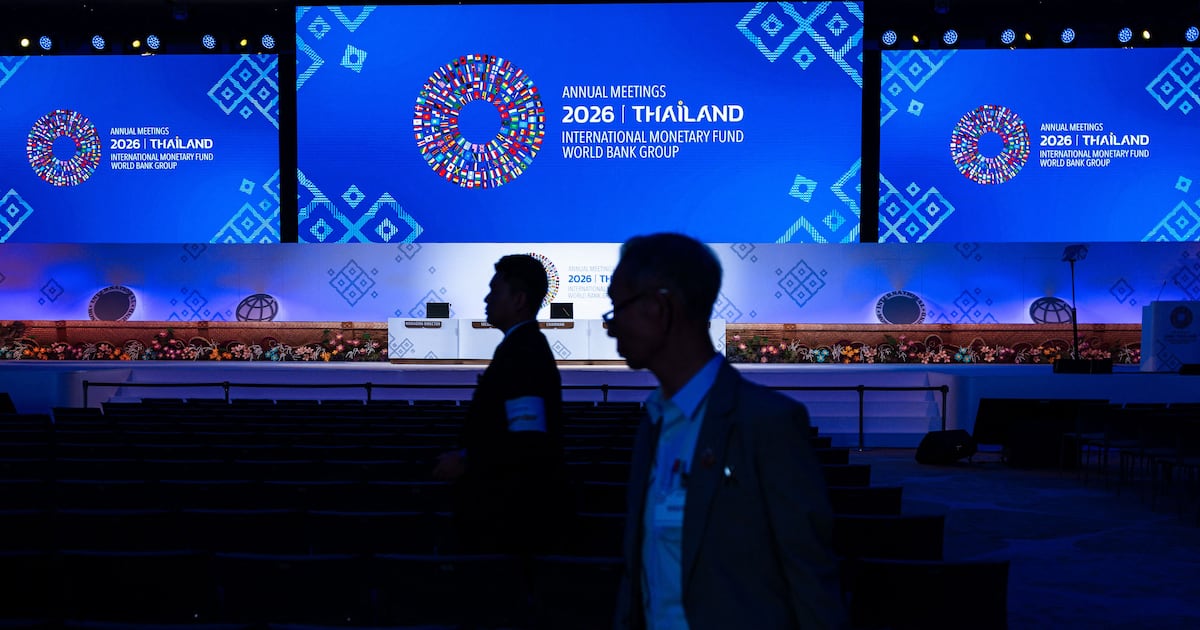
Finance ministers and central bankers gather in Bangkok from Monday for the IMF and World Bank annual meetings. The Iran war, higher energy prices, rising interest rates and debt burdens are set to dominate.
1 / 2
The story, neutrally told
Mixed · 2Finance ministers, central bankers and other officials from IMF and World Bank member countries meet in Bangkok, Thailand, from Monday for the institutions' annual meetings. The NationalN “representatives from the IMF and World Bank member countries will meet in Bangkok, Thailand, from Monday” Read at The National ↗ The Jerusalem PostRC “Finance officials from around the world will gather in Thailand this week” Read at The Jerusalem Post ↗ Centre · 1The meetings are normally held in Washington for two consecutive years and in another member country every third year; the 2029 meetings are due in Abu Dhabi. The NationalN “The meetings are typically held in Washington for two consecutive years and in another member country every third year.” Read at The National ↗ Right · 1Reuters, in copy carried by The Jerusalem Post, said the US-Israeli-led war with Iran, now in its eighth month, and the inflation and hardship it has caused are expected to dominate the agenda; the war began on 28 February. The Jerusalem PostRC “The US-Israeli-led war with Iran, now in its eighth month, and the inflation and hardship it has caused will dominate the agenda”“since the start of the war on February 28” Read at The Jerusalem Post ↗
Mixed · 2The National reports that the Strait of Hormuz's prolonged partial closure has pushed Brent crude roughly 30 per cent above prewar levels, while Reuters says Iran's closure of the strait shut off some 20% of the world's oil. The NationalN “the Strait of Hormuz’s prolonged partial closure driving the price for Brent crude roughly 30 per cent higher than prewar levels” Read at The National ↗ The Jerusalem PostRC “shutting off some 20% of the world's oil” Read at The Jerusalem Post ↗ Centre · 1Other inflationary pressures cited include AI-driven electricity demand and the debt issuance it requires, US national debt reaching $40 trillion, and a 24-year high in the 10-year US Treasury yield this week, according to The National. The NationalN “The yield on the 10-year US Treasury, a benchmark for global borrowing costs, recorded a 24-year high this week.” Read at The National ↗ Centre · 1Central banks are tightening: the US Federal Reserve raised rates by a quarter point in September, starting a new tightening cycle; the European Central Bank and Bank of Japan have also raised rates, and the Bank of England is expected to follow next month. Traders expect three more Fed hikes by July 2027, per CME Group data. The NationalN “entered a new tightening cycle in September after it raised interest rates by a quarter point”“Traders anticipate the Fed will raise interest rates three more times by July 2027, according to CME Group data.” Read at The National ↗
Mixed · 2IMF managing director Kristalina Georgieva said most countries should adopt a "prudently hawkish" posture and suggested austerity was returning for advanced economies, saying "Some very tough political choices stare us in the face". In her curtain-raiser speech she also warned, "Winter is coming." The NationalN “said the environment was right for most countries to adopt a “prudently hawkish” posture” Read at The National ↗ The Jerusalem PostRC “telling the audience, "Winter is coming."” Read at The Jerusalem Post ↗ Right · 1World Bank President Ajay Banga told Reuters global growth had held up better than feared, but pressure is building from soaring diesel prices, rising fertilizer costs and a looming "super" El Niño; the Bank is not revising its global forecasts down for now. The Jerusalem PostRC “Banga said the Bank was not revising down its global forecasts at the moment, but was keeping a close eye on developments.” Read at The Jerusalem Post ↗ Right · 1The IMF has signalled little change to its 3% global growth forecast for 2026 and may raise next year's slightly, though Ukraine and Gulf states hit by Iranian strikes may see downgrades, according to Reuters. The Jerusalem PostRC “The IMF has signaled little change to its forecast of 3% global growth in 2026 and may slightly raise its forecast for next year.” Read at The Jerusalem Post ↗
Right · 1US Treasury Secretary Scott Bessent will skip the meetings and a G20 meeting, sending two senior officials while handling "domestic engagements", a US official said; Reuters said this may frustrate counterparts. The Jerusalem PostRC “US Treasury Secretary Scott Bessent will be notably absent, dispatching two senior officials in his stead while he handles some "domestic engagements," a US official said.” Read at The Jerusalem Post ↗ Right · 1G7 countries have agreed to release 100 million barrels of diesel and crude from emergency reserves, and President Donald Trump on Friday announced a deal with Russia to supply more diesel with a temporary waiver of US sanctions, which Ukrainian President Volodymyr Zelenskiy criticised. The Jerusalem PostRC “Group of Seven countries have agreed to release 100 million barrels of diesel and crude oil from emergency reserves”“The move drew swift criticism from Ukrainian President Volodymyr Zelenskiy.” Read at The Jerusalem Post ↗ Centre · 1Low-income countries are a central concern. The World Bank has pledged up to $60 billion since the war began, the African Development Bank launched a $5.1 billion framework and the Asian Development Bank is mobilising $4 billion; the IMF reached a staff-level agreement with Pakistan to unlock $1.21 billion and Bangladesh has requested a programme. The NationalN “the World Bank has pledged up to”“reached a staff-level agreement with Pakistan that would unlock $1.21 billion” Read at The National ↗
Right · 1Public debt is at its highest since World War Two and will exceed 100% of GDP before 2030, the IMF says, and G20 diplomats see little appetite for a debt-service suspension like the one early in the Covid crisis, Reuters reported. The Jerusalem PostRC “The IMF says public debt is at the highest level since World War Two and will exceed 100% of GDP before 2030.”“G20 diplomats said there is little appetite for such action now” Read at The Jerusalem Post ↗ Mixed · 2Critics question the IMF's role: Boston University's Marina Zucker-Marques doubts low-income countries' appetite for IMF funding given conditionality, and Eurodad's Iolanda Fresnillo fears the review of conditionality policy "is just going to make things worse". The NationalN “Ms Zucker-Marques questioned how eager low-income countries might be for more funding from the IMF, citing the fund's conditionality for programmes.” Read at The National ↗ The Jerusalem PostRC “"We fear that this review of conditionality policy is just going to make things worse."” Read at The Jerusalem Post ↗ Centre · 1Defenders include Rachel Glennerster of the Centre for Global Development, who said the international financial institutions are "weathering these crises remarkably well compared to other multilaterals". The NationalN ““The international financial institutions are weathering these crises remarkably well compared to other multilaterals,” Rachel Glennerster” Read at The National ↗
Right · 1Reuters also noted security concerns for the 10,000-plus travellers because flight routes to Bangkok often pass through the Middle East, following recent attacks on Saudi airports. The Jerusalem PostRC “Flight routes to Bangkok often route through the Middle East, posing immediate security challenges to the 10,000-plus travelers” Read at The Jerusalem Post ↗
Every sentence links to the reporting it rests on. The pill in front of each says where its sources sit: Left, Centre or Right when one side supplies at least half of them, Mixed when they are evenly split. The number is how many outlets it cites.
Left0 outlets
No left outlet in our sources has covered this story yet.
Centre1 outlet
- Framing
- Economic preview centred on a return of inflation and a hawkish turn in monetary policy, with Iran war energy shocks, AI-related demand and US debt as drivers.
- Emphasis
- Central bank rate rises, bond yields, austerity for advanced economies, and financing for low-income countries.
- Leaves out or plays down
- Does not mention Bessent's absence, the G7 reserve release or El Niño.
- Charged language
- “perfect storm”“hawkish”
- For example
-
“This year's meetings come amid a renewed threat of inflation.” — The National
Right1 outlet
- Framing
- Reuters copy carried by The Jerusalem Post frames the meetings around the Middle East war, energy supply and geopolitics, including the US absence and the Russia diesel deal.
- Emphasis
- Geopolitics, oil stocks, Bessent's absence, El Niño, debt and conditionality, and a link to the 7 October attack.
- Leaves out or plays down
- Says less about central bank rate decisions and the AI-driven bond yield pressure.
- Charged language
- “October 7 massacre”“Winter is coming”
- For example
-
“under the shadow of a widening war in the Middle East, the biggest energy supply shock ever” — The Jerusalem Post
What every side reports
- Meetings are in Bangkok from Monday.
- The Iran war and the Strait of Hormuz disruption are driving energy prices and inflation.
- Georgieva has issued hawkish or stark warnings.
- Low-income countries face higher borrowing costs and IMF conditionality worries.
International Monetary Fund organisation
Managing director Kristalina Georgieva urges a "prudently hawkish" stance and warns "Winter is coming"; the IMF expects roughly 3% global growth in 2026 and is reviewing its conditionality policy.
“said the environment was right for most countries to adopt a “prudently hawkish” posture” — The National
“telling the audience, "Winter is coming."” — The Jerusalem Post
World Bank Group organisation
President Ajay Banga says growth has held up better than feared but pressures from energy, fertilizer, El Niño and debt are building; the Bank has pledged up to $60 billion since the war began.
“It's that put together that creates its own challenges” — The Jerusalem Post
“the World Bank has pledged up to” — The National
Left0 articles
No coverage yet.
Centre1 article
-
Hawkish sentiment returns to IMF and World Bank meetings
Neutral Analytical preview linking monetary tightening and bond yields to the Iran war and AI-driven demand.
Right1 article
-
Middle East conflicts, energy supplies, to dominate IMF-World Bank meetings in Thailand
Alarmist Reuters copy via The Jerusalem Post stresses war, energy shock and geopolitical risks overshadowing the meetings.
- 11 Oct 04:00 First The NationalN Hawkish sentiment returns to IMF and World Bank meetings
- 11 Oct 06:14 +2h 14m The Jerusalem PostRC Middle East conflicts, energy supplies, to dominate IMF-World Bank meetings in Thailand
Times are when each article was published, or when we first saw it if the outlet gave no time.