Wounded US soldiers say military medical care failed them after Iran drone strike in Kuwait
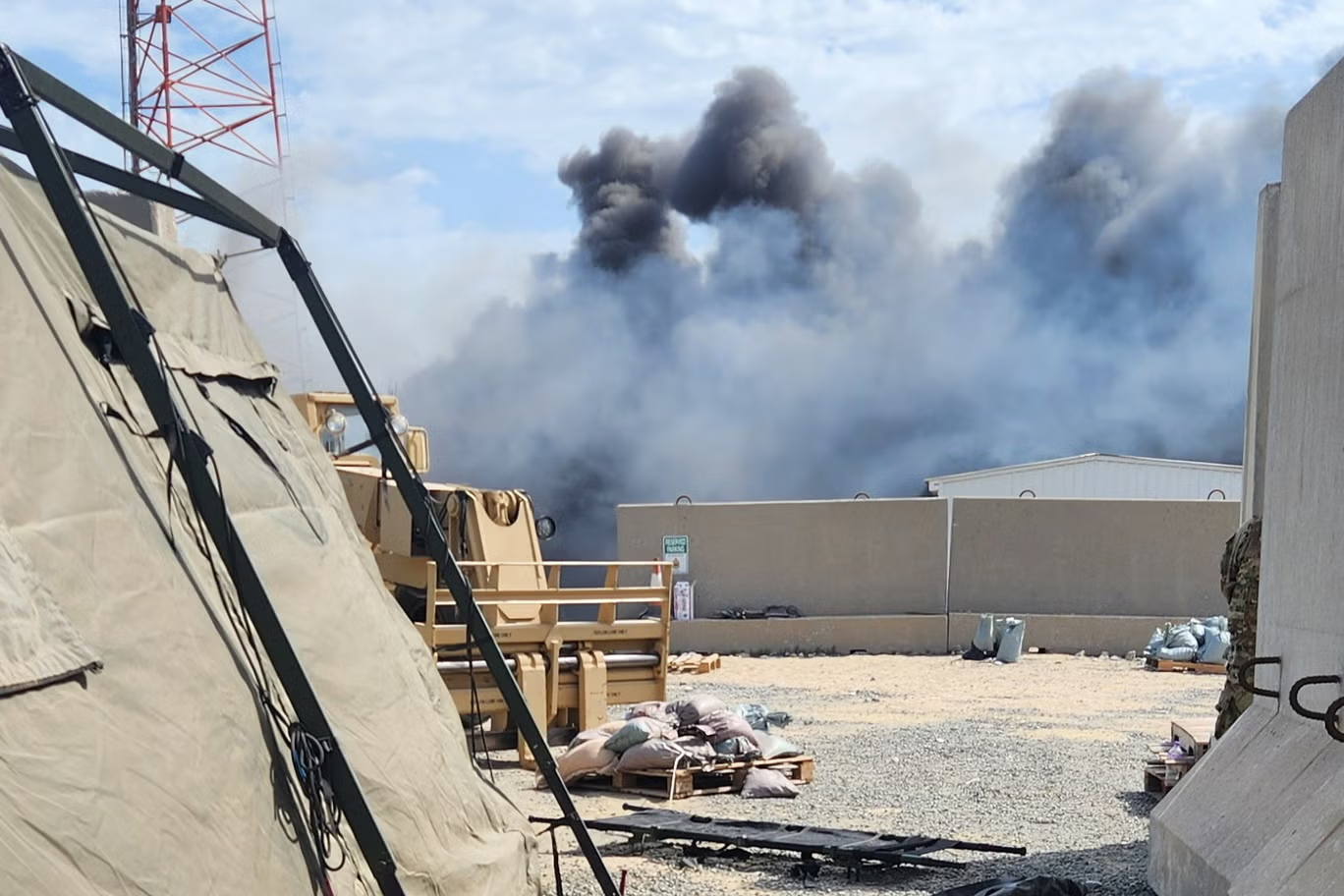
Nine injured US service members told the Associated Press, on the record, that they had to fight for treatment after an Iranian drone strike at Port Shuaiba, Kuwait, on 1 March. The Pentagon says its medical response was appropriate.
Updated (version 2). New coverage since the last version from Arab News.


1 / 3
The story, neutrally told
Left · 2Nine injured US service members spoke on the record to the Associated Press about the military medical care they received, saying it frequently left them fighting to secure treatment on their own. The IndependentLC “nine injured service members spoke on the record to the AP, describing a military medical apparatus that frequently left them fighting to secure treatment on their own” Read at The Independent ↗ Raw StoryL “Nine U.S. service members wounded in the Iran war have gone on the record about the military medical care they received” Read at Raw Story ↗ Left · 2They were among dozens wounded in an Iranian drone strike on 1 March at Port Shuaiba in Kuwait, on the second day of the US war with Iran; the attack killed six troops. The IndependentLC “Lincón was among dozens of U.S. service members wounded during an Iranian drone strike on March 1.” Read at The Independent ↗ Raw StoryL “which killed six troops on the second day of the war” Read at Raw Story ↗ Right · 1The AP's wire copy, carried by Arab News, adds that the wounded are raising concerns publicly, many for the first time, about whether commanders underestimated the threat, and that the Pentagon has so far released few details about the strike. Arab NewsRC “are raising concerns publicly, many for the first time, about whether commanders underestimated the threat.”“The Pentagon has so far released few details about the Iranian drone strike on Port Shuaiba” Read at Arab News ↗
Left · 2Army Lt. Col. Arturo Lincón had shrapnel damage a vertebral artery that supplies blood to the brain, putting him at risk of a stroke. The Army did not admit him to Landstuhl Regional Medical Center in Germany; he was sent to barracks and told to schedule outpatient appointments himself. The IndependentLC “he was dispatched to nearby barracks and instructed to book outpatient appointments on his own” Read at The Independent ↗ Raw StoryL “told to schedule outpatient appointments” Read at Raw Story ↗ Left · 2Chief Warrant Officer 4 Rodney Bearman, with shrapnel wounds from his face to his legs, said that about ten days after the strike the wounded were flown to Germany on a cargo aircraft, strapped to the floor. On landing they found they had not been documented as combat casualties, which he attributed to a coding error, so they were not admitted to Landstuhl. The IndependentLC “Upon landing in Germany, Bearman said they discovered they had not been documented as combat casualties, preventing their admission to Landstuhl.” Read at The Independent ↗ Raw StoryL “which Bearman attributed to a coding error” Read at Raw Story ↗ Left · 2Maj. Stephen Ramsbottom, who needed surgery to remove shrapnel from his head, said he waited more than four months for MRI results and had to build his own case for everything. Medical documents showed he and another officer received no formal traumatic brain injury diagnosis until reaching Fort Hood, Texas. The IndependentLC “neither received a formal TBI diagnosis until arriving at Fort Hood” Read at The Independent ↗ Raw StoryL “"I've had to build my own case for everything," he told AP.” Read at Raw Story ↗
Left · 1Maj. Billy Key said he received no specialized care until mid-April, when he was assigned to a soldier recovery unit for head trauma, hearing loss and lung damage from smoke inhalation. The IndependentLC “Maj. Billy Key recounted that he did not receive specialized care until mid-April” Read at The Independent ↗ Left · 1Immediately after the strike, soldiers treated one another with tourniquets and basic first aid and used Google to find the nearest hospital in Kuwait City, about 20 minutes away. The most critically injured were flown out of Kuwait within two days, while others waited because continued Iranian missile and drone threats made evacuation flights too hazardous. The IndependentLC “soldiers equipped with tourniquets and basic first-aid training treated one another before using Google to navigate to the nearest hospital in Kuwait City”“The threat of ongoing missile and drone attacks from Iran rendered evacuation flights too hazardous.” Read at The Independent ↗ Left · 1Lincón later did seven weeks of outpatient therapy at Walter Reed, still has shrapnel near his spinal cord that cannot be removed, and has returned to duty as an instructor at Fort Leavenworth. His one-year temporary passport, issued after his own was destroyed, was reissued as a 10-year passport after AP inquiries to the State Department, and his Servicemembers' Group Life Insurance traumatic injury claim was denied for failing to meet hearing loss thresholds. The IndependentLC “Lincón underwent seven weeks of specialized outpatient therapy at Walter Reed National Military Medical Center in Maryland”“His claim for Traumatic Injury benefits under Servicemembers' Group Life Insurance was denied for failing to meet hearing loss thresholds” Read at The Independent ↗
Left · 2The Pentagon told the AP that all wounded personnel arriving at its facilities are evaluated and may be admitted depending on injury severity under "healthcare-industry practices", and maintained its medical response was appropriate. A Pentagon official said Landstuhl's main wartime mission is to stabilize patients for transport to US facilities rather than admit them. The IndependentLC “The Pentagon maintained that the medical response was appropriate.”“Landstuhl’s primary mission during combat situations is to stabilize patients for transport to specialized military facilities in the U.S., rather than admitting them.” Read at The Independent ↗ Raw StoryL “evaluated and may be admitted based on the severity of the injury” Read at Raw Story ↗ Left · 1The Army and Pentagon declined to comment further, with the Army saying it had not yet briefed the families of the fallen on its internal inquiry into the incident. The IndependentLC “Both the Army and the Pentagon declined to comment, with the Army stating it had not yet briefed the families of the fallen regarding its internal inquiry into the incident.” Read at The Independent ↗ Left · 1Dr. James Kelly of the Invisible Wounds Foundation said delays in diagnosing traumatic brain injuries are common in war and that initial screenings should be done by qualified medical staff, not fellow service members. The AP article also notes that years of drawdowns left the region without major US military medical installations, such as the Air Force Theater Hospital at Balad, Iraq, handed to Iraq in 2011. The IndependentLC “"It’s disappointing but not surprising," said Kelly”“Those choices left the region without any major military medical installations run by the U.S.” Read at The Independent ↗
Left · 1Raw Story adds that Defense Secretary Pete Hegseth has said a drone "squirted" through US defenses, while survivors told CBS News they dispute that account. Raw StoryL “Defense Secretary Pete Hegseth has said a drone "squirted" through U.S. defenses, but survivors disputed that account to CBS News.” Read at Raw Story ↗ Right · 1The AP copy carried by Arab News describes it as the Iran war's deadliest strike yet on American troops, and places the story in a war now entering its eighth month that is weighing on Republican candidates as midterm voting begins. Arab NewsRC “the Iran war’s deadliest strike yet on American troops”“Now entering its eighth month, the war— and its upheaval of the economy — is dragging down Republican candidates” Read at Arab News ↗
Every sentence links to the reporting it rests on. The pill in front of each says where its sources sit: Left, Centre or Right when one side supplies at least half of them, Mixed when they are evenly split. The number is how many outlets it cites.
Left2 outlets
- Framing
- Both outlets lead with the soldiers' testimony of a medical system that left them to fend for themselves. Both rest on AP reporting: the Independent carries the full AP piece (bylined Watson, Brook and Toropin), and Raw Story summarises it with attribution to the AP.
- Emphasis
- Individual accounts (Lincón, Ramsbottom, Bearman), the coding error, delayed TBI diagnoses. Raw Story adds Hegseth's 'squirted' remark and the survivors' dispute. The Independent adds the Pentagon's explanation of Landstuhl's role, the expert comment, closure of regional hospitals and administrative problems with Lincón's passport and insurance claim.
- Leaves out or plays down
- Raw Story leaves out most of the Pentagon's explanations (Landstuhl's mission, field concussion checks), the evacuation danger from Iranian attacks and the regional drawdown context. The Independent omits the Hegseth dispute.
- For example
-
“describing a military medical apparatus that frequently left them fighting to secure treatment on their own.” — The Independent
“which they say left them fighting for treatment on their own, according to the Associated Press.” — Raw Story
Centre0 outlets
No centre outlet in our sources has covered this story yet.
Right1 outlet
- Framing
- Arab News (Lean right) carries AP wire copy rather than its own reporting; the piece leads on the soldiers' claim that the military failed them and on whether commanders underestimated the threat, then moves to midterm politics and the war's economic effects.
- Emphasis
- Command-level threat assessment, the Pentagon's limited disclosure about the strike, and the war's political cost to Republicans.
- Leaves out or plays down
- Its text gives none of the individual medical accounts (Lincón, Ramsbottom, Bearman), the coding error, or the Pentagon's defence of its medical response.
What every side reports
- Nine injured service members spoke on the record to the AP about their medical care.
- The Iranian drone strike at Port Shuaiba, Kuwait, on 1 March killed six troops and wounded dozens.
- Lincón was not admitted to Landstuhl and was sent to barracks for outpatient care.
- Some wounded did not get a formal TBI diagnosis until Fort Hood.
- The Pentagon says wounded personnel are evaluated and admitted according to injury severity under healthcare-industry practices.
Where accounts differ
-
Whether the military medical response was adequate
- Left
- Both outlets relay the soldiers' accounts of failures; the Independent notes the Pentagon maintained the response was appropriate, and Raw Story carries the Pentagon's statement after the soldiers' accounts.
-
How the drone penetrated US defences
- Left
- Raw Story reports Hegseth said a drone 'squirted' through, while survivors told CBS it is a falsehood to say 'one squeezed through'. The Independent does not address this.
-
The 1 March Iranian drone strike at Port Shuaiba in Kuwait killed six US troops.
Supported- Supports 3
- Raw Story, The Independent, Arab News
-
Wounded soldiers say the US military medical system failed them after the Port Shuaiba strike.
Reported- Reports 3
- Raw Story, The Independent, Arab News
US military organisation
The Pentagon says its medical response was appropriate and that wounded troops are evaluated and may be admitted by injury severity under healthcare-industry practices; the Army declined to comment, citing its unfinished internal inquiry.
“The Pentagon maintained that the medical response was appropriate.” — The Independent
“The Army declined to comment, saying it hasn't yet briefed the families of those killed on its investigation into the attack.” — Raw Story
Kuwait place
Kuwait is the site of the Port Shuaiba strike and of the initial hospital treatment in Kuwait City; no Kuwaiti position is reported.
“nearest hospital in Kuwait City, approximately 20 minutes away” — The Independent
Left2 articles
-
Sympathetic Long AP-sourced account centred on the soldiers' experiences, with the Pentagon's responses and expert and structural context included.
-
US soldiers wounded in Iran attack speak out after horrific medical treatment by Pentagon
Critical Short summary of the AP report framed as an indictment of Pentagon care, adding the dispute over Hegseth's account of the strike.
Centre0 articles
No coverage yet.
Right1 article
-
Arab NewsRC · · via AP
Soldiers seriously wounded in Iranian drone strike tell AP the US military failed them
Neutral AP wire copy: frames the wounded soldiers' criticism as a question of whether commanders underestimated the threat, alongside midterm and economic context.
- 5 Oct 15:42 First The IndependentLC Soldiers Googled nearest hospital in Kuwait after Iran attack, claiming military’s medical system failed to help
- 5 Oct 19:17 +3h 35m Raw StoryL US soldiers wounded in Iran attack speak out after horrific medical treatment by Pentagon
- 5 Oct 20:28 +4h 46m Arab NewsRC Soldiers seriously wounded in Iranian drone strike tell AP the US military failed them via AP
Times are when each article was published, or when we first saw it if the outlet gave no time.