Satellite imagery shows Israel still demolishing Gaza buildings a year after ceasefire
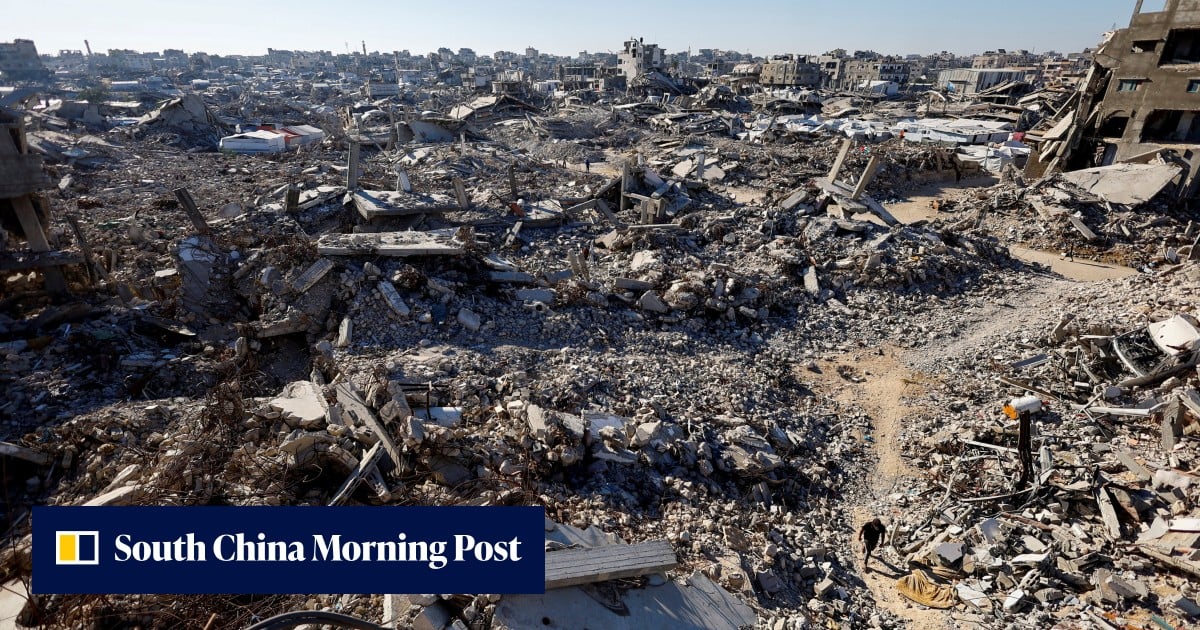
An Associated Press analysis of Planet Labs satellite imagery says Israel's military has razed Rafah and other areas and kept demolishing buildings since the ceasefire a year ago. Israel says the demolitions stop Hamas using the buildings and destroy its tunnels.
1 / 1
The story, neutrally told
Centre · 1Satellite imagery shows the Israeli military has systematically razed the southern Gaza city of Rafah, once home to a quarter million people, along with other towns and districts, according to the Associated Press. South China Morning PostN “Satellite imagery shows the Israeli military has systematically razed the southern city and other towns and districts to the ground” Read at South China Morning Post ↗ Centre · 2Demolition with bulldozers and explosives has continued since the Israel-Hamas ceasefire deal reached a year ago, as Israel holds about 60 per cent of the territory. South China Morning PostN “Demolition, using bulldozers and explosives, has continued unabated since the Israel-Hamas ceasefire deal reached a year ago” Read at South China Morning Post ↗ Hindustan TimesN “demolitions using bulldozers and explosives have continued since the Israel-Hamas ceasefire agreement reached a year ago” Read at Hindustan Times ↗ Centre · 1Planet Labs imagery shows the vast majority of buildings in the Israeli-held part have been reduced to rubble, much of it after major fighting ended, and at least 50 Israeli military outposts, at least 18 built since the ceasefire began. South China Morning PostN “The Planet Labs imagery shows at least 50 Israeli military outposts built throughout the Israeli-held part of Gaza, at least 18 of them constructed since the ceasefire began.” Read at South China Morning Post ↗
Centre · 2Most of Rafah was razed before the ceasefire, but troops continue to demolish the few remaining buildings; several abandoned UN buildings were spared, and a municipal sports field appears to contain a military base. South China Morning PostN “Most of Rafah was razed before the ceasefire, but images show that troops continue to demolish the few remaining buildings.” Read at South China Morning Post ↗ Hindustan TimesN “The sports field is reportedly now being used as a military base.” Read at Hindustan Times ↗ Centre · 1Elsewhere, Beni Suhaila was levelled over the past year, most of the al-Awda Hospital Complex in Jabaliya was reduced to rubble in recent months, and most of Beit Hanoun and Shijaiya are now levelled. South China Morning PostN “Levelled over the past year, the town is now a wasteland”“most of the al-Awda Hospital Complex was reduced to rubble in recent months” Read at South China Morning Post ↗ Centre · 2The Israeli military says it demolishes buildings to prevent Hamas using them and to destroy its tunnel networks. South China Morning PostN “The Israeli military says it demolishes buildings to prevent their use by Hamas militants or to destroy the group's tunnel networks.” Read at South China Morning Post ↗ Hindustan TimesN “The Israeli military says the demolitions are intended to prevent Hamas from using buildings and to destroy its tunnel networks.” Read at Hindustan Times ↗
Centre · 2A UN-appointed expert said in a February report that the destruction of civilian housing and infrastructure was "unprecedented even by the terrible standards of modern warfare since the 20th century" and could constitute a crime against humanity or reach the level of genocide; Israel rejects genocide accusations, saying it targets Hamas and its infrastructure embedded in civilian areas. South China Morning PostN “Israel rejects accusations of genocide, saying it targets Hamas militants and their infrastructure that are interwoven with civilian areas.” Read at South China Morning Post ↗ Hindustan TimesN “Israel and Prime Minister Benjamin Netanyahu's government reject the genocide allegations” Read at Hindustan Times ↗ Centre · 1Hindustan Times adds that a UN commission concluded in September 2025 that Israel had committed genocide, and that Amnesty International, Human Rights Watch and the International Association of Genocide Scholars reached similar conclusions. Hindustan TimesN “In September 2025, a United Nations commission concluded that Israel had committed genocide in Gaza.” Read at Hindustan Times ↗ Centre · 2The ceasefire stopped the largest offensives, but Israel still strikes almost daily, saying it targets Hamas members; Al Jazeera, cited by Hindustan Times, counts 1,462 Palestinians killed since the ceasefire. South China Morning PostN “Israel hits tents, cars and buildings almost daily in strikes that it says target Hamas members” Read at South China Morning Post ↗ Hindustan TimesN “According to Al Jazeera, 1,462 Palestinians have been killed since the ceasefire.” Read at Hindustan Times ↗
Centre · 2Gaza's roughly 2 million people are squeezed into about 40 per cent of the territory, mostly in tents; more than one in 10 of the pre-war population has been killed or wounded. South China Morning PostN “Gaza's population is squeezed into about 40 per cent of the tiny territory” Read at South China Morning Post ↗ Hindustan TimesN “More than one in 10 people from Gaza's pre-war population has reportedly been killed or wounded” Read at Hindustan Times ↗ Centre · 1Few can rebuild because Israel bars most construction material, and the ceasefire's large-scale reconstruction plan has not started because Israel and Hamas have not agreed on Hamas disarming; aid has eased the famine of last year, but most people still depend on relief. South China Morning PostN “The ceasefire agreement's plan for the large-scale reconstruction of Gaza has never got off the ground”“most of the population remains dependent on international relief” Read at South China Morning Post ↗
Every sentence links to the reporting it rests on. The pill in front of each says where its sources sit: Left, Centre or Right when one side supplies at least half of them, Mixed when they are evenly split. The number is how many outlets it cites.
Left0 outlets
No left outlet in our sources has covered this story yet.
Centre2 outlets
- Framing
- Both outlets lead on satellite imagery of Rafah's destruction; SCMP carries AP's full analysis, while Hindustan Times rewrites it with added context on the 'All Eyes on Rafah' campaign and genocide findings.
- Emphasis
- Scale of razing, post-ceasefire demolitions, displacement and Israel's stated reasons; Hindustan Times adds casualty figures and human rights bodies' genocide conclusions.
- Leaves out or plays down
- Hindustan Times omits AP's detail on outposts and specific towns; the AP copy gives no post-ceasefire death toll and no Israeli response on the specific imagery beyond its general rationale.
- Charged language
- “erased”“wounds on top of wounds”“Rafah in ruins”
- For example
-
“the city of Rafah, once home to a quarter million people, has been erased.” — South China Morning Post
“From 'All Eyes on Rafah' to Rafah in ruins” — Hindustan Times
Right0 outlets
No right outlet in our sources has covered this story yet.
What every side reports
- Satellite imagery shows continued demolition in Rafah and other parts of Israeli-held Gaza since the ceasefire a year ago.
- Israel controls about 60% of Gaza; the population is concentrated in about 40%.
- Israel says demolitions target Hamas use of buildings and tunnels, and rejects genocide accusations.
Where accounts differ
-
Whether Israel's actions amount to genocide
- Centre
- SCMP (AP) cites a UN-appointed expert's warning it could be a crime against humanity or genocide; Hindustan Times states a UN commission, Amnesty, HRW and IAGS concluded genocide. Both report Israel rejects this.
Left0 articles
No coverage yet.
Centre2 articles
-
South China Morning PostN · · via AP
Israel continues demolishing buildings in Gaza a year after ceasefire
Critical AP copy run by SCMP presents imagery-based evidence of systematic razing alongside Israel's stated security rationale.
-
Once a home, now in rubble: Satellite images show Gaza city destroyed by Israel-Hamas war
Sympathetic Hindustan Times recasts the AP findings around Rafah's symbolic status and adds genocide findings by UN and rights groups.
Right0 articles
No coverage yet.
- 7 Oct 09:11 First South China Morning PostN Israel continues demolishing buildings in Gaza a year after ceasefire via AP
- 7 Oct 09:55 +44m Hindustan TimesN Once a home, now in rubble: Satellite images show Gaza city destroyed by Israel-Hamas war
Times are when each article was published, or when we first saw it if the outlet gave no time.