Italy's lower house passes confidence votes on Meloni's electoral reform ahead of final ballot
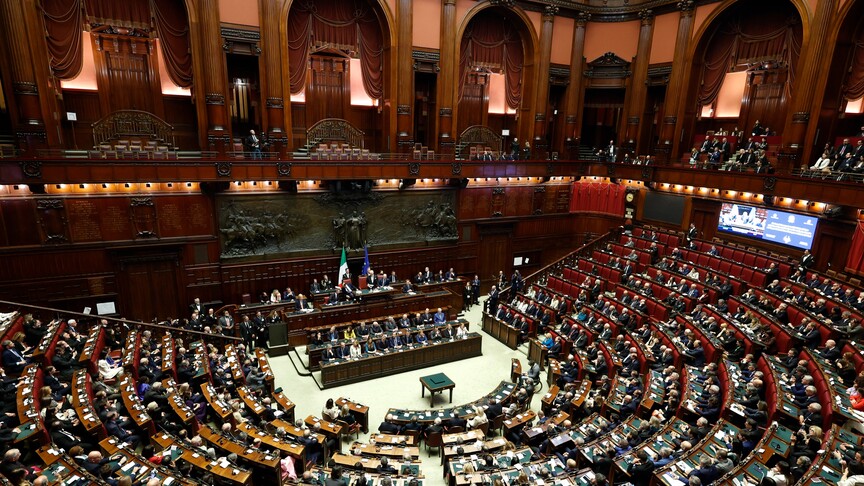
Italy's Chamber of Deputies approved confidence votes on the first articles of Prime Minister Giorgia Meloni's contested electoral reform on 6 and 7 October. A final secret ballot is expected on Thursday.

1 / 2
The story, neutrally told
Mixed · 2On Tuesday 6 October, Italy's lower house approved the first articles of an electoral reform backed by Prime Minister Giorgia Meloni in two confidence votes. The Straits TimesRC “Parliament approved the first articles of the bill in two confidence votes in the lower house.” Read at The Straits Times ↗ Anadolu AgencyN “The lower house approved confidence motions Tuesday on Articles 1 and 2, covering the electoral systems for the Chamber of Deputies and Senate.” Read at Anadolu Agency ↗ Right · 1Reuters reported that the second of those votes passed with 227 in favour, 149 against and three abstentions, and that the first passed by a similarly comfortable margin. The Straits TimesRC “The second vote was passed with 227 votes in favour, 149 against and three abstentions.” Read at The Straits Times ↗ Centre · 1On Wednesday 7 October, the Chamber approved a third and final confidence vote, on Article 3, by 228 to 144 with three abstentions, according to public broadcaster Rai as cited by Anadolu. That article redraws constituencies in South Tyrol, including Merano, Bressanone and Bolzano. Anadolu AgencyN “Lawmakers backed the confidence motion on Article 3 by a 228-144 vote, with three abstentions.” Read at Anadolu Agency ↗
Centre · 1Article 8, which extends voting away from one's place of residence to family caregivers, passed 214-0 with opposition parties abstaining; the government attached no confidence motion to it. Anadolu AgencyN “Lawmakers also approved Article 8 on Wednesday in a 214-0 vote, while opposition parties abstained.” Read at Anadolu Agency ↗ Mixed · 2Final approval is expected on Thursday 8 October in a secret ballot. The bill has already passed the Senate and returned to the lower house after amendments. The Straits TimesRC “Final approval of the package is expected on Thursday in a secret ballot.” Read at The Straits Times ↗ Anadolu AgencyN “The reform, which has passed the Senate and returned to the lower house following amendments, has drawn strong criticism from opposition parties.” Read at Anadolu Agency ↗ Mixed · 2Reuters says the bill introduces a fully proportional system with a seat bonus guaranteeing a parliamentary majority to any alliance winning more than 42% of the vote. It reports that Meloni could resign if the bill is rejected. Anadolu adds that it combines voter preferences with fixed lead candidates on party lists. The Straits TimesRC “It introduces a fully proportional electoral system, with a seat bonus guaranteeing a parliamentary majority to any alliance winning more than 42% of the vote.”“Meloni could resign if the bill is rejected.” Read at The Straits Times ↗ Anadolu AgencyN “Its provisions include voter preferences alongside fixed lead candidates on party lists, as well as changes to electoral rules.” Read at Anadolu Agency ↗
Centre · 1Opposition parties have strongly criticised the reform. Women's associations in Modena have asked President Sergio Mattarella to return it to parliament if he sees constitutional problems, arguing its candidate selection rules undermine equal access to elected office. A network opposing the reform says it is preparing legal challenges, seeking referral to the Constitutional Court once the law takes effect. Anadolu AgencyN “Women’s associations in Modena have appealed to President Sergio Mattarella to return the legislation to parliament if he identifies constitutional concerns”“A network opposing the reform also said it was preparing legal challenges to file once the law takes effect, seeking a referral to the Constitutional Court.” Read at Anadolu Agency ↗ Mixed · 2An election is due by the end of next year. Reuters notes speculation about a vote in May 2027 alongside local elections in major cities, and Anadolu reports that Deputy Prime Minister and Forza Italia leader Antonio Tajani said his party favours completing the parliamentary term. The Straits TimesRC “Latest speculation points to a possible vote in May 2027 to coincide with local elections in major cities.” Read at The Straits Times ↗ Anadolu AgencyN “Deputy Prime Minister and Forza Italia leader Antonio Tajani said Tuesday that his party favored completing the parliamentary term.” Read at Anadolu Agency ↗
Every sentence links to the reporting it rests on. The pill in front of each says where its sources sit: Left, Centre or Right when one side supplies at least half of them, Mixed when they are evenly split. The number is how many outlets it cites.
Left0 outlets
No left outlet in our sources has covered this story yet.
Centre1 outlet
- Framing
- Procedural, vote-by-vote account of the confidence motions and individual articles, with attention to legal and civil-society objections.
- Emphasis
- Article-level votes, the South Tyrol constituencies, the caregiver provision, Modena women's associations' appeal to Mattarella and planned Constitutional Court challenges.
- Leaves out or plays down
- Does not mention the 42% seat bonus or that Meloni could resign if the bill fails.
- For example
-
“The reform, which has passed the Senate and returned to the lower house following amendments, has drawn strong criticism from opposition parties.” — Anadolu Agency
Right1 outlet
- Framing
- Reuters wire copy carried by the Straits Times; a short bullet summary stressing the political stakes for Meloni and the election timetable.
- Emphasis
- The 42% seat bonus, the possibility Meloni resigns if the bill fails, and speculation about a May 2027 election.
- Leaves out or plays down
- Does not cover opposition or legal objections, or the later Wednesday vote.
- Charged language
- “fiercely contested”
- For example
-
“approved part of a fiercely contested electoral reform championed by Prime Minister Giorgia Meloni” — The Straits Times
What every side reports
- The lower house approved confidence votes on the electoral reform's first articles.
- A final secret ballot is expected on Thursday.
- The reform has drawn strong opposition criticism.
Left0 articles
No coverage yet.
Centre1 article
-
Italian parliament's lower house clears confidence votes on electoral reform ahead of final ballot
Neutral Detailed procedural report on the votes, citing Rai, with the objections of opponents and civil society.
Right1 article
-
The Straits TimesRC · · via Reuters
Italy's electoral reform clears initial confidence vote hurdle
Neutral Reuters wire copy, carried by the Straits Times, summarising the votes and the stakes for Meloni in bullets.
- 6 Oct 16:49 First The Straits TimesRC Italy's electoral reform clears initial confidence vote hurdle via Reuters
- 7 Oct 15:46 +22h 57m Anadolu AgencyN Italian parliament's lower house clears confidence votes on electoral reform ahead of final ballot
Times are when each article was published, or when we first saw it if the outlet gave no time.