Japan's MMX spacecraft to launch to Mars's moon Phobos to bring back samples
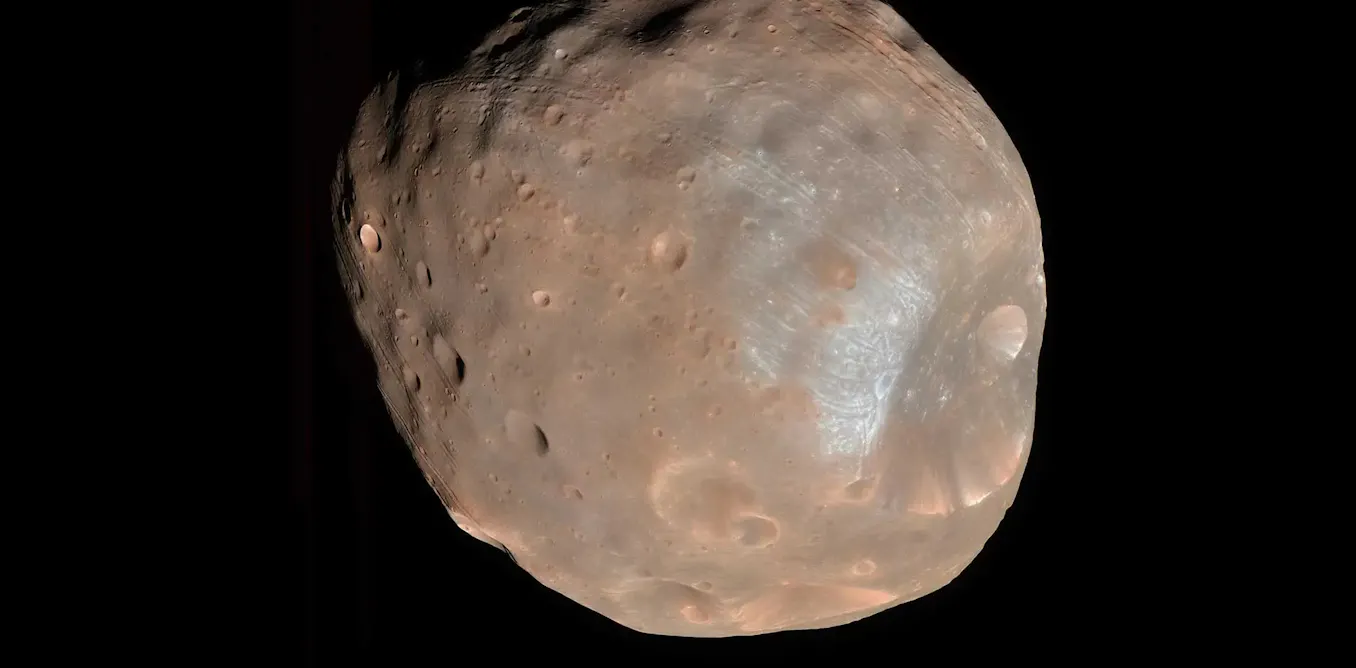
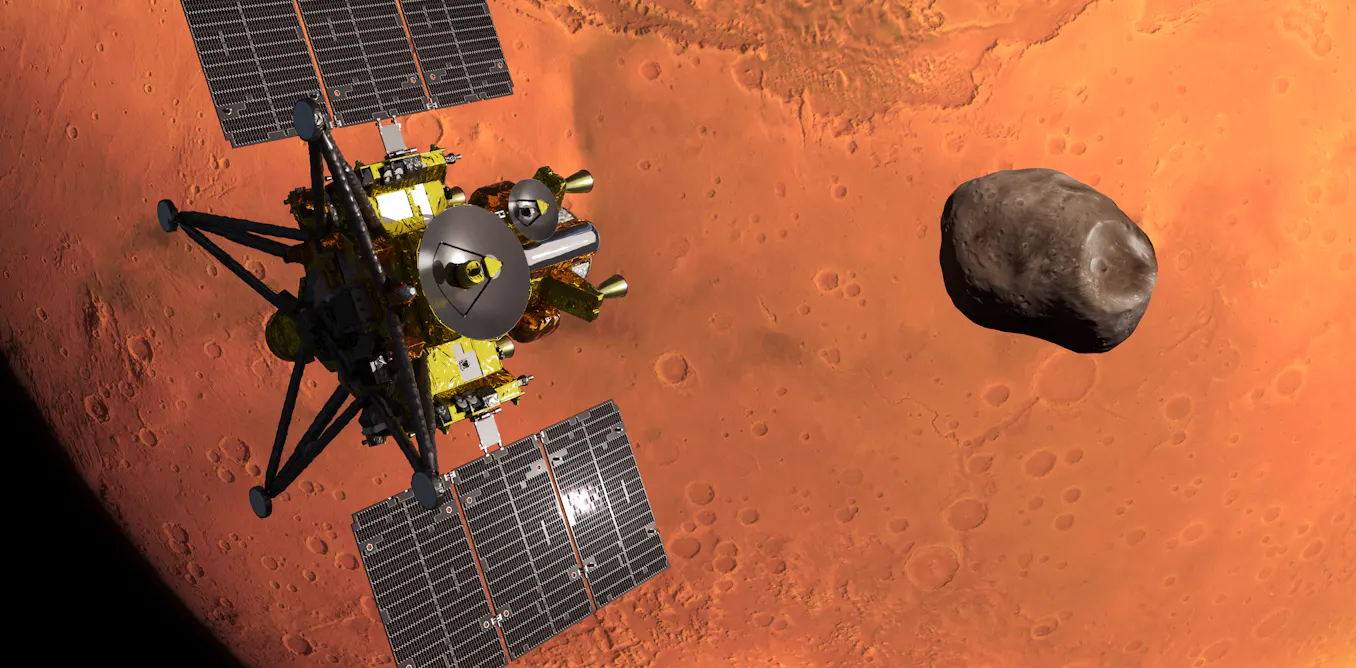
Japan's JAXA is due to launch the Martian Moons eXploration (MMX) spacecraft on 19–20 October to collect samples from Phobos and return them to Earth in 2031. The samples are meant to settle how Mars got its moons.

1 / 2
The story, neutrally told
Mixed · 2Japan's space agency JAXA is about to launch the Martian Moons eXploration (MMX) spacecraft towards Phobos, the larger of Mars's two moons, with the aim of bringing back a sample. New ScientistN “the Martian Moons eXploration (MMX) spacecraft launches towards the larger of the two moons, Phobos” Read at New Scientist ↗ The ConversationLC “A Japanese space mission is about to launch towards Mars.” Read at The Conversation ↗ Mixed · 2The launch is on an H3 rocket from the Tanegashima Space Center in southern Japan. The Conversation gives the time as Monday 19 October at 20:41 BST, while New Scientist gives 20 October (the two are consistent if the latter uses Japanese local time). The ConversationLC “The mission will lift off on Monday October 19 at 20:41 BST on an H3 rocket from the Tanegashima Space Center” Read at The Conversation ↗ New ScientistN “On 20 October, the Martian Moons eXploration (MMX) spacecraft launches” Read at New Scientist ↗ Mixed · 2MMX should reach Mars in August 2027 and enter an orbit alongside Phobos to map its surface, also observing Deimos along the way. One Conversation article instead says it arrives in 'late 2027'. New ScientistN “it should arrive at Mars in August 2027, entering an orbit that keeps it alongside Phobos” Read at New Scientist ↗ The ConversationLC “arriving in August 2027” Read at The Conversation ↗ The ConversationLC “It will arrive at the red planet in late 2027, and return to Earth in 2031.” Read at The Conversation ↗
Left · 1The mission is led by JAXA with the US, France, Germany and the European Space Agency. It carries a small rover called Idefix, developed by JAXA, the French space agency Cnes and the German Aerospace Center (DLR). The Conversation describes it as microwave-oven-sized, and another Conversation article says it weighs 25kg. The ConversationLC “MMX is led by the Japanese Aerospace Exploration Agency (Jaxa), in collaboration with the US, France, Germany and the European Space Agency (Esa).”“a small microwave oven-sized rover called Idefix, which has been developed jointly by Jaxa, the French space agency Cnes and the German Aerospace Center (DLR)” Read at The Conversation ↗ The ConversationLC “MMX will also deploy a 25kg rover called Idefix on Phobos’ surface.” Read at The Conversation ↗ Mixed · 2According to The Conversation, the rover is due to be dropped in early 2029 and operate for about 100 days, and the main module lands in 2030 for about 2.5 hours. New Scientist says the spacecraft will make one or two brief landings, and that the rover is the first placed on so small a body, so part of its purpose is to test whether a wheeled rover works in such low gravity. The ConversationLC “In early 2029, the MMX exploration module will deploy a small microwave oven-sized rover called Idefix”“In 2030, the module will swoop down and land on Phobos, remaining on its surface for about 2.5 hours.” Read at The Conversation ↗ New ScientistN “it will take on two tasks: to drop off a small rover called IDEFIX and to pick up samples” Read at New Scientist ↗ Mixed · 2Two sampling devices are carried. One blasts gas at the surface to blow dust and pebbles into a container. The other drives a hollow cylinder into the ground to take a core. The Conversation calls the coring device the C-sampler, says it takes a core up to 2cm deep, and calls the gas device the P-sampler, a back-up with a small risk of toppling the spacecraft; New Scientist says the core is several centimetres deep. New ScientistN “one that shoots a puff of gas onto the surface, blowing dust and pebbles back up into a sampling container, and another that blasts a hollow cylinder into the ground” Read at New Scientist ↗ The ConversationLC “The P-sampler is a back-up option, but carries some small risk of toppling the spacecraft in low gravitational fields like the one on Phobos.” Read at The Conversation ↗
Mixed · 2The spacecraft aims to gather at least 10 grams, which would be the first sample return from a Martian moon, and bring it back to Earth in 2031. The Conversation says the capsule will land by parachute in Australia and be taken to Japan. The ConversationLC “Having gathered at least 10 grams of material, the spacecraft will leave the Martian moon”“It will land using parachutes in Australia, where it will be recovered and transported to Japan.” Read at The Conversation ↗ New ScientistN “It is expected to arrive home in 2031.” Read at New Scientist ↗ Mixed · 2The science goal is to settle how Phobos and Deimos formed, a question researchers have debated for more than a century. One hypothesis is that they are captured asteroids. The other is that they formed from debris thrown out when an object hit Mars, as Earth's Moon is thought to have formed. New ScientistN “researchers have debated whether the two are captured asteroids or formed from an impact on Mars” Read at New Scientist ↗ The ConversationLC “Two main hypotheses dominate discussions of how Mars got these moons.” Read at The Conversation ↗ Mixed · 2The moons' shapes and surfaces resemble asteroids, but their near-circular orbits around Mars's equator fit the impact idea better. The captured-asteroid idea also needs an extremely dense early Martian atmosphere to trap them. A composition resembling known asteroid meteorites would favour capture, while a lot of Martian material would favour a giant impact. New ScientistN “their circular orbits around Mars’s equator are more consistent with the impact hypothesis” Read at New Scientist ↗ The ConversationLC “If the composition of Phobos is similar to that of meteorites from known categories of asteroid, it would favour the asteroid capture theory.” Read at The Conversation ↗
Mixed · 2The samples might also contain material from Mars itself, thrown up by impacts and preserved on Phobos. The Conversation calls MMX a 'lite-version' of the Mars Sample Return programme, which it says was effectively cancelled by US Congress over budget pressures. New ScientistN “These samples could illuminate not just the history of Phobos and Deimos, but also of Mars.” Read at New Scientist ↗ The ConversationLC “budgetary pressures led to the programme being effectively cancelled by US Congress” Read at The Conversation ↗ Mixed · 2The Conversation notes that Russia's 2011 Phobos-Grunt mission failed to leave Earth orbit, while JAXA has already returned asteroid samples with Hayabusa and Hayabusa 2. NASA's Tom Statler, whose team collaborates on MMX, said the answer would help illuminate the early era when the inner planets may have acquired much of their water and organic compounds. The ConversationLC “Russia tried this in 2011 with its Phobos Grunt mission.”“The space agency has already proved that it can return samples from asteroids with its Hayabusa space missions” Read at The Conversation ↗ New ScientistN “Having the answer will help illuminate that early era when Earth and the other inner planets may have been acquiring much of their water and organic compounds” Read at New Scientist ↗
Every sentence links to the reporting it rests on. The pill in front of each says where its sources sit: Left, Centre or Right when one side supplies at least half of them, Mixed when they are evenly split. The number is how many outlets it cites.
Left1 outlet
- Framing
- Two explainers by university academics in The Conversation cover the science and engineering of MMX and the competing theories of how Mars got its moons.
- Emphasis
- Technical detail: instruments, sampler design, mission schedule, and the physical properties of the moons.
- Leaves out or plays down
- Does not give a single consistent arrival date or instrument count across its two articles.
- Charged language
- “swipe soil samples”“hapless asteroids”
- For example
-
“MMX could therefore be considered a lite-version of the Mars Sample Return (MSR) mission.” — The Conversation
“Now, with the launch of this landmark space mission, scientists could be on the verge of a breakthrough.” — The Conversation
Centre1 outlet
- Framing
- New Scientist presents a shorter news preview, framing the launch as a step towards solving a century-old mystery.
- Emphasis
- The payoff of the samples for the moons' origin and for early solar system history, including a possible bonus of Martian material.
- Leaves out or plays down
- Gives less detail on instruments, partners and the 2029–2030 landing schedule.
- Charged language
- “verge of solving the mystery”“vexing scientists”
- For example
-
“We may be on the verge of solving the mystery of the Martian moons.” — New Scientist
“The samples, though, are the most important part of the mission.” — New Scientist
Right0 outlets
No right outlet in our sources has covered this story yet.
What every side reports
- MMX is a JAXA-led mission launching from Tanegashima Space Center towards Phobos.
- It aims to bring back Phobos samples to Earth in 2031.
- It is meant to resolve whether Phobos and Deimos are captured asteroids or formed from a Mars impact.
- It carries a small rover called Idefix and two sampling methods.
Where accounts differ
-
Mars arrival date
- Left
- One Conversation article says August 2027, another says late 2027.
- Centre
- New Scientist says August 2027.
-
Launch date
- Left
- Monday 19 October at 20:41 BST.
- Centre
- 20 October, without a time zone.
-
Number of science instruments
- Left
- One article says 13 instruments, another says 11.
- Centre
- Not stated.
JAXA organisation
JAXA leads the mission, picks the landing site from the orbital map, and aims to return Phobos samples in 2031, building on its Hayabusa asteroid sample returns.
“the spacecraft’s operators at the Japan Aerospace Exploration Agency (JAXA) will use it to pick out a spot on Phobos for MMX to land” — New Scientist
“Jaxa is well placed to succeed.” — The Conversation
Phobos other
Phobos is the larger and closer-orbiting of Mars's two moons, with a mean diameter of 22.2km and very low gravity, and is the target for sampling.
“Of the two Martian moons, Phobos is the largest and orbits closer to the planet. It has a mean diameter of 22.2km” — The Conversation
“The moon has about 0.1% the gravitational pull that Earth does.” — The Conversation
Left2 articles
-
How did Mars get its moons? Japan’s MMX space mission aims to solve the puzzle
Neutral Explainer on the competing theories of how Mars got its moons, presenting MMX as the likely route to an answer.
-
Japan’s MMX mission aims to swipe soil samples from Mars’ moon Phobos
Neutral Detailed mission walkthrough from launch to sample return, with historical context on failed and successful sample missions.
Centre1 article
-
Japan is launching a mission to Mars’s largest moon Phobos
Neutral Concise launch preview presenting the samples as likely to settle a long-running mystery.
Right0 articles
No coverage yet.
- 15 Oct 15:21 First The ConversationLC How did Mars get its moons? Japan’s MMX space mission aims to solve the puzzle
- 16 Oct 10:18 +18h 58m The ConversationLC Japan’s MMX mission aims to swipe soil samples from Mars’ moon Phobos
- 16 Oct 18:00 +26h 39m New ScientistN Japan is launching a mission to Mars’s largest moon Phobos
Times are when each article was published, or when we first saw it if the outlet gave no time.
Ask about this story
Loading…