Ladybird, a from-scratch browser engine, releases its first alpha for macOS and Linux
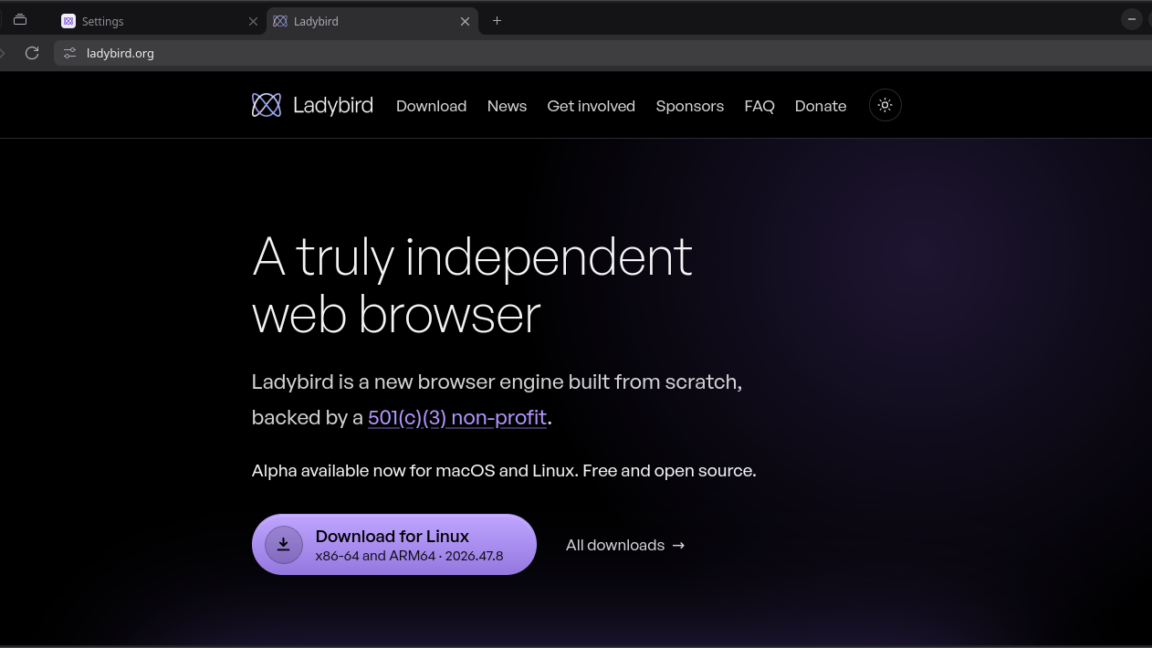
The Ladybird project released its first downloadable alpha on 23 November, for macOS and Linux, after more than four years of development. Its developers call it modest but functional and make no security promises; a Windows version is planned for later.

1 / 2
The story, neutrally told
Left · 2On Monday 23 November, Ladybird developer Andreas Kling announced that the independent web browser is launching in alpha on macOS and Linux, following more than four years of development. The VergeLC “On Monday, Ladybird developer Andreas Kling announced that the browser is launching in alpha on macOS and Linux following more than four years of development.” Read at The Verge ↗ Ars TechnicaLC “the Ladybird project released its first downloadable alpha on November 23, offering prebuilt versions for macOS and Linux” Read at Ars Technica ↗ Left · 1Until now, users had to compile Ladybird from source; the alpha is an installable package with automatic updating, delivered as a rolling release channel. Ars TechnicaLC “Previously, curious users had to compile the browser themselves from its source. Now it’s an installable package with automatic updating.” Read at Ars Technica ↗ Left · 2Both outlets stress that its engine is new: most popular browsers use just three engines (Gecko, Blink and WebKit), whereas Ladybird's rendering engine and its LibJS JavaScript engine were written from scratch. Kling wrote that the engine is "our own, built from the ground up, and not a fork". The VergeLC “the most popular browsers use just three today: Gecko, Blink, and WebKit.” Read at The Verge ↗ Ars TechnicaLC ““The engine is our own, built from the ground up, and not a fork,” project lead Andreas Kling wrote in Monday’s announcement.” Read at Ars Technica ↗
Left · 2Kling described the browser around the engine as "modest, but functional" and warned that some websites won't work. He also said the project makes "no promises about security today" and wants security researchers to try to hack it. The VergeLC ““is modest but functional,” adding that “some websites won’t work” during the alpha.” Read at The Verge ↗ Ars TechnicaLC “so we make no promises about security today.” Read at Ars Technica ↗ Left · 2The project is backed by a nonprofit, the Ladybird Browser Initiative, a 501(c)(3) funded by sponsorships and donations. Its website says there are no sponsored search-engine deals and that sponsors have no say in the roadmap. Ars TechnicaLC “Kling formed the Ladybird Browser Initiative, a 501(c)(3) nonprofit funded by sponsorships and donations.” Read at Ars Technica ↗ The VergeLC “Ladybird is backed by a nonprofit organization with the goal of creating “an independent, fast and secure browser that respects user privacy and fosters an open web,”” Read at The Verge ↗ Left · 2Ladybird began as part of Kling's SerenityOS project and was initially written in C++. It is now moving to Rust, starting with its JavaScript engine according to Ars Technica. The Verge adds that developers began porting the code to Rust using AI. Ars TechnicaLC “The Ladybird project was borne out of Kling’s SerenityOS project”“the project has since started shifting toward Rust, starting with its JavaScript engine.” Read at Ars Technica ↗ The VergeLC “its developers eventually began porting the code to Rust using AI.” Read at The Verge ↗
Left · 2A Windows version is planned for a "later stage" of the project. The VergeLC “A Windows version of Ladybird will arrive during a “later stage” of the project.” Read at The Verge ↗ Ars TechnicaLC “The project says that future support for Windows is planned” Read at Ars Technica ↗ Left · 1Ars Technica's reviewer tested alpha version 2026.47.8 on a mini PC running Fedora Linux 44 with KDE Plasma 6.8.3. They found it fast and stable, with Google Maps, GitHub and YouTube working, though it stalled when they skipped repeatedly through a 4K video streamed from a personal Jellyfin server with about 10 tabs open. Ars TechnicaLC “I tested the Ladybird alpha version 2026.47.8 on my AceMagic W1 mini PC”“after skipping around in the file over and over again, the browser eventually got stuck.” Read at Ars Technica ↗ Left · 1Ars Technica argues that Ladybird is unlikely to shift the market soon, but that an independent implementation can reveal where sites depend on Chromium-specific behaviour rather than published standards. The reviewer said it won't replace Firefox for them yet. Ars TechnicaLC “The fact that Ladybird exists isn’t likely to shift the market tides any time soon”“it won’t be replacing Firefox for me anytime soon” Read at Ars Technica ↗
Every sentence links to the reporting it rests on. The pill in front of each says where its sources sit: Left, Centre or Right when one side supplies at least half of them, Mixed when they are evenly split. The number is how many outlets it cites.
Left2 outlets
- Framing
- Both outlets present the alpha as a notable milestone: a genuinely independent engine in a market dominated by three. The Verge reports the announcement briefly. Ars Technica adds a hands-on review and an argument for engine diversity.
- Emphasis
- Engine independence and its history, the nonprofit funding model, Kling's caveats, and in Ars Technica's case performance on real sites.
- Leaves out or plays down
- The Verge gives no hands-on results or security warning. Neither outlet reports independent security assessments or compatibility data beyond one reviewer's test.
- Charged language
- “life beyond Chromium”“out in the cold”
- For example
-
“The release makes Ladybird the first browser in years to arrive with an entirely new engine.” — The Verge
“the most surprising thing about the alpha build was how little it feels like alpha software.” — Ars Technica
Centre0 outlets
No centre outlet in our sources has covered this story yet.
Right0 outlets
No right outlet in our sources has covered this story yet.
What every side reports
- The alpha was announced by Andreas Kling on Monday 23 November for macOS and Linux.
- Ladybird's engine was built from scratch after more than four years of development.
- Kling calls the browser modest but functional, and the alpha is not ready for general use.
- A Windows version is planned for later.
- The project is run by a nonprofit and is moving code from C++ to Rust.
Andreas Kling person
Kling presents the engine as independent and not a fork, the browser as modest but functional, and the alpha as early. He warns that some sites won't work, invites security researchers to hack it, and promises nothing on security.
“We want security nerds to hack it!” — Ars Technica
““some websites won’t work”” — The Verge
Ladybird (web browser) product
The project says it aims at an independent, fast and secure browser that respects privacy and fosters an open web. It has no sponsored search deals and gives sponsors no say over the roadmap.
““an independent, fast and secure browser that respects user privacy and fosters an open web,”” — The Verge
“sponsoring entities have no say in the project roadmap.” — Ars Technica
Left2 articles
-
Ladybird, the first new browser engine in years, is now available to test
Neutral Short news report on the alpha announcement, with engine history and Kling's caveats.
-
Ladybird's new alpha shows there's life beyond Chromium
Sympathetic Hands-on review that praises the alpha's performance and the value of engine diversity, while noting limits and security warnings.
Centre0 articles
No coverage yet.
Right0 articles
No coverage yet.
- 23 Nov 22:38 First The VergeLC Ladybird, the first new browser engine in years, is now available to test
- 25 Nov 17:33 +42h 55m Ars TechnicaLC Ladybird's new alpha shows there's life beyond Chromium
Times are when each article was published, or when we first saw it if the outlet gave no time.
Ask about this story
Loading…