Lumina simulation recreates the universe's first 2 billion years on the Frontier supercomputer
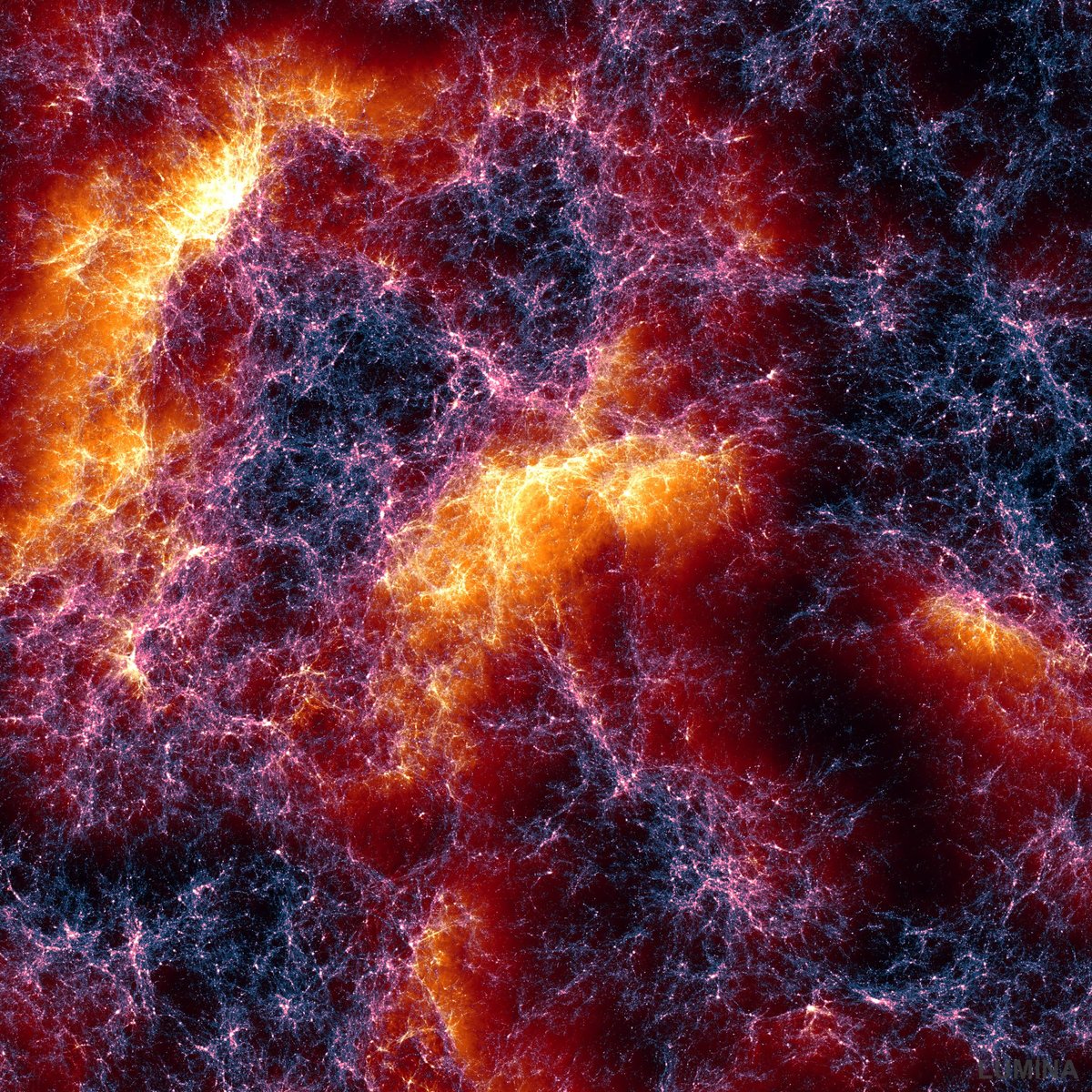
Researchers from Harvard-Smithsonian CfA, MIT and other institutions have built Lumina, a large simulation of the early universe from about 45 million to 2 billion years after the Big Bang. It models how early stars and galaxies drove reionization and can be compared with telescope data.
Updated (version 2). New coverage since the last version from Scientific American.

1 / 2
The story, neutrally told
Centre · 2An international team of researchers has built a simulation called Lumina that recreates the first 2 billion years of the universe, according to coverage of a study published in Monthly Notices of the Royal Astronomical Society. Hindustan TimesN “a team of international researchers has managed to successfully develop one of the most detailed models of the universe yet as per a recent study published in the scientific journal Monthly Notices of the Royal Astronomical Society” Read at Hindustan Times ↗ NewsweekN “allowing researchers to follow the emergence of stars and galaxies across the first 2 billion years of cosmic history” Read at Newsweek ↗ Centre · 1Newsweek says the team includes researchers from MIT and the Center for Astrophysics | Harvard & Smithsonian, and that the simulation starts roughly 45 million years after the Big Bang, in the cosmic "dark ages" before the first stars and galaxies. NewsweekN “Developed by researchers from institutions including the Massachusetts Institute of Technology (MIT) and the Center for Astrophysics | Harvard & Smithsonian, it begins roughly 45 million years after the Big Bang” Read at Newsweek ↗ Centre · 1Lumina follows dark matter, gas, stars and radiation, and contains around half a trillion computational elements, such as dark matter particles and gas cells. NewsweekN “The simulation contains around half a trillion computational elements, including dark matter particles and gas cells” Read at Newsweek ↗
Left · 1Scientific American's Phil Plait gives a more precise count: Lumina divides its volume into 432 billion individual sectors of space, resolving scales of around 1,400 light-years, and reaches back to just 50 million years or so after the Big Bang. He notes it does not include magnetism. Scientific AmericanLC “It does this by dividing that volume over a staggering 432 billion individual sectors of space”“(I’ll note it does not include the effects of magnetism, which are ridiculously complex and difficult to calculate.)” Read at Scientific American ↗ Centre · 2It covers a region of space roughly 1.5 billion light-years across in each direction (Hindustan Times, citing NASA) or about 1.6 billion light-years wide (Newsweek), and is described as covering about 100 times as much space as earlier simulations. Hindustan TimesN “As per NASA, the Lumina spans roughly 1.5 billion light-years across in each direction” Read at Hindustan Times ↗ NewsweekN “across a volume of space about 1.6 billion light-years wide”“According to MIT, it simulates a volume of the universe 100 times larger than past models.” Read at Newsweek ↗ Centre · 2The simulation was run on Frontier, a supercomputer at Oak Ridge National Laboratory in Tennessee; Hindustan Times says more than 15,000 of its graphics processing units were used for nearly three years. Hindustan TimesN “More than 15,000 graphics processing units of Frontier, a supercomputer at Oak Ridge National Laboratory in Tennessee, took nearly three years of computing power” Read at Hindustan Times ↗ NewsweekN “The simulation was run using the Frontier supercomputer at Oak Ridge National Laboratory in Tennessee.” Read at Newsweek ↗
Centre · 2Lumina models reionization, the process in which ultraviolet radiation from early stars and galaxies stripped electrons from hydrogen atoms, letting light travel farther. Newsweek reports its results indicate that hydrogen reionization was primarily driven by radiation from early stars and galaxies. Hindustan TimesN “ultraviolet radiation from these early light sources stripped electrons from hydrogen atoms” Read at Hindustan Times ↗ NewsweekN “with its results indicating that hydrogen reionization was primarily driven by radiation from early stars and galaxies” Read at Newsweek ↗ Centre · 1Hindustan Times adds that, for the first time, changes in both hydrogen and helium can be seen together in a single simulation, and that it can show how different regions evolved at different rates and how dark matter and ordinary matter moved. Hindustan TimesN “changes in both hydrogen and helium, the second most common element in space, can be seen simultaneously” Read at Hindustan Times ↗ Left · 1Scientific American reports that the results split the credit: stars ionized hydrogen and stripped one electron from helium atoms, while the higher energy output of supermassive black holes was needed to ionize helium completely. Plait writes that hydrogen reionization completed about 12.5 billion years ago, and that total helium reionization started around 12.8 billion years ago and finished about 1.2 billion years later. Scientific AmericanLC “Stars were responsible for the ionization of hydrogen and for removing one electron off helium atoms”“the reionization of hydrogen completed about 12.5 billion years ago” Read at Scientific American ↗
Left · 1Scientific American adds that the simulation's size lets rare, influential objects such as quasars form, so their effects are included. The initial results were published on October 26 in Monthly Notices of the Royal Astronomical Society. Scientific AmericanLC “relatively rare (but extremely influential) objects such as super-powerful, ionizing-radiation-spewing quasars can form as well”“The researchers published their initial results on October 26 in the Monthly Notices of the Royal Astronomical Society.” Read at Scientific American ↗ Centre · 1Lead author Oliver Zier of the Center for Astrophysics told CNN, as quoted by Hindustan Times, that the simulation shows both the cosmic web and individual galaxies. He said disagreement with telescope observations would be more interesting, because it would point to missing physics in the model. Hindustan TimesN ““We have a cosmological volume where you can see this cosmic web, how galaxies are clustered. At the same time, we resolve individual galaxies,””““But it’s actually more interesting if they don’t agree, because then that means that there’s something missing in our model, and that might give hints to missing physics,”” Read at Hindustan Times ↗ Centre · 1Julian Muñoz of the University of Texas at Austin, who was not involved in the study, called Lumina "a really impressive technical achievement" that is bigger and runs for longer cosmic time than past detailed simulations of this kind. Hindustan TimesN ““Lumina is a really impressive technical achievement,” Julian Muñoz, an assistant professor of astronomy at the University of Texas at Austin, told CNN.” Read at Hindustan Times ↗
Centre · 1Newsweek stresses that Lumina is a computer model applying known physics, not an observation of the past. Astronomers can compare it with data from telescopes such as the James Webb Space Telescope, and the MIT team plans to make it available to other scientists. NewsweekN “Rather than being an observation of the past, Lumina is a computer model that applies scientists' understanding of physics”“The MIT team plans to make Lumina available to other scientists to enable further comparisons with observations.” Read at Newsweek ↗ Centre · 1Study co-author Xuejian Shen of MIT said the simulation's size produces enormous populations of virtual galaxies that can be compared with large samples expected from upcoming surveys. Agreement would support current models, while differences would show where they need refinement. NewsweekN “Study co-author Xuejian Shen said the simulation's size creates enormous populations of virtual galaxies”“Differences could reveal where those models need refinement.” Read at Newsweek ↗ Centre · 1Hindustan Times notes Lumina has not yet been fully released to the public, though videos let viewers zoom in on individual galaxies. Zier cautioned that it is still only a very small part of the universe. Hindustan TimesN “Though the Lumina has not yet been released fully for the public”““Even though Lumina is very big, it’s still only a very small part of the universe,”” Read at Hindustan Times ↗
Every sentence links to the reporting it rests on. The pill in front of each says where its sources sit: Left, Centre or Right when one side supplies at least half of them, Mixed when they are evenly split. The number is how many outlets it cites.
Left1 outlet
- Framing
- Scientific American's Phil Plait writes an explanatory, first-person column that places Lumina in a brief history of the universe and calls it a record-breaking simulation.
- Emphasis
- Numbers on resolution and sector count, the split role of stars and black holes in hydrogen and helium reionization, and the limits of the model (no magnetism).
- Leaves out or plays down
- Does not name the Frontier supercomputer, the computing time, or outside expert comment in the text read.
- Charged language
- “breathtaking”“staggering”
- For example
-
“Lumina is the best-yet attempt to model the physics underpinning one of the most important events in cosmic history” — Scientific American
“And Lumina indicates the answer is both!” — Scientific American
Centre2 outlets
- Framing
- Both outlets present Lumina as a technical and scientific milestone. Hindustan Times leads on the scale of the feat and uses quotes from Zier and an outside expert. Newsweek leads on what the model is and how it will be tested against telescope data.
- Emphasis
- Hindustan Times stresses the computing effort (15,000 GPUs, nearly three years) and the hydrogen-and-helium first. Newsweek stresses that it is a model, the Webb context, and reionization being driven by stars and galaxies.
- Leaves out or plays down
- Newsweek omits the computing time and the helium point. Hindustan Times omits the half-trillion element count, the 45-million-year start and the finding on what drove reionization. Neither gives Scientific American's split between stars (hydrogen) and black holes (full helium ionization).
- For example
-
“Lumina is a really impressive technical achievement” — Hindustan Times
“Rather than being an observation of the past, Lumina is a computer model” — Newsweek
Right0 outlets
No right outlet in our sources has covered this story yet.
What every side reports
- Lumina is a simulation of the early universe covering its first 2 billion years.
- It was run on the Frontier supercomputer at Oak Ridge National Laboratory in Tennessee.
- It models reionization driven by early stars and galaxies.
- It can be compared with observations from telescopes such as the James Webb Space Telescope.
- Oliver Zier of the Center for Astrophysics is named as a lead researcher.
Where accounts differ
-
Width of the simulated region
- Centre
- Hindustan Times, citing NASA, says about 1.5 billion light-years in each direction; Newsweek says about 1.6 billion light-years wide.
-
Lumina simulates a region of space roughly 1.5 to 1.6 billion light-years across.
Reported- Reports 3
- Scientific American, Hindustan Times, Newsweek
-
Lumina's results indicate that early stars and galaxies drove hydrogen reionization, with black holes also contributing in the simulation.
Supported- Supports 2
- Scientific American, Newsweek
- Reports 1
- Hindustan Times
Lumina simulation other
Presented as a very large, detailed model that can be tested against telescope observations. Disagreement would reveal missing physics, and it is still a small part of the universe.
““Even though Lumina is very big, it’s still only a very small part of the universe,”” — Hindustan Times
“Agreement between observations and the simulation would support current models” — Newsweek
Reionization topic
Described as the process in which radiation from early stars and galaxies ionized hydrogen, making the universe transparent; Lumina's results point to stars and galaxies as the main drivers.
“Lumina reproduces this process, with its results indicating that hydrogen reionization was primarily driven by radiation from early stars and galaxies.” — Newsweek
South Asia1 outlet
Hindustan Times focuses on the scale of the achievement, relayed through CNN interviews.
“More than 15,000 graphics processing units of Frontier” — Hindustan Times
Hindustan Times
North America2 outlets
Newsweek explains the science and context, including Webb observations, and notes it used an AI assistant to produce the story.
“Astronomers can now compare Lumina's virtual universe with actual observations from telescopes” — Newsweek
Newsweek, Scientific American
Left1 article
-
Record-breaking simulation sheds light on cosmic ‘dark ages’
Celebratory Opinion-style explainer that praises Lumina as a record-breaking step in simulating the universe and stresses that stars and black holes both drove reionization.
Centre2 articles
-
New supercomputer simulation ‘Lumina’ provides glimpse into first 2 billion years of the universe
Celebratory Admiring explainer built on CNN quotes, emphasising the scale and novelty of the simulation.
-
Scientists Recreate 2 Billion Years of the Early Universe
Neutral Explanatory piece placing Lumina in the context of Webb observations and clarifying that it is a model, not an observation.
Right0 articles
No coverage yet.
- 12 Nov 08:51 First Hindustan TimesN New supercomputer simulation ‘Lumina’ provides glimpse into first 2 billion years of the universe
- 12 Nov 17:03 +8h 12m NewsweekN Scientists Recreate 2 Billion Years of the Early Universe
- 13 Nov 11:45 +26h 54m Scientific AmericanLC Record-breaking simulation sheds light on cosmic ‘dark ages’
Times are when each article was published, or when we first saw it if the outlet gave no time.
Ask about this story
Loading…