Ming Dynasty Buddha statue found in Shark Bay, WA, handed back to China
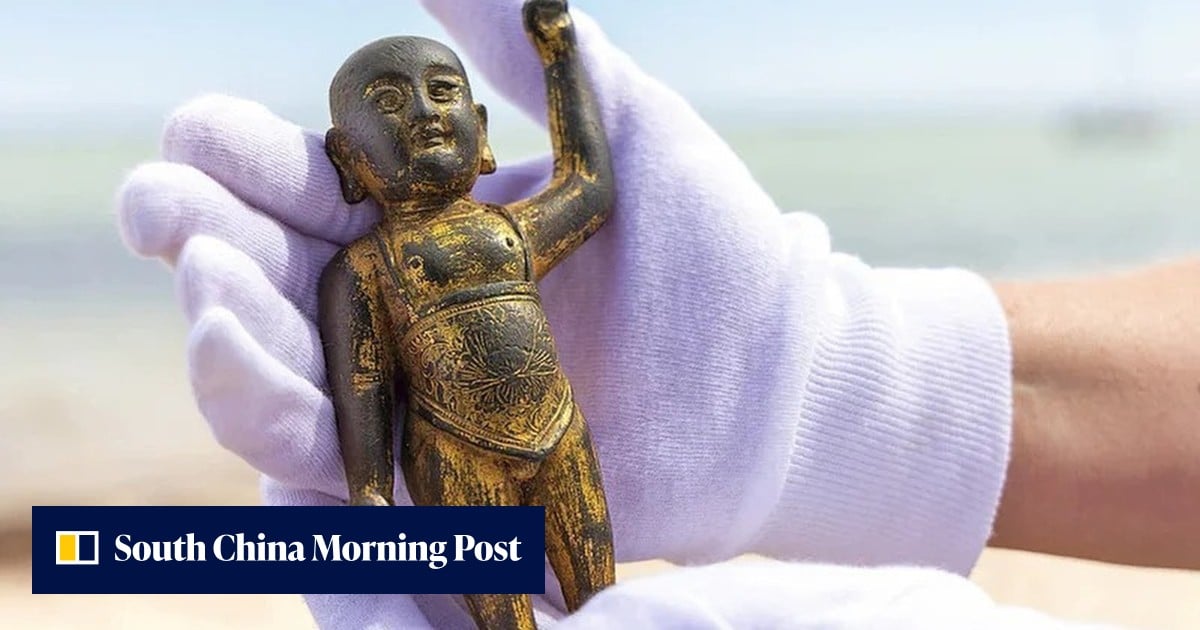
A 15cm bronze Ming Dynasty Buddha found by two prospectors in Western Australia in 2018 was handed to Chinese consular officials at Denham on Tuesday 13 October. How it got there remains unresolved.
1 / 2
The story, neutrally told
Mixed · 2A 15-centimetre bronze Buddha statue from the Ming Dynasty was formally handed to Chinese consular representatives at a ceremony on the Denham foreshore in Shark Bay, Western Australia, on Tuesday 13 October 2026. ABC News (Australia)LC “It was formally handed over to Chinese consular representatives in an emotional ceremony at the Denham foreshore this morning.” Read at ABC News (Australia) ↗ South China Morning PostN “The 15cm (six-inch) bronze figurine was formally handed over to Chinese consular representatives during a ceremony in the coastal town of Denham in Shark Bay on Tuesday” Read at South China Morning Post ↗ Mixed · 2Prospectors Leon Deschamps and Shayne Thomson found it in 2018 while testing metal-detecting equipment beside a roadside in the Shark Bay region, unearthing it from beneath 20cm of topsoil. ABC News (Australia)LC “Leon Deschamps and Shayne Thomson were testing prospecting equipment on a roadside in the Shark Bay region in 2018” Read at ABC News (Australia) ↗ South China Morning PostN “Discoverers Leon Deschamps and Shayne Thomson unearthed the statue in 2018 while testing metal detecting equipment in the area.” Read at South China Morning Post ↗ Mixed · 2The pair advocated for its return to China as a gesture of peace and goodwill, and honoured their late friend, Malgana man Nick Pedrocchi, to whom they had promised its safe passage home. ABC News (Australia)LC “They had promised him they would ensure the Buddha's safe passage home.” Read at ABC News (Australia) ↗ South China Morning PostN “Since then, they have said it should be returned to China as a gesture of goodwill.” Read at South China Morning Post ↗
Mixed · 2Asian art expert Lee Young verified the statue as dating to the Ming Dynasty (1368–1644). Such figures were used in ceremonies for Buddha's birthday, when water was poured over the shoulders. ABC News (Australia)LC “Asian art expert Lee Young verified the Buddha dated back to the Ming Dynasty” Read at ABC News (Australia) ↗ South China Morning PostN “Asian art specialist Lee Young authenticated the statue as a genuine piece from the Ming Dynasty (1368-1644)” Read at South China Morning Post ↗ Mixed · 2Simon Wu, president of the Australia China Friendship Society WA, called the return an extraordinarily generous gesture that showed respect and goodwill. ABC News (Australia)LC “Today is an example of how we can bring cultures, countries and people together through a small object.” Read at ABC News (Australia) ↗ South China Morning PostN “described the return as extraordinarily generous.” Read at South China Morning Post ↗ Mixed · 2The statue will go to China with red Shark Bay earth and a golden pearl shell. It will undergo further testing to establish its history before display in a Beijing museum. ABC News (Australia)LC “Further testing will be carried out to determine the statue's history before it is displayed in a Beijing museum.” Read at ABC News (Australia) ↗ South China Morning PostN “The ABC reported that the Buddha would be returned to China along with some of Shark Bay’s distinctive red earth and a golden pearl shell.” Read at South China Morning Post ↗
Left · 1How it reached Australia is unresolved. The finders explored with the TV program Shipwreck Hunters Australia a theory that it came from a Ming treasure ship, but said a link to the 19th-century pearling industry, which employed many Chinese workers, is more likely. ABC News (Australia)LC “The pair even worked with the Shipwreck Hunters Australia TV program to explore the theory that it came from a Ming treasure ship.”“They say it is more likely linked to the beginnings of WA's pearling industry” Read at ABC News (Australia) ↗ Centre · 1The South China Morning Post said there is no evidence that the seafarer Zheng He ever reached Australia, called the pearler theory more plausible, and cited Western Australian Museum records of an 1886 census showing 102 Chinese among more than 200 pearling workers. It described the statue as believed to be the oldest Chinese artefact found in Australia, and noted Australia's 2023 return of other cultural relics to China. South China Morning PostN “there is no evidence that he ever reached Australia.”“an 1886 census showed that more than 200 people were working in the local pearling industry, including 60 Europeans, 102 Chinese and 68 Malays.”“In 2023, Australia returned a batch of valuable cultural relics to China” Read at South China Morning Post ↗ Left · 1Deschamps and Thomson are calling for a monument in the region recognising Shark Bay as the birthplace of WA's pearling industry. ABC News (Australia)LC “Mr Deschamps and Mr Thomson are calling for a monument to be erected in the region to acknowledge Shark Bay as the birthplace of WA's pearling industry.” Read at ABC News (Australia) ↗
Every sentence links to the reporting it rests on. The pill in front of each says where its sources sit: Left, Centre or Right when one side supplies at least half of them, Mixed when they are evenly split. The number is how many outlets it cites.
Left1 outlet
- Framing
- Local, human-interest account of an emotional ceremony, centred on the finders and their late friend.
- Emphasis
- Finders' quotes, Malgana man Nick Pedrocchi, friendship and goodwill, calls for a pearling monument.
- Leaves out or plays down
- No wider diplomatic context such as the 2023 relic returns.
- Charged language
- “emotional ceremony”
- For example
-
“It was formally handed over to Chinese consular representatives in an emotional ceremony at the Denham foreshore this morning.” — ABC News (Australia)
Centre1 outlet
- Framing
- Frames the return as a diplomacy story with a lingering mystery over the statue's origin.
- Emphasis
- Historical evidence on origin, pearling census figures, scepticism of the Zheng He theory, prior 2023 returns.
- Leaves out or plays down
- Little on the finders' personal story or Nick Pedrocchi; no monument call.
- Charged language
- “ongoing mystery”
- For example
-
“but there is no evidence that he ever reached Australia.” — South China Morning Post
“A more plausible theory is that the statue arrived with Chinese pearlers and fishermen in the 19th century.” — South China Morning Post
Right0 outlets
No right outlet in our sources has covered this story yet.
What every side reports
- The 15cm bronze Buddha was handed to Chinese consular representatives at Denham, Shark Bay, on Tuesday.
- Leon Deschamps and Shayne Thomson found it in 2018.
- Lee Young verified it as Ming Dynasty.
- It will be further evaluated and then displayed in a Beijing museum.
- How it came to Australia is unsolved; the pearling-industry link is favoured.
Where accounts differ
-
Whether a Zheng He treasure-ship origin is credible
- Left
- ABC reports the finders explored the Ming treasure ship theory with a TV program, then favoured a pearling link.
- Centre
- SCMP says some media claimed it, but there is no evidence Zheng He reached Australia.
Oceania1 outlet
Local focus on the community ceremony and Shark Bay's pearling heritage.
“Shark Bay, for 100 years, was a pearling port.” — ABC News (Australia)
ABC News (Australia)
East and Southeast Asia1 outlet
Treats it as an Australia–China goodwill return, with historical analysis of origins.
“In 2023, Australia returned a batch of valuable cultural relics to China” — South China Morning Post
South China Morning Post
Left1 article
-
Ming Dynasty statue unearthed in WA back in Chinese hands
Sympathetic Warm local feature on the handover and the finders' motives.
Centre1 article
-
Australia hands Ming dynasty Buddha back to China amid ongoing mystery over its arrival
Neutral Concise report adding historical context and doubt over the treasure-ship theory.
Right0 articles
No coverage yet.
- 13 Oct 07:15 First ABC News (Australia)LC Ming Dynasty statue unearthed in WA back in Chinese hands
- 16 Oct 02:00 +66h 45m South China Morning PostN Australia hands Ming dynasty Buddha back to China amid ongoing mystery over its arrival
Times are when each article was published, or when we first saw it if the outlet gave no time.
Ask about this story
Loading…