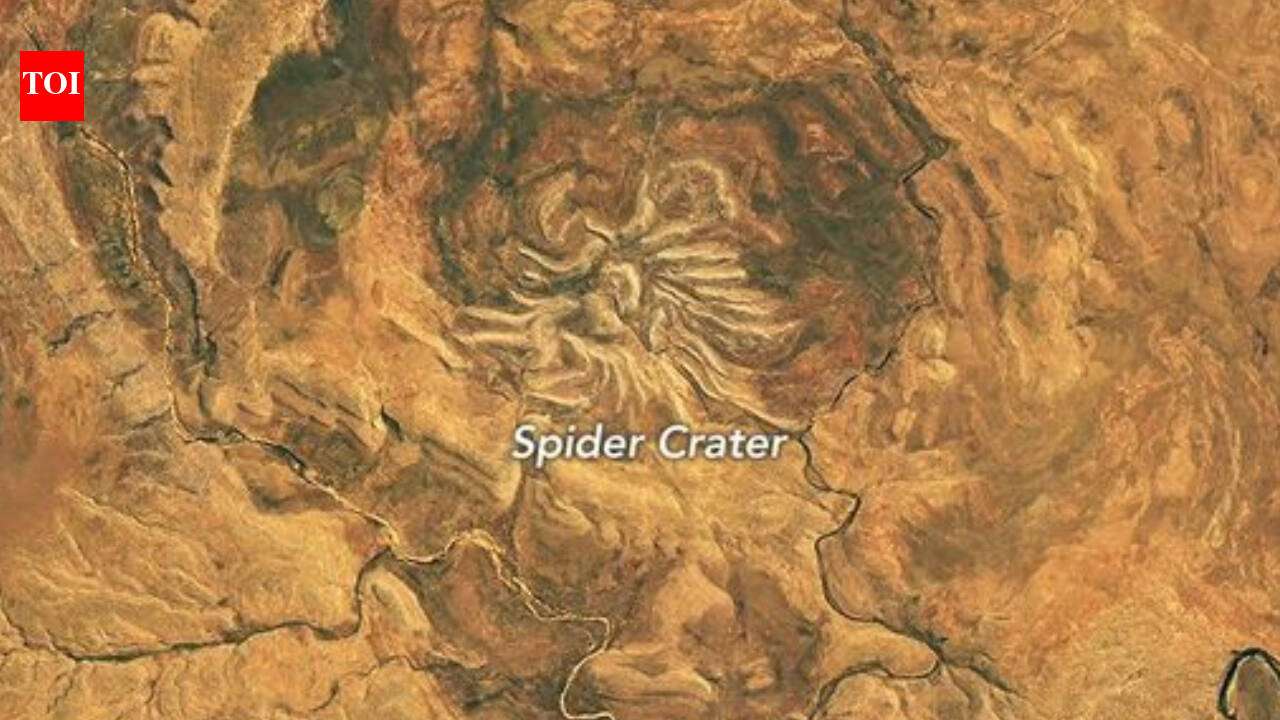
NASA Landsat 9 image shows Spider Crater impact structure in Western Australia
NASA released a Landsat 9 image of Spider Crater, an eroded meteorite impact structure in Western Australia's Kimberley region, whose central ridges resemble spider legs. Its age is uncertain, put at roughly 600 to 900 million years.

1 / 2
The story, neutrally told
Mixed · 2NASA has released a satellite image of Spider Crater, an eroded meteorite impact structure in the Kimberley region of Western Australia whose central ridges look like spider legs. Daily MailR “capturing what it called 'an impact structure with legs.'” Read at Daily Mail ↗ The Times of IndiaN “Spider Crater, hidden away in Western Australia’s Kimberley region” Read at The Times of India ↗ Centre · 1According to NASA, as relayed by the Times of India, the Operational Land Imager on the NASA-USGS Landsat 9 satellite acquired the image on 20 September 2026. The Times of IndiaN “the Operational Land Imager on the NASA-USGS Landsat 9 satellite acquired the image on September 20, 2026” Read at The Times of India ↗ Mixed · 2The oval structure measures about 13 km by 11 km (the Daily Mail gives eight by seven miles), and its spiderlike central portion is about 4 km (2.5 miles) across. The Times of IndiaN “measuring about 13 km by 11 km” Read at The Times of India ↗ Daily MailR “The oval-shaped impact structure is eight by seven miles, with a spiderlike central portion measuring 2.5 miles across.” Read at Daily Mail ↗
Centre · 1The legs are pale sandstone ridges, the more durable remnants of a central uplift, left standing as the surrounding rock layers weathered and eroded away. The Times of IndiaN “the pale sandstone ridges that make up the spiderlike pattern”“the surrounding rock layers weathered and eroded away” Read at The Times of India ↗ Mixed · 2The crater's origin was long debated, and some experts proposed a volcanic cause. The Times of IndiaN “competing ideas including the idea that volcanic eruptions created the formation” Read at The Times of India ↗ Daily MailR “Some experts suggested the strange formation had a volcanic origin.” Read at Daily Mail ↗ Mixed · 2The impact explanation rests on shatter cones, fan-shaped fractures that form under intense shock waves and are found across the central dome, and on laboratory analysis of shocked quartz and zircon crystals in the sandstone. The Times of IndiaN “Key among the clues were shatter cones, unique fan-shaped fractures” Read at The Times of India ↗ Daily MailR “Laboratory analysis of shocked quartz and zircon crystals in the sandstone” Read at Daily Mail ↗
Mixed · 2The Daily Mail adds that the crater was discovered in the 1950s, that impact evidence emerged in the 1970s, and that the zircon work could help reconstruct the angle of the meteorite's strike. The Times of India instead refers to 40 years of debate over its shape. Daily MailR “For years after its discovery in the 1950s, the crater baffled scientists”“until evidence emerged in the 1970s” Read at Daily Mail ↗ The Times of IndiaN “There has been 40 years of debate over its strange shape” Read at The Times of India ↗ Mixed · 2Both outlets say the exact age is unknown, with estimates between about 600 and 900 million years ago, in the late Precambrian according to the Times of India. The Times of IndiaN “an age between about 900 million and 600 million years ago” Read at The Times of India ↗ Daily MailR “Estimates place the collision between 600 million and 900 million years ago.” Read at Daily Mail ↗ Right · 1The Daily Mail also notes the site is remote and best seen from the air or from orbit, and describes sparse green vegetation against red rock, thickest along a stream crossing the crater. Daily MailR “its distinctive pattern best seen from the air or in satellite images”“Vegetation is especially thick along the banks of the thin stream” Read at Daily Mail ↗
Right · 1The Daily Mail closes by contrasting it with the North Pole Dome in the Pilbara region, which researchers in July dated to a 3.02-billion-year-old impact, making it the oldest known crater on Earth. Lead author Professor Chris Kirkland told the paper the impactor could have been 'kilometre–scale'. Daily MailR “Using advanced mineral dating techniques, they show that the crater was formed when a space rock smashed into Earth 3.02 billion years ago.”“this meteor could have been a 'kilometre–scale' object” Read at Daily Mail ↗
Every sentence links to the reporting it rests on. The pill in front of each says where its sources sit: Left, Centre or Right when one side supplies at least half of them, Mixed when they are evenly split. The number is how many outlets it cites.
Left0 outlets
No left outlet in our sources has covered this story yet.
Centre1 outlet
- Framing
- A science-explainer built on NASA's report, with a dramatic opening about a giant spider etched across the earth and a focus on the geology.
- Emphasis
- The image date, the central uplift, erosion of the sandstone ridges, the evidence for impact, and the late Precambrian age.
- Leaves out or plays down
- Does not give the discovery date or the North Pole Dome comparison, and does not mention the vegetation or the site's remoteness.
- Charged language
- “etched by the fury of the cosmos”“disquieting look”“one of the most violent encounters Earth has ever had with space”
- For example
-
“a giant spider etched across the earth” — The Times of India
“the beautifully preserved record of one of the most violent encounters Earth has ever had with space” — The Times of India
Right1 outlet
- Framing
- A curiosity-led piece on a 'mysterious' structure with 'legs', which then moves to another Australian crater and the paper's own interview.
- Emphasis
- The mystery of the structure, the discovery history, the remote terrain and vegetation, and the North Pole Dome comparison with a quote from Prof. Chris Kirkland.
- Leaves out or plays down
- Does not give the image date or Landsat 9's OLI instrument, and does not explain the central uplift.
- Charged language
- “mysterious structure”“otherworldly”
- For example
-
“NASA has released a new image of a mysterious structure hidden in a remote desert” — Daily Mail
“While the structure may look otherworldly” — Daily Mail
What every side reports
- NASA released a Landsat 9 image of Spider Crater in the Kimberley region of Western Australia.
- It is an oval meteorite impact structure with a spiderlike central pattern, shaped by erosion.
- Shatter cones and shocked quartz and zircon support an impact origin over a volcanic one.
- Its exact age is unknown, estimated at 600 to 900 million years.
Where accounts differ
-
How long the origin was debated
- Centre
- The Times of India cites 40 years of debate over the shape, including a volcanic theory.
- Right
- The Daily Mail says the crater baffled scientists after its 1950s discovery, until impact evidence emerged in the 1970s.
NASA organisation
NASA presents the Landsat 9 image as showing an impact structure with legs, and says the crater was shaped by a meteorite impact followed by hundreds of millions of years of erosion. It says the exact age remains unknown.
“NASA noted it is aptly named Spider Crater, a meteorite impact followed by hundreds of millions of years of erosion.” — Daily Mail
“The exact age of Spider Crater is unknown” — The Times of India
Spider Crater place
Spider Crater is described as an oval impact structure whose pale sandstone ridges form the spider pattern. Its age is uncertain, at 600 to 900 million years.
“a pattern of ridges about four kilometers wide radiating outwards like legs” — The Times of India
“Estimates place the collision between 600 million and 900 million years ago.” — Daily Mail
South Asia1 outlet
The Times of India writes a vivid explainer on the geology and its evidence.
“A recent satellite image has brought the amazing formation into sharp focus” — The Times of India
The Times of India
UK and Ireland1 outlet
The Daily Mail treats it as a curiosity and ties it to Australia's oldest crater.
“Australia is also home to the world's oldest impact crater.” — Daily Mail
Daily Mail
Left0 articles
No coverage yet.
Centre1 article
-
NASA satellite image reveals Australia's giant spider-shaped ancient crater
Celebratory Awed science explainer relaying NASA's report on how the spider shape formed and was identified as an impact structure.
Right1 article
-
Ancient impact crater 'with legs' spotted in Australian desert by NASA satellite
Mixed Light curiosity piece on a 'mysterious' structure that is mostly explained, padded with a separate item about the North Pole Dome.
- 14 Oct 12:25 First The Times of IndiaN NASA satellite image reveals Australia's giant spider-shaped ancient crater
- 14 Oct 18:51 +6h 27m Daily MailR Ancient impact crater 'with legs' spotted in Australian desert by NASA satellite
Times are when each article was published, or when we first saw it if the outlet gave no time.
Ask about this story
Loading…