New fossil crocodile Herugavialis cairensis identified from rock used for the Great Sphinx
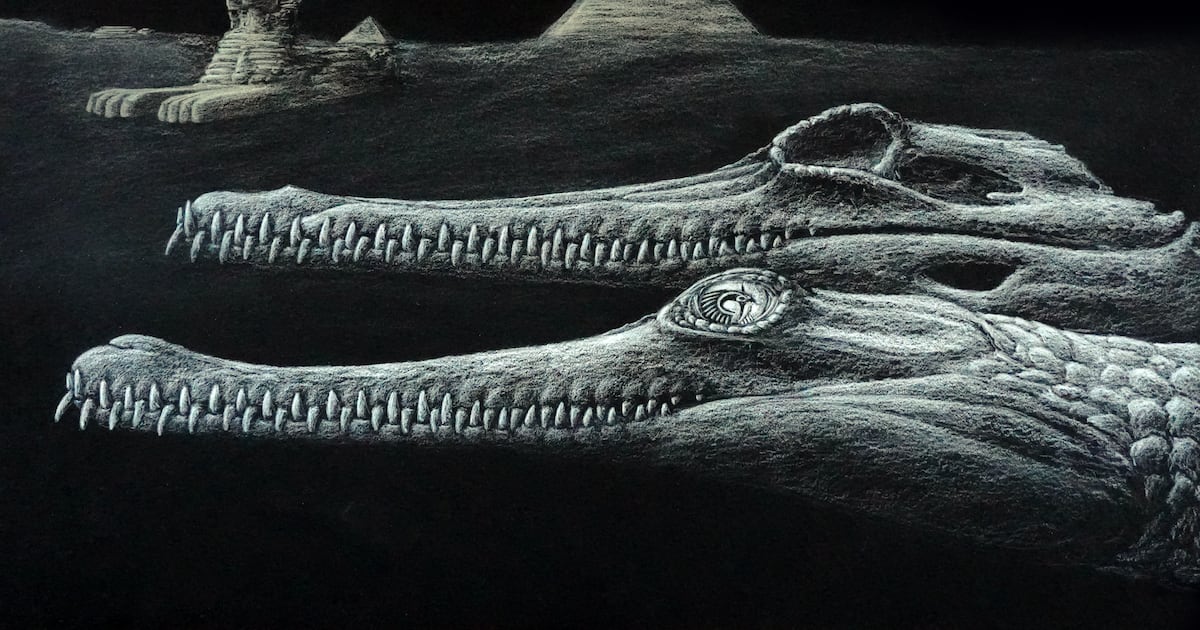
Researchers have named a new extinct gavial-type crocodile, Herugavialis cairensis, from a skull found in Egypt's Mokattam Formation limestone, the rock used to build the Great Sphinx. The skull was collected in the 1920s and was previously assigned to a living species.

1 / 2
The story, neutrally told
Mixed · 2A skull recovered a century ago from Egypt's Mokattam Formation has been identified as a new species of extinct crocodile, named Herugavialis cairensis. The NationalN “Fossils recovered a century ago in the rocks that make up the 45-million-year-old Mokattam Formation in Egypt have revealed a new species of crocodile.” Read at The National ↗ Daily MailR “This ancient predator has been dubbed Herugavialis cairensis” Read at Daily Mail ↗ Mixed · 2The limestone of the formation is the rock from which the Great Sphinx of Giza was built, and the skull is missing only the tip of its snout. The NationalN “contained the skull of a crocodile, missing only the tip of its snout” Read at The National ↗ Daily MailR “The fossil crocodile was found in the very same limestone rocks” Read at Daily Mail ↗ Mixed · 2The study was published in the journal Royal Society Open Science. Dr Paul Burke of the Swedish Museum of Natural History is lead author and Prof Philip Mannion of University College London is co-lead or co-author. The NationalN “who co-led the study published in the Royal Society Open Science journal” Read at The National ↗ Daily MailR “Lead author Dr Paul Burke, of the Swedish Museum of Natural History” Read at Daily Mail ↗
Mixed · 2The skull was first found in the 1920s and was thought to belong to the false gharial, Tomistoma schlegelii; CT scanning of the inside of the skull let an international team identify differences that led to its reclassification as a new species. The NationalN “A CT scan was used to look inside the skull, allowing an international team of researchers to identify several differences between the fossil and Tomistoma.” Read at The National ↗ Daily MailR “The fossilised skull of Herugavialis was actually discovered all the way back in the 1920s” Read at Daily Mail ↗ Mixed · 2Mannion said the name honours the Egyptian god Heru, who was possibly the inspiration for the Sphinx, and reflects the coincidence that both the Sphinx and the skull lack part of the nose or snout. The NationalN “we decided to name the new crocodile after the Egyptian god Heru, who was possibly the inspiration for this iconic monument” Read at The National ↗ Daily MailR “Given this coincidence with the famously missing nose of the Great Sphinx” Read at Daily Mail ↗ Mixed · 2Herugavialis belongs to the gavials, long-snouted crocodiles now found only in the Indian subcontinent and South-East Asia, though the fossil record shows them across nearly the whole globe for over 100 million years. The NationalN “They belong to a group of crocodiles known as gavials, which are today found only on the Indian subcontinent and in South-East Asia.” Read at The National ↗ Daily MailR “the fossil records show that these aquatic hunters once spanned nearly the entire globe for more than 100 million years” Read at Daily Mail ↗
Mixed · 2It shared shallow marine waters with at least two other gavial species. Burke said Mediterranean crocodile diversity fluctuated with global temperature and sea level before all crocodiles in the region were lost when the Mediterranean dried out about six million years ago. The NationalN “The shallow marine environments that covered much of the region were also home to at least two other species of gavials.” Read at The National ↗ Daily MailR “before the loss of all crocodiles in this region as a result of the drying of the Mediterranean approximately six million years ago” Read at Daily Mail ↗ Right · 1Burke told the Daily Mail that, given its long thin snout and sharp teeth like the Indian gharial's, Herugavialis probably ate fish, and the formation also preserves many fish fossils. He said the Sphinx itself could contain more such fossils but did not recommend tearing it apart to check. Daily MailR “The Indian gharial feeds primarily on fish, so we think that Herugavialis did the same.”“What I don’t recommend is tearing apart the Sphinx to see if there is!” Read at Daily Mail ↗ Mixed · 2The outlets give different ages: The National says the formation is 45 million years old and the Sphinx was sculpted about 5,000 years ago, while the Daily Mail says 54 million years and over 4,000 years ago. The NationalN “It was sculpted from the limestone rock of the Mokattam Foundation about 5,000 years ago and is 20 metres tall.” Read at The National ↗ Daily MailR “in the 54-million-year-old rocks of the Mokattam Formation in northern Egypt”“quarried over 4,000 years ago to construct the legendary Great Sphinx of Giza” Read at Daily Mail ↗
Every sentence links to the reporting it rests on. The pill in front of each says where its sources sit: Left, Centre or Right when one side supplies at least half of them, Mixed when they are evenly split. The number is how many outlets it cites.
Left0 outlets
No left outlet in our sources has covered this story yet.
Centre1 outlet
- Framing
- Short, straightforward science report on the reclassification of the fossil, with the study's quotes and context on gavial history.
- Emphasis
- Reclassification, CT scanning, gavial distribution and Mediterranean crocodile decline.
- Leaves out or plays down
- Does not discuss the diet of the animal or whether the Sphinx itself may contain fossils.
- For example
-
“It was thought the fossil belonged to the Tomistoma schlegelii species of freshwater crocodiles, but it has now been reclassified owing to analytical advances in palaeontology.” — The National
Right1 outlet
- Framing
- Leads with the Sphinx having a hidden secret, a more dramatic hook, then covers the science with an exclusive Burke quote.
- Emphasis
- The possibility of fossils inside the Sphinx, the animal's fish diet and its appearance.
- Leaves out or plays down
- Does not mention the Sphinx's height or that the fossil sits beside other gavial species in age context beyond a brief note.
- Charged language
- “The Sphinx's secret”“hidden fossils”“ancient predator”
- For example
-
“The Sphinx's secret: Egyptian monument was built from rocks filled with the hidden fossils of ancient crocodiles, scientists discover” — Daily Mail
What every side reports
- The new species Herugavialis cairensis was described from a skull found in Egypt's Mokattam Formation, the rock used for the Great Sphinx.
- The skull was collected about a century ago and had been thought to be Tomistoma schlegelii until CT scanning showed differences.
- The study appeared in Royal Society Open Science, with Paul Burke and Philip Mannion quoted.
- Herugavialis was a gavial that shared Egyptian waters with at least two other gavial species.
Where accounts differ
-
Age of the Mokattam Formation and of the Sphinx
- Centre
- The National: formation 45 million years old; Sphinx sculpted about 5,000 years ago.
- Right
- Daily Mail: formation 54 million years old; rock quarried over 4,000 years ago for the Sphinx.
Herugavialis cairensis other
The new species, a long-snouted fish-eating gavial, described from a 1920s skull and named for the god Heru.
“Herugavialis is a member of the gavial family, a group of crocodiles characterised by their long, thin snouts.” — Daily Mail
Great Sphinx of Giza other
The monument is built from the same limestone in which the fossil was found; Burke says it may hold more fossils.
“It was built from the same rocks where Herugavialis was found, so who knows.” — Daily Mail
Left0 articles
No coverage yet.
Centre2 articles
-
-
Egypt archaeology: Great Sphinx rocks reveal new species of ancient crocodile
Neutral Concise report of the new species and its reclassification.
Right1 article
-
Mixed Mystery-style hook about the Sphinx's secret alongside a detailed science account.
- 7 Oct 00:01 First The NationalN Great Sphinx rocks reveal new species of crocodile
- 7 Oct 00:01 First The NationalN Egypt archaeology: Great Sphinx rocks reveal new species of ancient crocodile
- 7 Oct 07:47 +7h 46m Daily MailR The Sphinx's secret: Egyptian monument was built from rocks filled with the hidden fossils of ancient crocodiles, scientists discover
Times are when each article was published, or when we first saw it if the outlet gave no time.