New megaraptoran dinosaur named from Isle of Wight fossil held since 1924
Researchers have named Invictibellatrix amberina, a tiger-sized predator that lived about 120 million years ago, from a partial braincase kept unstudied at the Natural History Museum since 1924. They say it is the first megaraptoran found in Europe.


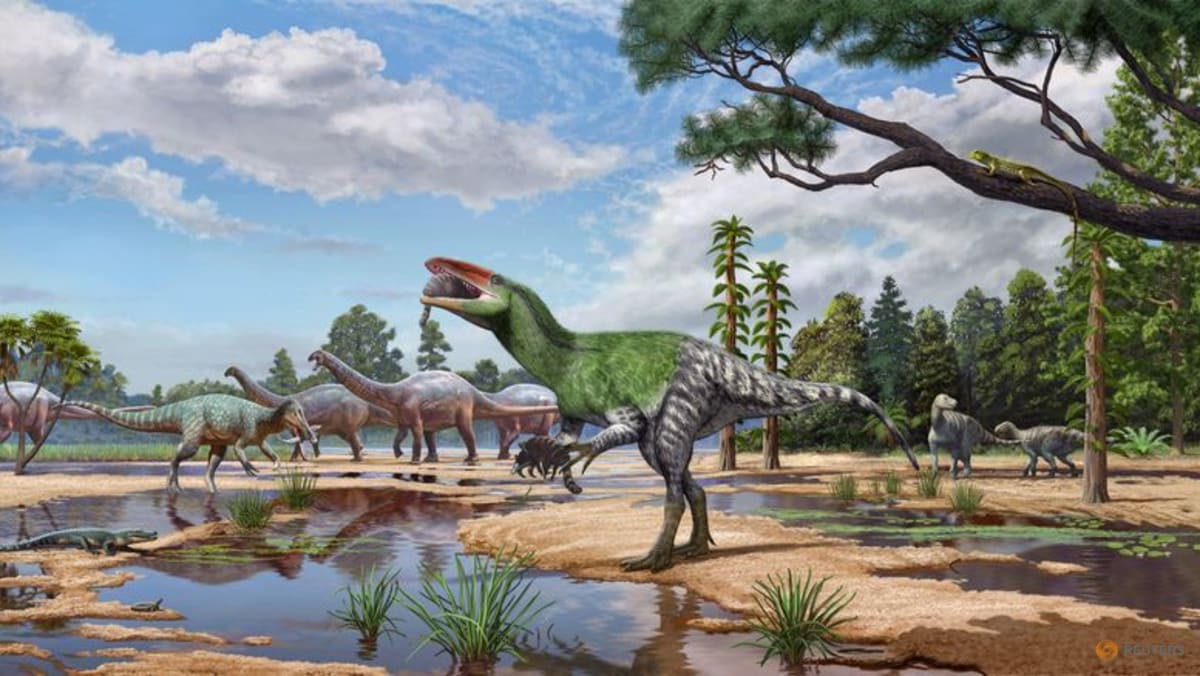
1 / 4
The story, neutrally told
Centre · 2Researchers have named a new species of predatory dinosaur, Invictibellatrix amberina, from a partial skull found on the Isle of Wight that had gone unstudied in the Natural History Museum for about a century. Evening StandardN “A new species of dinosaur has been discovered from a fossil found on the Isle of Wight which has been “overlooked” for study for more than a century” Read at Evening Standard ↗ New ScientistN “It was sitting unstudied in the museum for about 100 years” Read at New Scientist ↗ Centre · 2The fossil, a fragmentary braincase, was acquired by the museum in London in 1924 and was found in the Lower Cretaceous Wessex Formation on the island's south-west coast, in rocks about 120 million years old. New ScientistN “originally found in 120-million-year-old rocks from the Lower Cretaceous Wessex Formation on the south-west coast of the Isle of Wight” Read at New Scientist ↗ CNAN “The Invictibellatrix fossil, a fragmented braincase, was discovered about a century ago and acquired by the Natural History Museum in London in 1924.” Read at CNA ↗ Centre · 2The study, published in the journal Royal Society Open Science, was led by Cassius Morrison, described as now at the University of Leeds; the Evening Standard describes the team as led by University College London, and co-author Charlie Scherer is a UCL doctoral student. CNAN “a postdoctoral researcher at the University of Leeds in England and lead author of the study published in the journal Royal Society Open Science” Read at CNA ↗ Evening StandardN “according to the research team led by University College London (UCL)” Read at Evening Standard ↗
Centre · 1The researchers used CT scans to build a 3D model of the fossil and compared it with other dinosaurs; the closest match was the Argentinian megaraptoran Murusraptor, so they place the animal in the Megaraptora, which they say makes it the first megaraptoran found in Europe. New ScientistN “Morrison and his colleagues used CT scans to create a 3D scan of the fossil and compared it with features of other dinosaurs.”“If so, it is the first time a megaraptoran has been discovered in Europe.” Read at New Scientist ↗ Centre · 2The genus name means "unconquered female warrior". Megaraptorans were two-legged theropods with slender heads, lightly built skeletons and long, strong arms with large hand claws, and may be related to tyrannosaurs, though where they sit on the theropod family tree is debated. CNAN “There is a debate among dinosaur paleontologists as to where megaraptorans fit on the theropod family tree.” Read at CNA ↗ Evening StandardN “It has been named Invictibellatrix amberina, with the former meaning “unconquered female warrior.”” Read at Evening Standard ↗ Centre · 2Size estimates differ between reports: New Scientist and the Evening Standard give a length of 3 to 4 metres, about 1.5 metres tall, with claws 10 to 20 cm long, and New Scientist gives a weight of 200 to 300 kg, while CNA says about 5 metres (16 feet) with the weight of a large tiger. New ScientistN “about 3 to 4 metres long, some 1.5 metres tall and weighing between 200 and 300 kilograms” Read at New Scientist ↗ CNAN “was about 16 feet (5 meters) long, with the weight of a large tiger” Read at CNA ↗
Centre · 2It is thought to have had feathers and to have hunted small dinosaurs, lizards and mammals; it was not the island's top predator, and CNA says it may have filled a role like that of a hyena today. Evening StandardN “It would have eaten small dinosaurs, lizards and mammals.” Read at Evening Standard ↗ CNAN “may have filled a role similar to a hyena today” Read at CNA ↗ Centre · 2Morrison said humans would have been about a third of its body weight, making them suitable prey, and that it would have been more dangerous to people than a T. rex, which would have been too massive to bother with something so small. Evening StandardN “We would have been perfectly sized prey, about a third of their body weight.” Read at Evening Standard ↗ CNAN “A smaller theropod like Invictibellatrix would likely have been a much bigger threat to a human than something like T. rex” Read at CNA ↗ Centre · 2A leading hypothesis holds that megaraptorans originated in Asia and spread through Europe into Africa and then South America, and the researchers say the new species supplies fossil evidence for the European step; New Scientist says the Isle of Wight was then attached to mainland Europe with a subtropical climate. CNAN “This hypothesis was lacking fossil evidence because no megaraptorans had been known from Europe until now.” Read at CNA ↗ New ScientistN “the Isle of Wight was still firmly attached to both mainland Britain and the rest of Europe, and the environment would have been subtropical” Read at New Scientist ↗
Centre · 1Jake Kotevski of Monash University told New Scientist that the finding, if the classification holds, would fill a gap in knowledge of the group, but that more fossils are needed to support or reject the hypothesis; he also regretted that the fossil could not be compared in more detail with the earlier Wessex Formation theropod Eotyrannus, whose remains do not overlap with it. New ScientistN “However, more fossils are required to support or reject this hypothesis.”“none of the fossilised remains of the two individuals directly overlap, so it is hard to compare them.” Read at New Scientist ↗ Centre · 2The reports differ on the original finder: New Scientist says the fossil was acquired from a Reverend Reginald Hooley, while the Evening Standard credits amateur palaeontologist Reginald Walter Tooley with finding it at the foot of a cliff. The Standard says the research was funded by the Palaeontographical Society, the Royal Society and UK Research and Innovation. New ScientistN “acquired from a Reverend Reginald Hooley in 1924” Read at New Scientist ↗ Evening StandardN “amateur palaeontologist Reginald Walter Tooley”“The research was funded by the Palaeontographical Society, the Royal Society and UK Research and Innovation.” Read at Evening Standard ↗
Every sentence links to the reporting it rests on. The pill in front of each says where its sources sit: Left, Centre or Right when one side supplies at least half of them, Mixed when they are evenly split. The number is how many outlets it cites.
Left1 outlet
No left outlet in our sources has covered this story yet.
Centre3 outlets
- Framing
- All three outlets are centre-rated and report the naming as a science discovery story, leading on the century-old fossil and the first European megaraptoran, with Morrison's remark about humans as prey for colour.
- Emphasis
- New Scientist adds outside expert caution and the Eotyrannus comparison; the Evening Standard stresses the fossil being overlooked and the funders; CNA stresses how megaraptorans hunted compared with T. rex and the evolutionary debate.
- Leaves out or plays down
- The Evening Standard and CNA do not carry the outside expert's caveat that more fossils are needed. CNA does not mention the Eotyrannus comparison. The reports do not agree on the animal's length or the original finder.
- Charged language
- “unconquered female warrior”“enigmatic”“ruling queens”
- For example
-
“Meet Invictibellatrix amberina, the unconquered female warrior” — New Scientist
“It is a real mystery that this fossil was overlooked for so long, sitting in a drawer for nearly 100 years.” — Evening Standard
“Isle of Wight fossil sheds light on enigmatic meat-eating dinosaurs” — CNA
Right0 outlets
No right outlet in our sources has covered this story yet.
What every side reports
- The new species is named Invictibellatrix amberina, meaning 'unconquered female warrior'.
- It lived about 120 million years ago on what is now the Isle of Wight.
- The fossil is part of a skull acquired by the Natural History Museum in London in 1924 and unstudied for about a century.
- The researchers say it is the first megaraptoran found in Europe.
- Lead author Cassius Morrison says it would have been a bigger threat to humans than a T. rex.
Where accounts differ
-
Length of the animal
- Centre
- New Scientist and the Evening Standard say 3 to 4 metres; CNA says about 5 metres (16 feet).
-
Who found or supplied the fossil
- Centre
- New Scientist says it was acquired from a Reverend Reginald Hooley; the Evening Standard says it was found by amateur palaeontologist Reginald Walter Tooley.
-
Lead institution
- Centre
- The Evening Standard says the team was led by UCL; New Scientist and CNA place lead author Morrison at the University of Leeds.
-
Invictibellatrix amberina is the first megaraptoran dinosaur found in Europe.
Reported- Supports 1
- New Scientist
- Reports 2
- CNA, Evening Standard
-
The fossil was acquired by the Natural History Museum in London in 1924 and lay unstudied for about a century.
Reported- Reports 3
- CNA, Evening Standard, New Scientist
-
Invictibellatrix was about 3 to 4 metres long.
Reported- Disputes 1
- CNA
- Reports 2
- Evening Standard, New Scientist
-
A human would have been suitable-sized prey for Invictibellatrix, more at risk than from a T. rex.
Reported- Reports 3
- CNA, Evening Standard, New Scientist
Invictibellatrix amberina other
Presented by its describers as a small early megaraptoran and the first from Europe; it was an agile hunter, not the apex predator of its time.
“It was not the apex predator of its time” — Evening Standard
“Invictibellatrix is one of the smallest megaraptorans.” — CNA
Natural History Museum organisation
The museum held the partial skull from 1924 until researchers examined it; reports describe it as sitting unnoticed in a collection drawer.
“It was left in one of the collection's drawers ever since, and no one noticed it until a couple of years ago” — CNA
Isle of Wight place
Described as a source of many fossils, with Morrison suggesting more may be waiting to be found.
“Lots of bones are found on the Isle of Wight – who knows what else is waiting to be discovered.” — Evening Standard
UK and Ireland3 outlets
UK outlets lead on the century-old museum fossil and the British connection; New Scientist adds expert caution.
“Dinosaur named new species 102 years after fossil found on Isle of Wight” — New Scientist
“New dinosaur species discovered from fossil ‘overlooked’ for over 100 years” — Evening Standard
New Scientist, Evening Standard, Daily Mirror
East and Southeast Asia1 outlet
CNA frames it as a broader window on an enigmatic dinosaur group and its global spread.
“helps show how the group spread globally” — CNA
CNA
Left1 article
Centre3 articles
-
Dinosaur named new species 102 years after fossil found on Isle of Wight
Neutral Science-news report including outside expert caution and the unresolved Eotyrannus comparison.
-
New dinosaur species discovered from fossil ‘overlooked’ for over 100 years
Neutral Short news report centred on the overlooked fossil, Morrison's quotes about danger to humans, and funding.
-
CNAN ·
Isle of Wight fossil sheds light on enigmatic meat-eating dinosaurs
Neutral Agency-style explainer on megaraptoran hunting style versus T. rex and the global spread hypothesis.
Right0 articles
No coverage yet.
- 14 Oct 00:01 First New ScientistN Dinosaur named new species 102 years after fossil found on Isle of Wight
- 14 Oct 00:06 +5m Evening StandardN New dinosaur species discovered from fossil ‘overlooked’ for over 100 years
- 14 Oct 00:07 +6m CNAN Isle of Wight fossil sheds light on enigmatic meat-eating dinosaurs
- 14 Oct 00:11 +10m Daily MirrorL New dinosaur species which preyed on humans discovered from Isle of Wight fossil 'overlooked' for 100 years
Times are when each article was published, or when we first saw it if the outlet gave no time.
Ask about this story
Loading…