NZ wētāpunga, world's heaviest insect, rated recovering after 11,000 bred and released
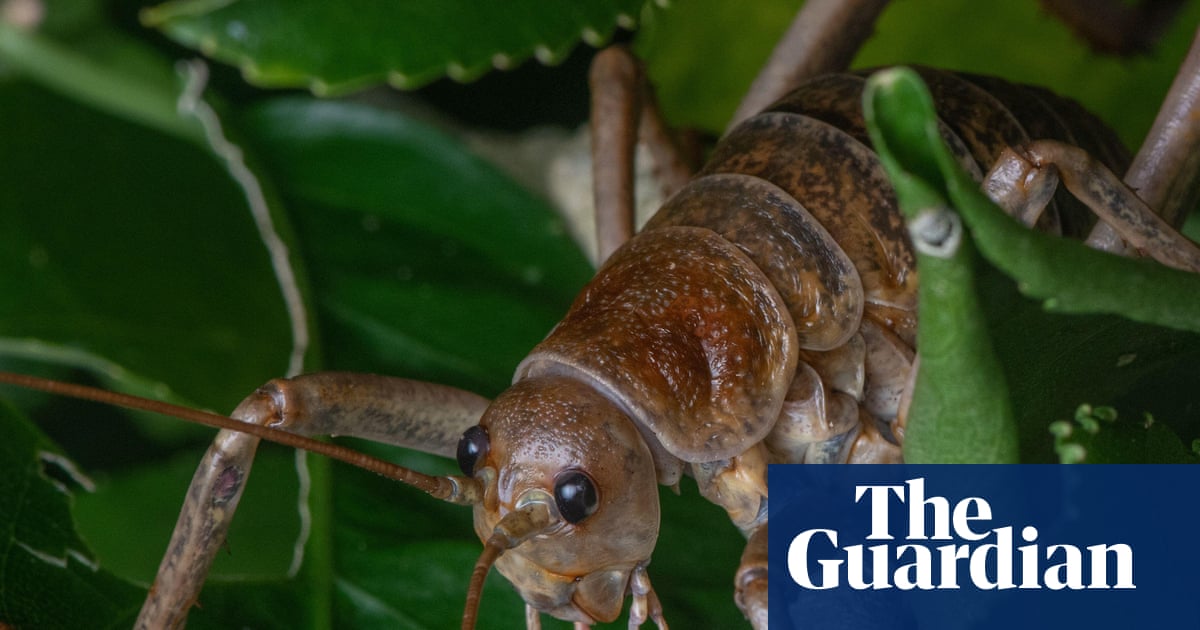
A 15-year breeding programme has released 11,000 wētāpunga in New Zealand, and the species' conservation status has been upgraded from "nationally endangered". The results appear in a New Zealand Journal of Zoology report co-authored by Dr Chris Green.

1 / 2
The story, neutrally told
Mixed · 2New Zealand's wētāpunga, believed to be the world's heaviest insect, is officially recovering after a breeding programme that has released 11,000 insects into the wild. The GuardianLC “is officially “recovering” thanks to a groundbreaking breeding programme that has overseen the release of 11,000 insects into the wild.” Read at The Guardian ↗ Daily MailR “scientists have bred and released 11,000 wētāpunga at 10 specially chosen sites around New Zealand.” Read at Daily Mail ↗ Mixed · 2Dr Chris Green, an honorary researcher at the Department of Conservation, documented the programme in the New Zealand Journal of Zoology; he said "The future of wētāpunga is looking bright." The GuardianLC ““The future of wētāpunga is looking bright,” said Dr Chris Green, an honorary researcher at the department of conservation” Read at The Guardian ↗ Daily MailR “The success was published in the New Zealand Journal of Zoology.” Read at Daily Mail ↗ Mixed · 2An adult female can weigh as much as a mouse, grow nearly 10cm long and have a leg span of up to 20cm. The GuardianLC “Its body can grow up to 10cm long (nearly 4in) and its leg span can be as wide as 20cm.” Read at The Guardian ↗ Daily MailR “An adult female wētāpunga can weigh as much as a mouse, grow nearly four inches (10cm) long” Read at Daily Mail ↗
Mixed · 2The insects once lived across parts of the North Island but declined because of introduced predators such as cats, rats and stoats, and habitat loss; they were considered endangered by the 1990s and are presumed extinct in the wild on the mainland. The GuardianLC “By the 1990s, they were considered “endangered” and are now presumed extinct in the wild on New Zealand’s mainland.” Read at The Guardian ↗ Daily MailR “The introduction of cats, rats, and stoats to otherwise predator-free areas has sent the wētāpunga's numbers tumbling” Read at Daily Mail ↗ Right · 1The Daily Mail reports the remaining population had shrunk to a single Hauraki Gulf island with a handful of breeding adults; after rats were eradicated it rose from 78 in 2005 to 172 in 2009, and from 2008 researchers took six breeding-age wētāpunga to Butterfly Creek and Auckland Zoo. Daily MailR “rising from just 78 in 2005 to 172 in 2009”“Starting in 2008, researchers carefully collected six breeding-age wētāpunga from the wild” Read at Daily Mail ↗ Mixed · 2Over 15 years, tens of thousands have been bred at Butterfly Creek and Auckland Zoo, reared as nymphs in communal creches on a three-part diet of fresh foliage, leaf litter and fish flakes; Green said the protein is critical to the youngest nymphs' survival. The GuardianLC “The young wētāpunga – or nymphs – are fed a three-part diet of fresh foliage, fish flake protein and leaf litter.” Read at The Guardian ↗ Daily MailR “The addition of extra protein is critical for young nymphs' survival” Read at Daily Mail ↗
Mixed · 2There have been 45 separate releases or translocations, which the Daily Mail says were on eight predator-free islands and two fenced mainland reserves north of Auckland; Green called 45 "a very high number in any recovery of a species". The GuardianLC “45 separate translocations to wild habitats, which is “a very high number in any recovery of a species”” Read at The Guardian ↗ Daily MailR “on eight predator-free islands and two fenced-off nature reserves across north Auckland” Read at Daily Mail ↗ Mixed · 2Monitoring on two islands (named by the Daily Mail as Motuora and Tiritiri Matangi) shows self-sustaining populations, with at least four generations born, and the Guardian reports a fifth; the conservation status has moved from "nationally endangered" to "nationally recovering" (the Daily Mail wrote "nationally increasing"). The GuardianLC “with fourth and fifth generations born there” Read at The Guardian ↗ Daily MailR “On Motuora and Tiritiri Matangi islands, at least four generations of wētāpunga have been born.”“raised from 'nationally endangered' to 'nationally increasing'.” Read at Daily Mail ↗ Mixed · 2Green said he knew of no other invertebrate breeding programme of this scale or success, and hopes other institutions will copy it; the Daily Mail quotes him naming the Canterbury knobbled weevil and native stag beetles as candidates. The GuardianLC “he was not aware of any other examples of breeding programmes working to this scale, or with such success.” Read at The Guardian ↗ Daily MailR “for example the Canterbury knobbled weevil, and several native stag beetle species.” Read at Daily Mail ↗
Every sentence links to the reporting it rests on. The pill in front of each says where its sources sit: Left, Centre or Right when one side supplies at least half of them, Mixed when they are evenly split. The number is how many outlets it cites.
Left1 outlet
- Framing
- Guardian leads with a hopeful conservation success story built around Green's quotes and the upgrade to recovering.
- Emphasis
- Green's comments, New Zealand's vulnerability and its lead in invertebrate recovery, and the hope that others copy the model.
- Leaves out or plays down
- Omits population figures from 2005 and 2009, the six founders and the names of the islands.
- Charged language
- “groundbreaking”“back from the brink”
- For example
-
“is officially “recovering” thanks to a groundbreaking breeding programme” — The Guardian
“New Zealand is particularly vulnerable to species decline because of its high rates of endemism and problems with introduced pests.” — The Guardian
Centre0 outlets
No centre outlet in our sources has covered this story yet.
Right1 outlet
- Framing
- Daily Mail presents an 'astonishing comeback' with a more detailed, narrative history of the programme.
- Emphasis
- Population numbers, the six founders, named islands, the 'industrialised' breeding and other species that could benefit.
- Leaves out or plays down
- Omits Green's remarks on New Zealand's wider vulnerability and that it leads in invertebrate recovery.
- Charged language
- “astonishing comeback”“magnificent creepy crawlies”“industrialised”
- For example
-
“The world's heaviest insect has made an astonishing comeback after conservationists saved the giant bug from the brink of extinction.” — Daily Mail
“These magnificent creepy crawlies used to be found all across New Zealand's North Island” — Daily Mail
What every side reports
- 11,000 wētāpunga have been bred and released over about 15 years
- Breeding took place at Butterfly Creek and Auckland Zoo
- There have been 45 releases to the wild
- Two islands have self-sustaining populations
- Status improved from 'nationally endangered'
- Dr Chris Green documented the work in the New Zealand Journal of Zoology
Where accounts differ
-
New conservation status label
- Left
- The Guardian: 'nationally recovering'.
- Right
- The Daily Mail: 'nationally increasing'.
-
Generations on the two islands
- Left
- The Guardian: fourth and fifth generations born.
- Right
- The Daily Mail: at least four generations.
Wētāpunga other
The species is presented as recovering, with self-sustaining island populations and an improved status, though presumed extinct in the wild on the mainland.
“the species’ conservation status has improved from “nationally endangered” to “nationally recovering”.” — The Guardian
“are now presumed extinct in the wild on New Zealand’s mainland.” — Daily Mail
Left1 article
-
‘The future is bright’: breeding programme brings world’s heaviest insect back from the brink
Celebratory Optimistic conservation report centred on Green's quotes and the programme as a model for others.
Centre0 articles
No coverage yet.
Right1 article
-
Celebratory Upbeat, colourful account stressing an 'astonishing comeback' and the programme's history.
- 5 Oct 06:19 First The GuardianLC ‘The future is bright’: breeding programme brings world’s heaviest insect back from the brink
- 6 Oct 12:42 +30h 23m Daily MailR World's heaviest insect makes astonishing comeback after conservationists save giant bug from extinction
Times are when each article was published, or when we first saw it if the outlet gave no time.