A year after Gaza ceasefire, Trump plan stalled: Hamas armed, Israel holds two-thirds
A year after the 10 October 2025 Gaza ceasefire, Reuters reporting says Trump's 20-point plan has stalled on disarmament, Israeli withdrawal and reconstruction, while Israeli strikes continue.

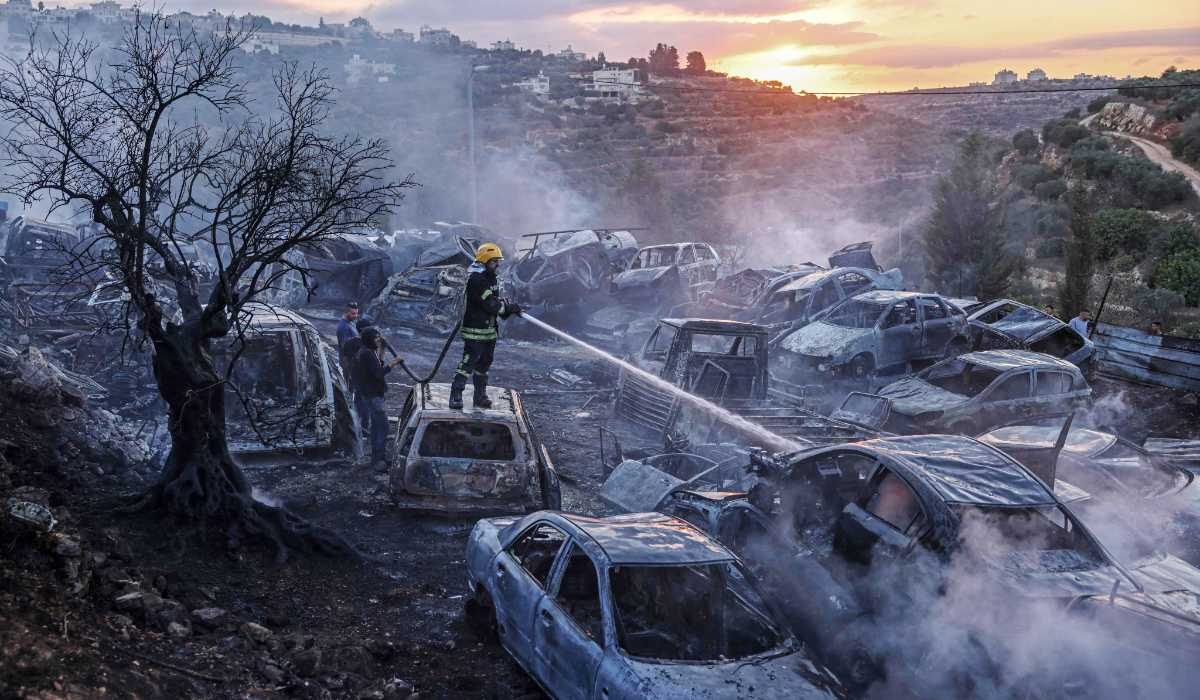
1 / 2
The story, neutrally told
Right · 2One year after the Gaza ceasefire began, US President Donald Trump's plan to end the war has stalled, with Hamas still armed, Israeli forces controlling about two-thirds of the strip and reconstruction barely underway. The Jerusalem PostRC “Trump’s broader plan remains stalled, with Hamas still armed, Israeli forces holding most of Gaza, and reconstruction barely underway.” Read at The Jerusalem Post ↗ Arab NewsRC “year-old plan to end the Gaza war has stalled, with Israel mounting near daily attacks and occupying around two-thirds of the shattered encl” Read at Arab News ↗ Right · 2The first phase produced a ceasefire on 10 October 2025 and the release of the last hostages seized in Hamas's 2023 attack, in exchange for hundreds of Palestinian prisoners and detainees held by Israel. Arab NewsRC “The initial phase resulted in a ceasefire on October 10, 2025 and secured the release of the last remaining hostages” Read at Arab News ↗ The Jerusalem PostRC “in exchange for hundreds of Palestinian prisoners and detainees held by Israel” Read at The Jerusalem Post ↗ Right · 1Later phases of the 20-point plan called for Hamas to disarm and for a Palestinian body, overseen by the Trump-led Board of Peace, to take over governance, with Israel gradually withdrawing and handing territory to a temporary International Stabilization Force (ISF). Arab NewsRC “Later phases foresaw Hamas disarming and new governance by a Palestinian body overseen by the Trump-led Board of Peace.” Read at Arab News ↗
Right · 2There has been no return to full-scale military operations, but Israeli strikes have continued; Gaza's health ministry says at least 1,400 Palestinians have been killed since the ceasefire, though it does not disclose militant casualties. Arab NewsRC “Gaza’s health ministry says at least 1,400 Palestinians have been killed since the October ceasefire” Read at Arab News ↗ The Jerusalem PostRC “There has been no return to full-scale military operations, but Israeli strikes have continued.” Read at The Jerusalem Post ↗ Right · 2Israel says its strikes target Hamas, which it accuses of trying to carry out attacks and rearm; Arab News's copy adds that Hamas denies this. The Israeli military says five Israeli soldiers have been killed since the ceasefire. Arab NewsRC “Israel says its strikes have targeted Hamas, accusing the group of trying to carry out attacks and rearm. Hamas denies this.” Read at Arab News ↗ The Jerusalem PostRC “Five Israeli soldiers have been killed by Palestinian terrorists, including both terror attacks and in combat, since the ceasefire, according to the IDF.” Read at The Jerusalem Post ↗ Right · 2The initial phase's "yellow line" left Israeli troops controlling 53% of Gaza; the military has since expanded its effective control to around two-thirds. Arab News's copy says this has squeezed the population of 2 million into a shrinking coastal strip, and both versions say Israel-backed Palestinian militias opposed to Hamas use the Israeli-held zone to attack Hamas-controlled areas. The Jerusalem PostRC “Since then, the military has expanded its effective control to around two-thirds of the territory.” Read at The Jerusalem Post ↗ Arab NewsRC “squeezing the population of 2 million into a shrinking coastal strip where they shelter in tents and damaged buildings.” Read at Arab News ↗
Right · 2The IPC hunger monitor says more than 1.2 million people still face acute hunger despite a scale-up of aid. It cited an average of 227 trucks a day from the ceasefire to the end of May, under half the 600 the plan stipulated. Israel says about 600 trucks enter daily, that Gaza is getting enough goods, and that it is meeting its obligations. COGAT did not immediately respond on the IPC figure. Aid agencies say Israel blocks items such as metal tent poles, engine oil and spare parts on the grounds that Hamas could use them for military purposes. Arab NewsRC “an average of 227 trucks a day carried humanitarian and commercial supplies into Gaza from the ceasefire to the end of May” Read at Arab News ↗ The Jerusalem PostRC “Israel says around 600 trucks carrying humanitarian aid and commercial goods enter each day”“Aid agencies say Israel is blocking essential items, including metal tent poles, engine oil and spare parts” Read at The Jerusalem Post ↗ Right · 2Disarmament is the key obstacle. Trump said Hamas and other militants accepted a 15-point Board of Peace roadmap to give up arms, with Israeli forces withdrawing as Hamas disarmed. Hamas said it would hand over weapons to be stored under the US-backed Palestinian technocratic government, while rejecting the word 'disarmament'. Israel called the plan unacceptable and said it would not withdraw until Hamas is fully disarmed. The Jerusalem PostRC “But Israel, skeptical that Hamas will give up its arms, called the plan unacceptable and said it would not carry out any withdrawal until Hamas is fully disarmed.” Read at The Jerusalem Post ↗ Arab NewsRC “Hamas said it had agreed to hand over its weapons to be stored under the control of the US-backed Palestinian technocratic government.” Read at Arab News ↗ Right · 1The Arab News copy adds that a plan unveiled in July to achieve disarmament has also stalled. Arab NewsRC “a plan unveiled in July to achieve this has also stalled.” Read at Arab News ↗
Right · 2The ISF has a commander, US Major General Jasper Jeffers, and personnel pledged by Indonesia, Morocco, Kazakhstan, Albania, Kosovo and Uganda, but is not yet assembled; Jeffers says the long-term plan is 20,000 troops and training 12,000 Palestinian police. The National Committee for the Administration of Gaza, led by Ali Shaath, a former Palestinian Authority deputy minister, was appointed in January and has yet to enter Gaza. The Jerusalem PostRC “Jeffers has said the long-term plan is for the ISF to use 20,000 troops and train 12,000 Palestinian police.” Read at The Jerusalem Post ↗ Arab NewsRC “It has yet to enter Gaza.” Read at Arab News ↗ Right · 2The Board of Peace unveiled a $2.45 billion rebuilding plan in September, a fraction of the $71.4 billion over ten years that an April EU and UN assessment put as the need. Arab NewsRC “The Board of Peace unveiled a $2.45 billion plan in September to begin rebuilding Gaza.” Read at Arab News ↗ The Jerusalem PostRC “estimated recovery and reconstruction needs at $71.4 billion over the next decade” Read at The Jerusalem Post ↗ Right · 2Israeli right-wing politicians have stepped up calls for mass "voluntary emigration" of Palestinians. Defense Minister Israel Katz said last month there was "no real solution for Gaza in the end without this migration". Trump backed away from earlier displacement comments, and Israeli officials say there are no plans to move people out by force. Arab NewsRC “Israeli Defense Minister Israel Katz said last month there was “no real solution for Gaza in the end without this migration.”” Read at Arab News ↗ The Jerusalem PostRC “Israeli officials have said there are no plans to move Gaza's population out by force.” Read at The Jerusalem Post ↗
Right · 1Israel holds a general election on 27 October, its first since the 7 October 2023 attack; some leading opposition figures have backed Trump's plan, and Arab News's copy says polls show pro- and anti-Netanyahu parties in a tight race. Arab NewsRC “Israel will hold a general election on October 27, the country’s first since the October 7, 2023, Hamas attack.”“Polls show pro- and anti-Netanyahu parties in a tight race.” Read at Arab News ↗
Every sentence links to the reporting it rests on. The pill in front of each says where its sources sit: Left, Centre or Right when one side supplies at least half of them, Mixed when they are evenly split. The number is how many outlets it cites.
Left0 outlets
No left outlet in our sources has covered this story yet.
Centre0 outlets
No centre outlet in our sources has covered this story yet.
Right2 outlets
- Framing
- Both outlets run the same Reuters explainer, which presents a stalled Trump plan, continuing Israeli strikes, an unfulfilled disarmament pledge and a large reconstruction gap. Differences are in wording: the Jerusalem Post version uses terms such as 'terrorists' and 'Hamas-run', while Arab News's copy uses 'militants' and adds Hamas's denial and the effect of the advancing line on displaced Palestinians.
- Emphasis
- Stalled disarmament, Israeli withdrawal and reconstruction; aid shortfall; Israeli election politics and 'voluntary emigration'.
- Leaves out or plays down
- The Jerusalem Post version leaves out Hamas's denial of rearming, the stalled July disarmament plan and the displacement caused by the advancing yellow line, which the Arab News copy includes. Neither includes left or centre outlets' views.
- Charged language
- “Palestinian terrorists”“Hamas-run health ministry”“shattered enclave”“advancing yellow line”
- For example
-
“Gaza's Hamas-run health ministry claims at least 1,400 Palestinians have been killed since the October ceasefire” — The Jerusalem Post
“The advancing yellow line has uprooted more Palestinians” — Arab News
What every side reports
- The ceasefire began on 10 October 2025 and the last hostages were released.
- Hamas remains armed and Israel controls about two-thirds of Gaza, up from 53% under the initial yellow line.
- At least 1,400 Palestinians have been killed since the ceasefire, according to Gaza's health ministry; five Israeli soldiers have been killed, according to the Israeli military.
- The IPC cites 227 trucks a day to end of May against 600 stipulated; Israel says about 600 enter daily.
- The Board of Peace's $2.45 billion plan compares with $71.4 billion in estimated needs.
- Israel votes on 27 October.
Where accounts differ
-
Aid volumes entering Gaza
- Right
- Israel says about 600 trucks a day enter and it is meeting its obligations; the IPC cites 227 a day to end of May, and aid agencies say Israel blocks essential items (both outlets carry the same Reuters account).
-
Whether Hamas is rearming and planning attacks
- Right
- Israel accuses Hamas of trying to attack and rearm; Arab News's copy adds that Hamas denies this, a line absent from the Jerusalem Post's version.
Donald Trump person
Trump says Hamas and other militants accepted a 15-point Board of Peace roadmap to give up arms and called it historic; his 20-point plan promises Gaza will be redeveloped for its people.
“Trump called it historic.” — Arab News
Hamas organisation
Hamas says it agreed to hand over weapons to be stored under the US-backed technocratic government while rejecting the word 'disarmament'; it denies Israel's rearmament claims (Arab News copy).
“Though Hamas rejected the word ‘disarmament’, this marked a once-unimaginable position for the Iran-backed group.” — Arab News
Israel1 outlet
The Jerusalem Post runs the Reuters explainer with Israeli-military terminology such as 'terrorists' and 'Hamas-run'.
“Five Israeli soldiers have been killed by Palestinian terrorists” — The Jerusalem Post
The Jerusalem Post
Middle East1 outlet
Arab News runs the Reuters copy with 'militants', Hamas's denial and the effect of the advancing yellow line on displaced Palestinians.
“Israel says its strikes have targeted Hamas, accusing the group of trying to carry out attacks and rearm. Hamas denies this.” — Arab News
Arab News
Left0 articles
No coverage yet.
Centre0 articles
No coverage yet.
Right2 articles
-
One year on, Trump's Gaza plan has not stopped Israeli fire or disarmed Hamas - explainer
Critical Reuters explainer run by the Jerusalem Post, framing the plan as stalled with Hamas armed, using 'terrorists' wording for Palestinian attackers.
-
Arab NewsRC · · via Reuters
One year on, Trump’s Gaza plan has not stopped Israeli fire or disarmed Hamas
Critical Reuters copy in Arab News, leading with near-daily Israeli attacks and occupation of a 'shattered enclave', and adding Hamas's denial and displacement from the advancing yellow line.
- 6 Oct 10:40 First The Jerusalem PostRC One year on, Trump's Gaza plan has not stopped Israeli fire or disarmed Hamas - explainer
- 6 Oct 22:51 +12h 11m Arab NewsRC One year on, Trump’s Gaza plan has not stopped Israeli fire or disarmed Hamas via Reuters
Times are when each article was published, or when we first saw it if the outlet gave no time.