Opinion writers assess the Trump–Xi White House summit
Two opinion pieces assess last week's Trump–Xi summit in Washington: the Wall Street Journal stresses its thin substance and image value, while the South China Morning Post uses Xi's remarks to argue that US–China conflict is not inevitable.
1 / 1
The story, neutrally told
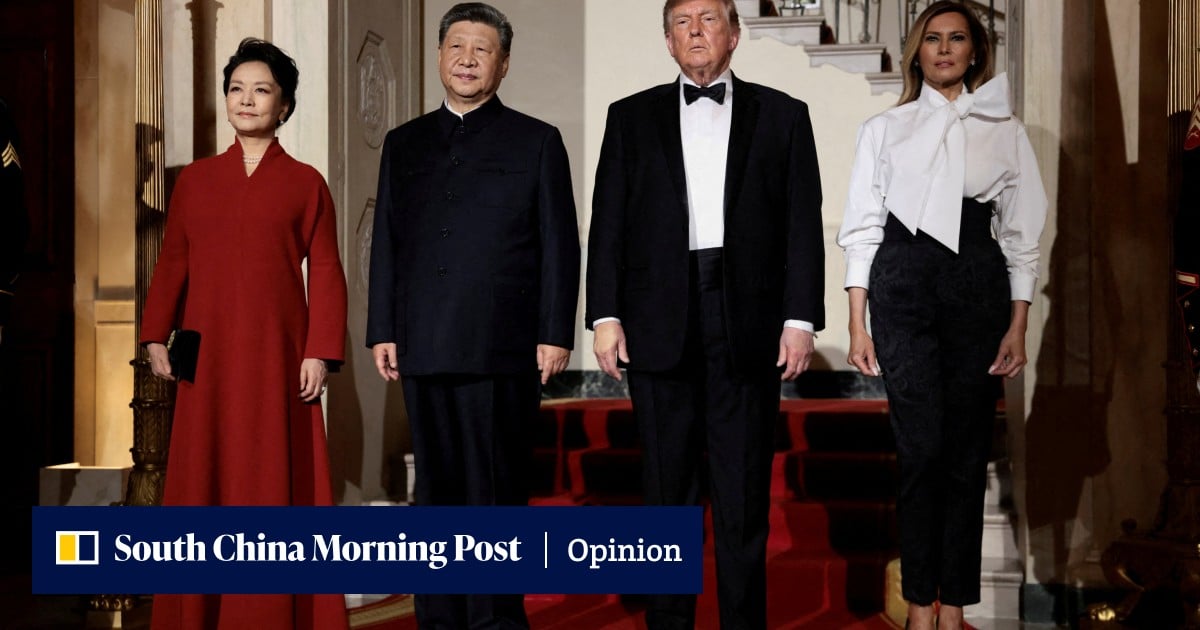
Chinese President Xi Jinping stood beside US President Donald Trump at the White House last week for a summit between the two leaders. South China Morning PostN “Standing beside US President Donald Trump at the White House last week, President Xi Jinping proposed” Read at South China Morning Post ↗ At the summit Xi proposed that competition between China and the United States should be "a race of catching up with one another", not "a wrestle where one either wins or loses". South China Morning PostN ““a race of catching up with one another”, not “a wrestle where one either wins or loses”” Read at South China Morning Post ↗ A Wall Street Journal opinion piece judged that the summit had "scant substance" but made both leaders "look larger than life". The Wall Street JournalRC “His summit with Xi had scant substance but made both leaders look larger than life.” Read at The Wall Street Journal ↗
A South China Morning Post opinion piece by David Gorombolyi takes Xi's words as a starting point to question the idea of the "Thucydides Trap", the notion that a rising and an established power are bound for war. South China Morning PostN “we should not become prisoners of a catchy metaphor as it can easily turn into a self-fulfilling prophecy.” Read at South China Morning Post ↗ The SCMP author cites Britain and the US after the 1895 Venezuela crisis, France and Germany after World War II, and Argentina and Brazil in the 1970s as rivalries that were managed without war. South China Morning PostN “Britain ultimately chose accommodation over an increasingly costly struggle for primacy in the western hemisphere.” Read at South China Morning Post ↗ The author says none of these cases is a blueprint for Washington and Beijing, and that AI, tariffs, Taiwan, Iran and the South China Sea are all tangible challenges that need not become a casus belli. South China Morning PostN “none of these need become a casus belli” Read at South China Morning Post ↗
The SCMP piece also questions whether Xi's metaphors can survive real disputes on trade, technology or political red lines, and says a workable formula will need political will on both sides. South China Morning PostN “Whether these metaphors survive the real disputes between the two countries on trade, technology or political red lines is another matter.” Read at South China Morning Post ↗
Every sentence links to the reporting it rests on.
Left0 outlets
No left outlet in our sources has covered this story yet.
Centre1 outlet
- Framing
- The SCMP opinion piece uses the summit and Xi's remarks to argue against fatalism about US–China conflict, drawing on historical power transitions.
- Emphasis
- Historical precedents of peaceful accommodation and the need for political will on both sides; takes Xi's words seriously.
- Leaves out or plays down
- Says little about the summit's concrete outcomes or how Trump framed it.
- Charged language
- “self-fulfilling prophecy”“Thucydides Trap”
- For example
-
“Xi’s words in Washington deserve to be taken seriously.” — South China Morning Post
Right1 outlet
- Framing
- The Wall Street Journal's opinion headline and lede treat the summit as more image than substance, focusing on how it made the leaders look.
- Emphasis
- Lack of concrete outcomes and the leaders' stature.
- Leaves out or plays down
- Nothing beyond the headline and lede can be compared with the SCMP's discussion of Xi's proposals or historical precedents.
- Charged language
- “scant substance”“larger than life”
- For example
-
“His summit with Xi had scant substance but made both leaders look larger than life.” — The Wall Street Journal
What every side reports
- Trump and Xi held a summit in Washington last week.
- Both pieces are opinion commentary, not news reports.
Where accounts differ
-
Whether the summit was substantive
- Centre
- The SCMP piece says Xi's words deserve to be taken seriously and treats the issues as manageable, without judging the summit's outcomes.
- Right
- The WSJ opinion says it had scant substance but boosted both leaders' image.
Xi Jinping person
Xi is presented as proposing a cooperative framing of competition with the US.
““a race of catching up with one another”, not “a wrestle where one either wins or loses”” — South China Morning Post
Donald Trump person
Trump is described as gaining stature from the summit, in the WSJ's view.
“His summit with Xi had scant substance but made both leaders look larger than life.” — The Wall Street Journal
North America1 outlet
The WSJ focuses on the summit's optics and lack of substance.
“His summit with Xi had scant substance but made both leaders look larger than life.” — The Wall Street Journal
The Wall Street Journal
East and Southeast Asia1 outlet
The SCMP stresses avoiding conflict and takes Xi's proposal seriously.
“The Thucydides Trap is useful as a warning but dangerous as a prophecy.” — South China Morning Post
South China Morning Post
Left0 articles
No coverage yet.
Centre1 article
-
South China Morning PostN · · Opinion
US-China conflict doesn’t have to become a self-fulfilling prophecy
Sympathetic Argues from history that a US–China clash is avoidable and that Xi's overture merits serious attention.
Right1 article
-
The Wall Street JournalRC · · Opinion
Opinion | Trump and Chinese Circumstance
Critical Casts the summit as light on substance but strong on optics for both leaders.
- 28 Sep 22:20 First The Wall Street JournalRC Opinion | Trump and Chinese Circumstance Opinion
- 30 Sep 13:30 +39h 10m South China Morning PostN US-China conflict doesn’t have to become a self-fulfilling prophecy Opinion
Times are when each article was published, or when we first saw it if the outlet gave no time.