Police divers find intact Roman artefacts off Porto Rotondo, Sardinia
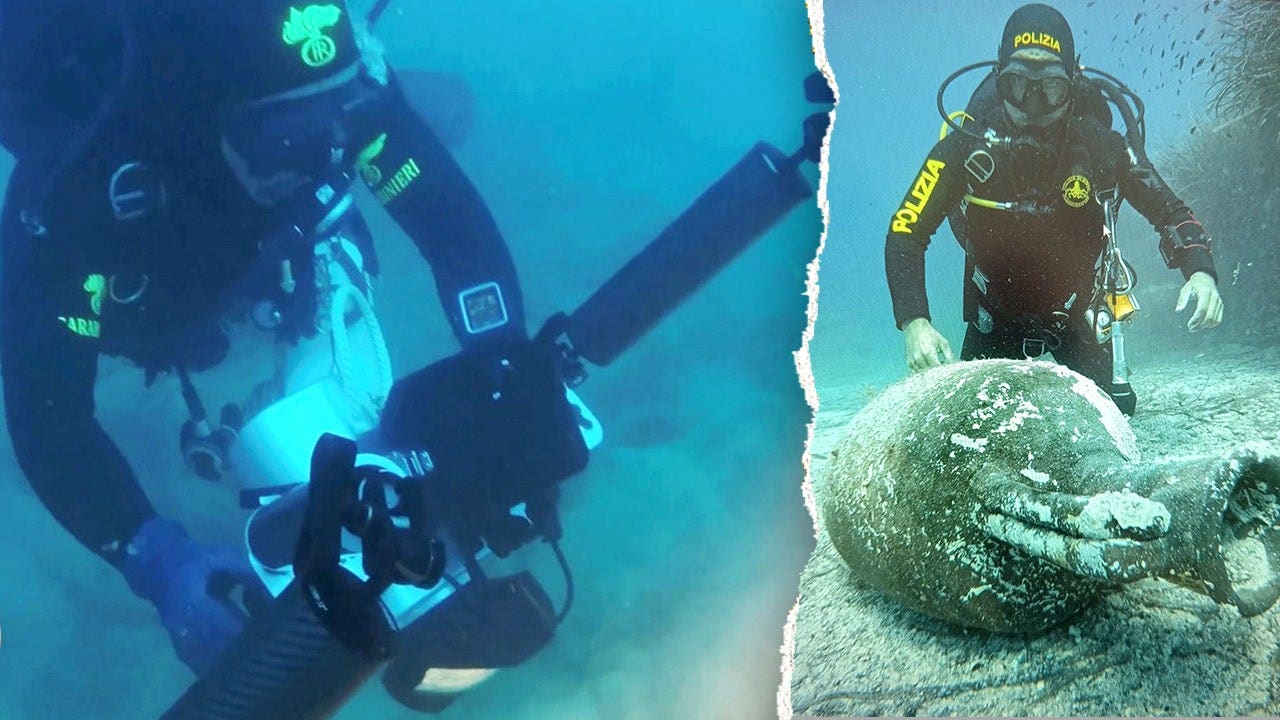
Italian police divers on a safety operation off Porto Rotondo, Sardinia, recovered three intact terracotta items, including a transport vessel, that may be about 2,000 years old. Specialists will now study them.

1 / 2
The story, neutrally told
Mixed · 2Police divers on a routine underwater safety operation off Porto Rotondo, on the Italian island of Sardinia, found Roman-era artefacts on the seabed. Fox NewsR “The artifacts were uncovered off the coast of Porto Rotondo in Sardinia, an Italian island in the Mediterranean Sea” Read at Fox News ↗ MetroLC “during an underwater safety operation by police based in nearby Olbia” Read at Metro ↗ Mixed · 2The officers, based in Olbia, first noticed a piece of broken terracotta and returned for a second dive, when they found largely intact items. Fox NewsR “They first noticed a piece of broken terracotta — prompting them to return for a second dive, when they discovered the largely intact vessels.” Read at Fox News ↗ MetroLC “later went back on a second dive, when they found a series of largely intact items.” Read at Metro ↗ Right · 1Officials said careful dredging led to the recovery of three intact terracotta artefacts, specifically a transport basin, along with other minor items. Fox NewsR “"Careful dredging action allowed the identification and subsequent recovery of three intact terracotta artifacts, specifically a transport basin, along with other minor items," officials said” Read at Fox News ↗
Right · 1Sassari Police Headquarters announced the find; Fox News, citing news agency Cover Images, says this was in late August, and the finds were made available to the competent archaeological superintendent. Fox NewsR “The discovery was announced by the Sassari Police Headquarters in late August.”“"The artifacts were recorded and made available to the competent Archaeological Superintendent."” Read at Fox News ↗ Mixed · 2A preliminary analysis suggests the items may date from the second half of the 1st century BC to the 1st century AD, with a possible origin in Lazio, Campania or the Iberian Peninsula, officials said. Fox NewsR “between the second half of the 1st century B.C. and the 1st century A.D., with a potential origin area that can be linked to Lazio, Campania or the Iberian Peninsula” Read at Fox News ↗ MetroLC “it is hypothesised that the items may date back to a time frame between the second half of the first century BC and the first century AD” Read at Metro ↗ Mixed · 2Images show police divers examining the seabed and an intact amphora in seagrass; amphorae carried goods such as wine, olive oil and grain. Fox NewsR “One image shows an intact amphora nestled among thick seagrass on the seafloor” Read at Fox News ↗ MetroLC “These were used to transport the likes of wine, olive oil and grain.” Read at Metro ↗
Mixed · 2Specialists will examine the items to establish their precise age and origin, and to determine whether they come from a larger archaeological site with more artefacts. Fox NewsR “Researchers will also determine whether the vessels came from a larger archaeological site — and if more artifacts await discovery.” Read at Fox News ↗ MetroLC “Scientists are also hoping to learn whether they come from a larger archaeological site where there could be more artifacts.” Read at Metro ↗ Mixed · 2Both outlets note a similar find earlier this year: a Roman merchant shipwreck with amphorae in the Ionian Sea off Apulia, found on a maritime patrol in June 2025 and dated to the late Imperial era (about 284–641 AD). Fox NewsR “The vessel was dated to the late Imperial era, which spanned roughly 284 A.D. to 641 A.D.” Read at Fox News ↗ MetroLC “It was dated to the late Imperial era, which spanned roughly 284 AD to 641 AD.” Read at Metro ↗
Every sentence links to the reporting it rests on. The pill in front of each says where its sources sit: Left, Centre or Right when one side supplies at least half of them, Mixed when they are evenly split. The number is how many outlets it cites.
Left1 outlet
- Framing
- Short human-interest piece led by the 2,000-year-old discovery, illustrated with a Carabinieri press handout.
- Emphasis
- The age of the items and the next steps for specialists.
- Leaves out or plays down
- Does not name Cover Images as source or give the late-August announcement date; says 'earlier this year'.
- Charged language
- “incredible”“fascinating”
Centre0 outlets
No centre outlet in our sources has covered this story yet.
Right1 outlet
- Framing
- Lifestyle/travel feature with a curiosity-driven headline, sourced to Cover Images.
- Emphasis
- The suspense of the find, details of the dives and the officials' quotes, plus links to related Fox stories.
- Leaves out or plays down
- Does not mention the Carabinieri handout credited by Metro.
- Charged language
- “strange objects”“remarkable ancient discovery”
What every side reports
- Police divers from Olbia found the items off Porto Rotondo during a routine safety dive.
- Three intact terracotta items, including a transport basin, were recovered.
- Preliminary dating is second half of 1st century BC to 1st century AD.
- Specialists will study the items further.
Left1 article
-
MetroLC ·
Police on routine dive make incredible 2000-year-old discovery
Celebratory Concise account presenting the dive as an incredible find, closely following the same official quotes.
Centre0 articles
No coverage yet.
Right1 article
-
Police officers spot strange objects underwater, then make remarkable ancient discovery
Celebratory Teaser-style headline presenting the find as a remarkable surprise, with detailed sourcing to Cover Images.
- 3 Oct 15:00 First Fox NewsR Police officers spot strange objects underwater, then make remarkable ancient discovery
- 4 Oct 13:18 +22h 17m MetroLC Police on routine dive make incredible 2000-year-old discovery
Times are when each article was published, or when we first saw it if the outlet gave no time.