Rubin Observatory team reports 2026 ED138, a possible large dwarf planet beyond Pluto
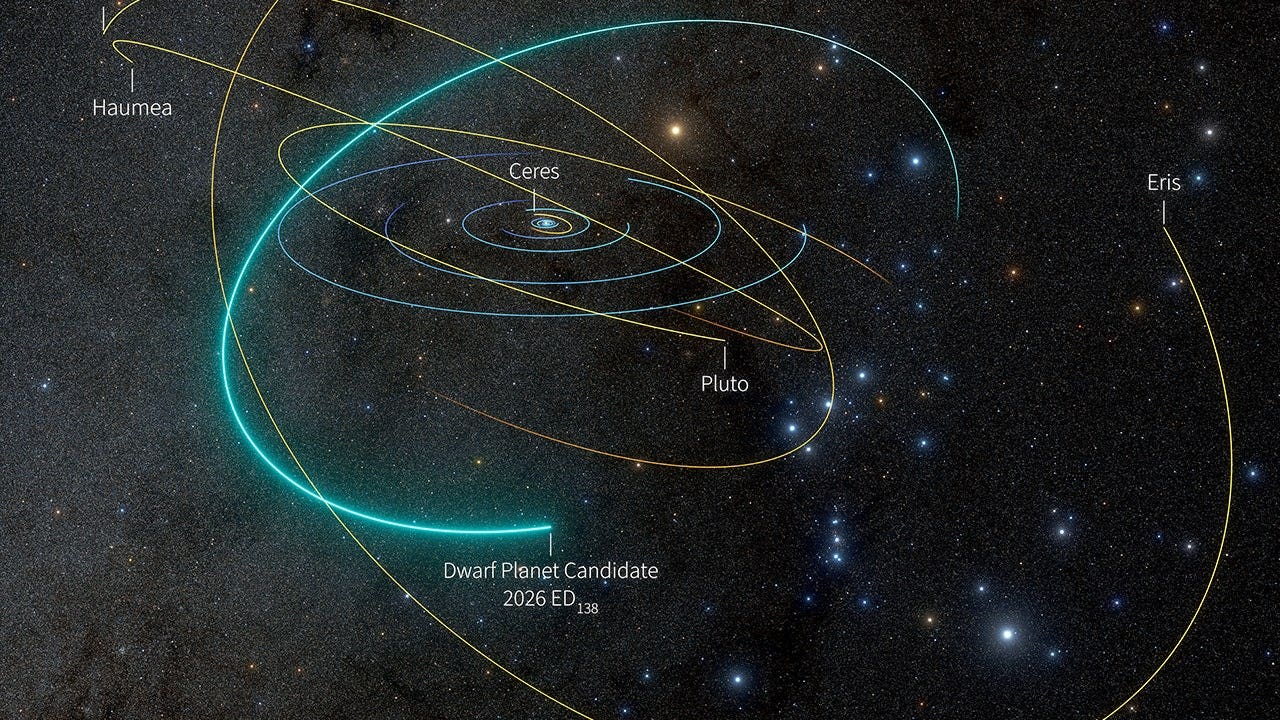
Astronomers using the Vera C. Rubin Observatory in Chile have identified 2026 ED138, a trans-Neptunian object estimated at 370–930 miles across that could be a large dwarf planet if confirmed. It is not the hypothesised Planet Nine.

1 / 2
The story, neutrally told
Mixed · 2Astronomers using the Vera C. Rubin Observatory in Chile have identified an object called 2026 ED138 beyond Pluto, which could be among the largest dwarf planets found in that region of the solar system if confirmed. Fox NewsR “Object 2026 ED138 was spotted beyond Pluto using observations from the Vera C. Rubin Observatory” Read at Fox News ↗ MetroLC “Researchers at the Vera C Rubin Observatory revealed last week that they have discovered a new dwarf planet, named 2026 ED138.” Read at Metro ↗ Right · 1Fox News reports the announcement was made on Oct. 27, and that Rubin astronomer Matthew Holman spotted the object on Oct. 13 while using software he developed with colleague Kevin Napier to search telescope data collected earlier this year. Fox NewsR “On Oct. 13, astronomer Matthew Holman was using computer software he developed with colleague Kevin Napier to search through telescope data collected earlier this year when he spotted the object.”“The discovery, announced Oct. 27” Read at Fox News ↗ Left · 1Metro gives a fuller observation history: a bright speck was seen on March 4, it had moved when looked at again weeks later, and its orbital arc was mapped from March to July. Metro adds that the object also appears in earlier images from other telescopes. MetroLC “On March 4, stargazers spotted a bright speck. When they looked again a few weeks later, it had moved.”“His team found that the dot was also visible in earlier images taken by other telescopes.” Read at Metro ↗
Mixed · 2Fox News gives a size estimate of 370 to 930 miles across, while Metro cites only Holman's estimate of up to 930 miles. Fox says the object is currently about 4.3 billion miles from the sun, against about 3.7 billion miles for Pluto's average distance. Fox NewsR “They estimated it measures between 370 and 930 miles across.”“ED138 is currently located about 4.3 billion miles from the sun, farther away than Pluto, which orbits the sun at an average distance of about 3.7 billion miles.” Read at Fox News ↗ MetroLC “Holman estimates that ED138 could be 930 miles wide” Read at Metro ↗ Right · 1The observatory said the object's brightness and distance suggested it is unusually large. Holman described his reaction as "one of excited disbelief" and said he checked whether he or the code had made an error. Fox NewsR “Holman described his reaction as "one of excited disbelief."”“Objects like this are very rare, so I immediately started checking whether I or the code had done something wrong.” Read at Fox News ↗ Right · 1Officials said it had gone unseen because it lies in a crowded region of sky near the Milky Way, and that Rubin's continuous monitoring of the southern sky and its algorithms allowed the team to find it. Fox NewsR “it was hiding in a crowded region of the sky near the Milky Way, where millions of stars made it difficult for earlier telescopes to detect.” Read at Fox News ↗
Mixed · 2Further observations are needed to pin down its size and whether it qualifies as a dwarf planet, and Metro notes the International Astronomical Union has not yet confirmed it. If it is confirmed, it could be named, and Metro counts it as the sixth dwarf planet after Ceres, Pluto, Eris, Haumea and Makemake. Fox NewsR “scientists hope to conduct further observations of ED138 to determine its exact size and whether it qualifies as a dwarf planet.” Read at Fox News ↗ MetroLC “The International Astronomical Union, which once stripped Pluto of its planethood, has yet to confirm ED138 is a dwarf planet.”“If confirmed, ED138 would be the sixth dwarf planet discovered so far” Read at Metro ↗ Left · 1Metro reports that the object's orbital tilt suggests it formed near Jupiter and Saturn and was flung outward by a gas giant. It also says ED138 is not the hypothesised Planet Nine, which some scientists propose to explain the clustering of six distant objects. MetroLC “The way its orbit is tilted suggests it was squished together somewhere around Jupiter and Saturn before being hurled outward by a gas giant.”“nor is it proof that such a celestial object could be lurking nearby.” Read at Metro ↗ Left · 1Dr Edward Bloomer of the Royal Observatory Greenwich told Metro the find shows scientists have not stopped exploring. MetroLC “Dr Edward Bloomer, an astronomer at the Royal Observatory Greenwich in London, tells Metro.” Read at Metro ↗
Right · 1Fox News adds that Rubin is funded jointly by the US National Science Foundation and the Department of Energy's Office of Science and began a 10-year sky survey in June 2026. Holman said other such worlds may be hiding in places earlier surveys skipped. Fox NewsR “The observatory, jointly funded by the U.S. National Science Foundation and the Department of Energy's Office of Science, began its 10-year survey of the sky in June 2026”“any others hiding in the places earlier surveys skipped are now within reach.” Read at Fox News ↗
Every sentence links to the reporting it rests on. The pill in front of each says where its sources sit: Left, Centre or Right when one side supplies at least half of them, Mixed when they are evenly split. The number is how many outlets it cites.
Left1 outlet
- Framing
- Metro takes a light, explanatory angle, linking the find to the Planet Nine question and quoting a Royal Observatory Greenwich astronomer.
- Emphasis
- Planet Nine, naming, the possibility of life, and the orbit's likely origin near Jupiter and Saturn.
- Leaves out or plays down
- Does not give the announcement date, the 370-mile lower size bound, the distance from the sun or Rubin's funding.
- Charged language
- “cosmic racetrack”
Centre0 outlets
No centre outlet in our sources has covered this story yet.
Right1 outlet
- Framing
- Fox News runs it as a science-discovery item built around the observatory's statement and Holman's quotes, in its lifestyle section.
- Emphasis
- The size range, distance, the observatory's statement, the unusually large brightness, and Rubin's funding and 10-year survey.
- Leaves out or plays down
- Does not mention Planet Nine, the origin of the orbit or the March observations.
- Charged language
- “hiding beyond Pluto”“potentially massive”
- For example
-
“A powerful new telescope has discovered a dwarf planet candidate beyond Pluto” — Fox News
What every side reports
- Rubin Observatory data led to the identification of 2026 ED138 beyond Pluto.
- Matthew Holman and his software are credited with finding it, and he estimates it at up to 930 miles across.
- It has not yet been confirmed as a dwarf planet.
- Pluto was reclassified from planet to dwarf planet.
Where accounts differ
-
Whether ED138 is already a dwarf planet
- Left
- Metro's headline and lede say a new dwarf planet has been discovered, though it later says 'if confirmed' and that the IAU has not confirmed it.
- Right
- Fox News calls it a 'dwarf planet candidate' and says its status is still to be determined.
-
Timeline of discovery
- Left
- Metro says a speck was spotted on March 4 and the orbit was found 'last month'.
- Right
- Fox News says Holman spotted it on Oct. 13 in data collected earlier this year, and the announcement came Oct. 27.
Vera C. Rubin Observatory organisation
Says that if confirmed ED138 would be among the largest dwarf planets in this region, and that Rubin's repeated sky surveys put other hidden worlds within reach.
“If confirmed, ED138 would be among the largest dwarf planets ever discovered in this region of the Solar System” — Fox News
Left1 article
-
MetroLC ·
We’ve discovered a new dwarf planet in our solar system – could ‘Planet 9’ be next?
Mixed Playful explainer that opens with a planet mnemonic, treats the find as a dwarf planet and then clarifies it is not Planet Nine.
Centre0 articles
No coverage yet.
Right1 article
-
Scientists discover potentially massive dwarf planet candidate hiding beyond Pluto
Neutral Straight report relaying the observatory's statement and Holman's quotes, calling ED138 a candidate pending confirmation.
- 2 Nov 16:04 First MetroLC We’ve discovered a new dwarf planet in our solar system – could ‘Planet 9’ be next?
- 2 Nov 21:43 +5h 40m Fox NewsR Scientists discover potentially massive dwarf planet candidate hiding beyond Pluto
Times are when each article was published, or when we first saw it if the outlet gave no time.
Ask about this story
Loading…