Revamped Huanggang Port opens with first joint clearance system for Hong Kong-mainland travellers
The rebuilt Huanggang Port between Shenzhen and Hong Kong opened on Monday 12 October after six years of redevelopment. It is the first Hong Kong-mainland border checkpoint where travellers show documents once under a "joint clearance" system.

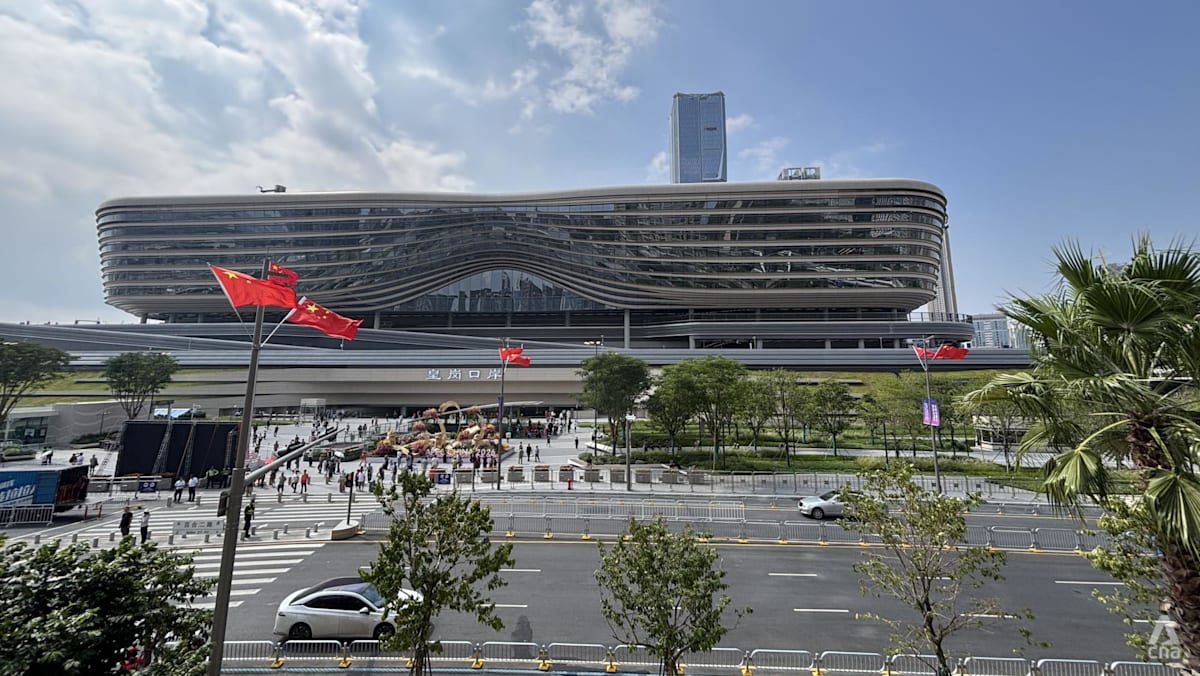
1 / 2
The story, neutrally told
Centre · 2The revamped Huanggang Port officially opened on Monday 12 October after six years of redevelopment, becoming the first land border checkpoint between Hong Kong and mainland China to use a "joint clearance" system for immigration. South China Morning PostN “The revamped Huanggang Port has officially opened after six years of redevelopment, becoming the first border checkpoint between Hong Kong and mainland China to use a “joint clearance” system for immigration.” Read at South China Morning Post ↗ CNAN “The revamped Huanggang Port officially opened on Monday (Oct 12) after six years of redevelopment” Read at CNA ↗ Centre · 1The facility opened at 6.30am, and officials from Hong Kong, Shenzhen and Guangdong province attended an opening ceremony on Sunday, where Chief Executive John Lee Ka-chiu called the project a "critical milestone" in cross-border connectivity. South China Morning PostN “The facility, which opened at 6.30am on Monday”“Chief Executive John Lee Ka-chiu called the new infrastructure “a critical milestone” in cross-border connectivity” Read at South China Morning Post ↗ Centre · 2It replaces the old Huanggang Port in Shenzhen, in use since 1989. Hong Kong and Shenzhen agreed in 2019 to redevelop it on site, as the existing infrastructure had limited room for expansion. CNAN “In 2019, the Hong Kong and Shenzhen authorities agreed to redevelop Huanggang Port on-site, transforming it into a sprawling multi-storey building.” Read at CNA ↗ South China Morning PostN “the retirement of the old checkpoint, in use since 1989” Read at South China Morning Post ↗
Centre · 2Under the new system, Hong Kong and mainland immigration checks are combined at one checkpoint, so travellers present one identity document and pass through an automated channel with three gates instead of queuing on each side of the border. South China Morning PostN “the new system allows travellers to complete clearance by presenting one identity document and passing through an automated channel with three gates.” Read at South China Morning Post ↗ CNAN “Passengers now wait in one line and are only required to show their documents once.” Read at CNA ↗ Centre · 2Authorities say clearance time for people on foot will fall from 30 minutes to about five, and for drivers from 10 minutes to two. For vehicles, one document is enough for what CNA describes as a "five-party inspection" by immigration and customs agencies of both sides and Hong Kong's Department of Health. South China Morning PostN “clearance time will be cut from 30 minutes to five minutes for travellers on foot, and from 10 minutes to two minutes for vehicle drivers.” Read at South China Morning Post ↗ CNAN “The data is collected by five agencies, including the immigration and customs agencies of both Hong Kong and Shenzhen and the Hong Kong Department of Health.” Read at CNA ↗ Centre · 1The port has 134 automated joint clearance channels and 64 manual counters. Hong Kong and mainland residents must register with immigration authorities on both sides to use the automated channels, and more than 160,000 had registered on the e-Channel app by noon on Friday. Eligible Hong Kong residents holding a valid mainland travel permit can use their Hong Kong identity cards for both directions, but are advised to carry both documents. South China Morning PostN “More than 160,000 residents had registered on the Immigration Department’s e-Channel mobile app as of noon on Friday.”“The revamped checkpoint has 134 automated channels using the “joint clearance” system and 64 manual counters.”“authorities have cautioned that eligible residents should still carry both identity documents with them at all times when crossing the border at the new facility.” Read at South China Morning Post ↗
Centre · 1The nine-storey building has a floor area of nearly 690,000 sq m, up from 140,000 sq m at the old port. It handles passengers only, not cargo, and is described as the only Hong Kong-Shenzhen land crossing open round the clock. CNAN “The new nine-storey building has a total floor area of nearly 690,000 sq m - a substantial increase from the 140,000 sq m at the old port”“the new Huanggang Port is solely used for passenger clearance.” Read at CNA ↗ Centre · 2Hong Kong travellers can reach the port by franchised bus, green minibus, cross-border coach or taxi, replacing the earlier shuttle bus from San Tin. There are six daytime bus routes and three green minibus routes, up to 600 taxis were to serve it on day one, and there are no public car parks. South China Morning PostN “There are six daytime bus routes and three green minibus routes that end at the revamped crossing.”“Up to 600 taxis will serve the checkpoint on its first day of operation.” Read at South China Morning Post ↗ CNAN “due to space constraints, no public car parks are available at the port.” Read at CNA ↗ Centre · 1Chief Secretary Eric Chan Kwok-ki, who inspected the automated lanes shortly before opening, called the start "satisfactory" and said passengers reported smooth clearance. He said 500 temporary signs had been put up inside the building and 300 on approach roads, and that he hoped staff would be familiar with procedures by the weekend to handle a surge. South China Morning PostN “Chan, the city’s No 2 official, says the opening was “satisfactory” and that passengers he had talked to reflected a smooth clearance.”“authorities have installed 500 temporary signs inside the building and 300 more along roads leading to the checkpoint.” Read at South China Morning Post ↗
Centre · 1Security chief Chris Tang Ping-keung said extra manpower and contingency plans were in place, that an Emergency Monitoring and Support Centre would be activated alongside a joint command centre with Shenzhen, and he urged people without urgent need to delay their visits. Tour agencies are advertising "five-minute clearance", with one saying its first tour sold out in under three hours. South China Morning PostN “Tang urged those who did not need to use the crossing immediately to delay their visits.”“Another said its first tour sold out in under three hours.” Read at South China Morning Post ↗ Centre · 2Capacity figures differ between reports. SCMP says the port can handle up to 300,000 passengers and 15,000 vehicles a day, with about 100,000 people a day expected initially. CNA says it is expected to handle about 200,000 passenger trips a day, possibly rising to about 300,000 once the MTR Northern Link Spur Line is commissioned. The old port averaged 40,000 travellers a day. South China Morning PostN “The revamped crossing is expected to be able to handle up to 300,000 passengers a day.”“The old Huanggang checkpoint in Shenzhen handled an average of 40,000 travellers a day” Read at South China Morning Post ↗ CNAN “Currently, the redeveloped Huanggang Port is expected to handle about 200,000 passenger trips per day. However, this may be increased to about 300,000” Read at CNA ↗ Centre · 2Officials and commentators placed the opening in the context of Greater Bay Area integration. Guangdong Party secretary Huang Kunming urged Shenzhen to use the port to align with Hong Kong's Northern Metropolis plan and said its co-location arrangement reflected "one country, two systems". Lee said it promotes "hard connectivity" and "connectivity of hearts", and a Hong Kong legislator said the shorter clearance could be extended to other ports if it succeeds. South China Morning PostN “He said its “co-location” clearance arrangement was a reflection of the “one country, two systems” governing principle.” Read at South China Morning Post ↗ CNAN “achieving ‘connectivity of hearts’ between the residents of mainland China and Hong Kong”“The vast reduction in clearance time could be extended to other ports if it proves successful, he said.” Read at CNA ↗
Every sentence links to the reporting it rests on. The pill in front of each says where its sources sit: Left, Centre or Right when one side supplies at least half of them, Mixed when they are evenly split. The number is how many outlets it cites.
Left0 outlets
No left outlet in our sources has covered this story yet.
Centre2 outlets
- Framing
- SCMP gives a live-style first-day account built around official inspections, logistics and passenger reaction. CNA gives an explainer on what is new and why it matters for Hong Kong-Shenzhen and Greater Bay Area connectivity, drawing on government releases, China Daily and SCMP.
- Emphasis
- Time savings, the automated channels, transport links, capacity and official statements on integration. CNA adds building size, the five-agency vehicle inspection and the future rail link.
- Leaves out or plays down
- Neither outlet reports any problems on opening day or criticism of the system. CNA's supporting voices are mostly officials or commentators quoted via China Daily.
- Charged language
- “a critical milestone”“landmark undertaking”“connectivity of hearts”
- For example
-
“Chan, the city’s No 2 official, says the opening was “satisfactory” and that passengers he had talked to reflected a smooth clearance.” — South China Morning Post
“CNA explores what's new about the revamped border checkpoint and its importance to Hong Kong, Shenzhen and the Greater Bay Area.” — CNA
Right0 outlets
No right outlet in our sources has covered this story yet.
What every side reports
- The revamped Huanggang Port opened on Monday 12 October 2026 after six years of redevelopment.
- It is the first Hong Kong-mainland land checkpoint to use a joint clearance system.
- Authorities say clearance time for pedestrians falls from 30 to about five minutes and for drivers from 10 to two minutes.
- It replaces the old port in service since 1989.
Where accounts differ
-
Daily passenger capacity of the new port
- Centre
- SCMP: can handle up to 300,000 passengers a day, with about 100,000 expected in initial operations. CNA: expected to handle about 200,000 trips a day, possibly rising to about 300,000 with the Northern Link Spur Line.
Left0 articles
No coverage yet.
Centre2 articles
-
‘Satisfactory’ opening for revamped Huanggang crossing
Neutral First-day report on the opening, centred on officials' inspection, practical details of the system, transport and crowd-management plans.
-
CNAN ·
CNA Explains: How the new Huanggang Port will improve Hong Kong-mainland connectivity
Sympathetic Explainer presenting the port as an improvement for connectivity, relying largely on official and China Daily voices.
Right0 articles
No coverage yet.
- 12 Oct 00:03 First South China Morning PostN ‘Satisfactory’ opening for revamped Huanggang crossing
- 12 Oct 12:19 +12h 16m CNAN CNA Explains: How the new Huanggang Port will improve Hong Kong-mainland connectivity
Times are when each article was published, or when we first saw it if the outlet gave no time.