Saudi surgeons separate 13-month-old Fijian conjoined twins in Riyadh
A Saudi team at King Abdullah Specialist Children's Hospital in Riyadh operated on 13-month-old Fijian conjoined twins on 15 October. ABC News later reported that doctors said the separation succeeded and reconstruction had begun.
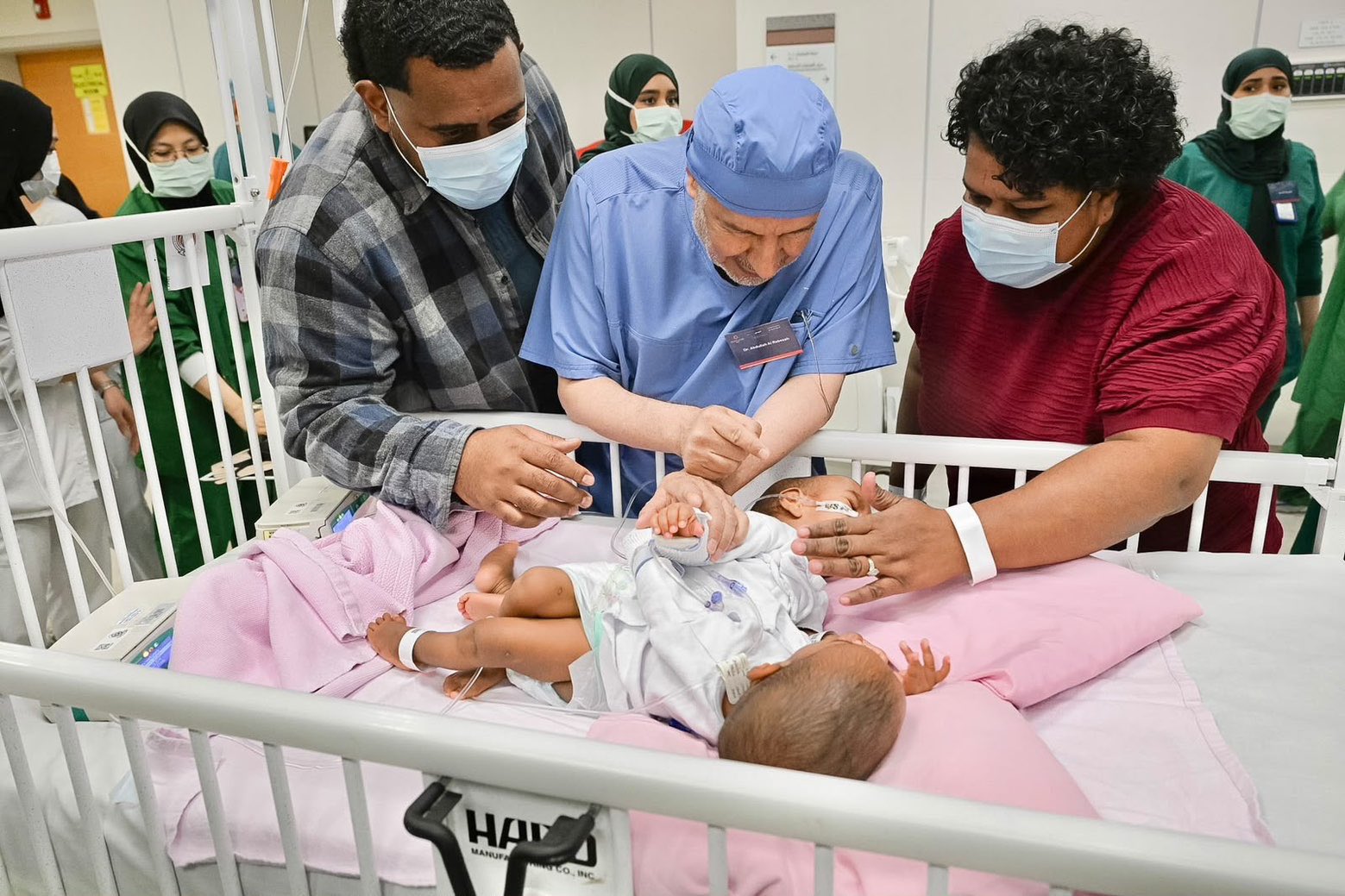
1 / 2
The story, neutrally told
Mixed · 2A Saudi medical team began surgery on Thursday 15 October at King Abdullah Specialist Children's Hospital in Riyadh to separate 13-month-old Fijian conjoined twins, under the Saudi Conjoined Twins Program. Arab NewsRC “A specialized Saudi medical team began complex surgery at King Abdullah Specialist Children’s Hospital in Riyadh on Thursday to separate 13-month-old Fijian conjoined twins” Read at Arab News ↗ ABC News (Australia)LC “The operation was carried out for free under the hospital's Saudi Conjoined Twins Program.” Read at ABC News (Australia) ↗ Right · 1The aid agency KSrelief, which runs the program, said the procedure involved 34 medical professionals and was planned in nine stages over about 15 hours. It described the operation as the 74th separation under the program. Arab NewsRC “The procedure involves 34 medical professionals and will be performed in nine stages over approximately 15 hours, marking the 74th separation procedure under the Saudi Conjoined Twins Program.” Read at Arab News ↗ Right · 1Dr Abdullah Al-Rabeeah, KSrelief supervisor general and head of the surgical team, said the twins arrived in Saudi Arabia on 21 July. He said assessment found them joined at the abdomen and pelvis, sharing a liver, intestines, colon, anus, urinary system, reproductive system and pelvic bone, and put the procedure's success rate at 70 percent. Arab NewsRC “the twins arrived in the Kingdom on July 21”“it was a complex procedure with a success rate of 70 percent” Read at Arab News ↗
Left · 1ABC News (Australia) reported that doctors later announced the twins had been successfully separated and that reconstruction was starting. It said the operation took almost 13 hours, and that the girls have their own hearts and lungs. ABC News (Australia)LC “doctors announced they had successfully separated the pair and were starting on their reconstruction”“The girls had their own hearts and lungs and required an almost 13-hour operation” Read at ABC News (Australia) ↗ Left · 1ABC named the sisters as Dicecea and Jesepeli Kikau and said they were born joined at the lower abdomen and pelvis, a condition known as omphalo-ischiopagus tetrapus. It also reported that their parents, Akeneta Vulimaiigiladi and Watisoni, gave them the Arabic names Noorah (for Jesepeli) and Sarah (for Dicecea) before surgery. ABC News (Australia)LC “the sisters, Dicecea and Jesepeli Kikau, were born joined at the lower abdomen and pelvis.”“chose to give them new Arabic names: Noorah for Jesepeli and Sarah for Dicecea.” Read at ABC News (Australia) ↗ Left · 1Three hours into the operation, Al Rabeeah told ABC it was "going well", "better than our expectation", and that the liver and bowel had been separated with no major bleeding. The mother said she was nervous as the girls went into theatre but felt less so watching by video link. ABC News (Australia)LC “"Better than our expectation, and the two girls are doing well so far in spite of the complexity of surgery,"”“became less so as she watched on via a video link” Read at ABC News (Australia) ↗
Left · 1The Fijian government said the family turned to Saudi Arabia after hospitals in the United States, the United Kingdom, Australia and Mexico wanted large up-front payments, and called the free treatment a lifeline. The government also said this is the second recorded case of conjoined twins in Fiji in 50 years. The twins were born eight weeks premature and have a triplet sister, Hossana, who is not conjoined. ABC News (Australia)LC “after hospitals in the United States, the United Kingdom, Australia and Mexico wanted large up-front payments.”“The girls are the second recorded case of conjoined twins in Fiji in 50 years, according to the government.” Read at ABC News (Australia) ↗ Mixed · 2Arab News said the case was the first separation of conjoined twins from Fiji, and that the program has cared for 159 sets of twins from 28 countries since 1990. ABC, citing the hospital, said the twins came from a program covering 29 countries. Arab NewsRC “which has provided care for 159 sets of conjoined twins from 28 countries since 1990” Read at Arab News ↗ ABC News (Australia)LC “the twins were its 74th set of conjoined twins to be separated from 29 countries.” Read at ABC News (Australia) ↗
Every sentence links to the reporting it rests on. The pill in front of each says where its sources sit: Left, Centre or Right when one side supplies at least half of them, Mixed when they are evenly split. The number is how many outlets it cites.
Left1 outlet
- Framing
- ABC News (Australia) leads with the outcome: a successful separation of an "exceptionally rare" case. It centres on the family and Fiji's perspective.
- Emphasis
- The mother's experience, the parents' Arabic names for the girls, the medical condition, and the Fijian government's account that the family sought free care because Western hospitals demanded large up-front payments.
- Leaves out or plays down
- Does not mention the 70 percent success-rate estimate, the 34-person team, or the Saudi leadership's role in the program.
- Charged language
- “exceptionally rare”“lifeline”
- For example
-
“In what was described as an "exceptionally rare" case, doctors in Saudi Arabia say a complex operation to separate 13-month-old Fijian conjoined twins has been successful.” — ABC News (Australia)
“It said the offer of free treatment through the Saudi Conjoined Twins Program was a lifeline for the family.” — ABC News (Australia)
Centre0 outlets
No centre outlet in our sources has covered this story yet.
Right1 outlet
- Framing
- Arab News reports the start of the surgery largely through the KSrelief statement, crediting King Salman and Crown Prince Mohammed bin Salman and presenting the program as a source of Saudi prestige.
- Emphasis
- Logistics (34 staff, nine stages, about 15 hours), the 70 percent success-rate estimate, the program's record of 159 sets of twins since 1990, and thanks to the Saudi leadership.
- Leaves out or plays down
- Does not include the family's voice, the Western hospitals' costs, or any result, since it was published when the surgery began.
- Charged language
- “global leader in the field”
What every side reports
- The twins are 13 months old and from Fiji.
- The surgery took place at King Abdullah Specialist Children's Hospital in Riyadh on Thursday 15 October.
- It was done under the Saudi Conjoined Twins Program and was described as its 74th separation.
- The operation was planned in nine stages.
- Abdullah Al Rabeeah is the surgical lead.
Where accounts differ
-
Number of countries the program has served
- Left
- ABC News, citing the hospital: the twins were its 74th set, from 29 countries.
- Right
- Arab News: 159 sets of twins from 28 countries since 1990.
-
Length of the operation
- Left
- ABC News: an almost 13-hour operation.
- Right
- Arab News (at the start): planned for about 15 hours.
-
Spelling of the twins' names
- Left
- ABC News: Jesepeli and Dicecea Kikau.
- Right
- Arab News: Jesepeli and Diceacea.
King Salman Humanitarian Aid and Relief Center organisation
KSrelief said the surgery was carried out on the directives of King Salman and the Crown Prince. It presented the case as the 74th under its program, with a 70 percent estimated success rate.
“In implementation of the directives of King Salman and Crown Prince Mohammed bin Salman” — Arab News
“it was a complex procedure with a success rate of 70 percent” — Arab News
Fiji place
The Fijian government said the family went to Saudi Arabia after hospitals elsewhere asked for large up-front payments. It described the free treatment as a lifeline and noted this was the second recorded case of conjoined twins in Fiji in 50 years.
“It said the offer of free treatment through the Saudi Conjoined Twins Program was a lifeline for the family.” — ABC News (Australia)
“The girls are the second recorded case of conjoined twins in Fiji in 50 years, according to the government.” — ABC News (Australia)
Middle East1 outlet
Arab News presents the operation as an achievement of the Saudi program and its leadership.
“which has made the Kingdom a global leader in the field” — Arab News
Arab News
Oceania1 outlet
ABC News (Australia) focuses on the Fijian family and government, including why they sought care abroad.
“The Fijian government said the family sent the twins to Saudi Arabia after hospitals in the United States, the United Kingdom, Australia and Mexico wanted large up-front payments.” — ABC News (Australia)
ABC News (Australia)
Left1 article
-
Complex surgery successfully separates Fijian conjoined twins
Sympathetic Reports a successful separation with a human-interest focus on the family and the Fijian government's account of why they went to Saudi Arabia.
Centre0 articles
No coverage yet.
Right1 article
-
Saudi doctors begin separation surgery on Fijian conjoined twins
Celebratory Reports the start of the operation from the KSrelief statement and the surgical lead, crediting the Saudi leadership and the program's global standing.
- 15 Oct 17:21 First Arab NewsRC Saudi doctors begin separation surgery on Fijian conjoined twins
- 15 Oct 23:28 +6h 7m ABC News (Australia)LC Complex surgery successfully separates Fijian conjoined twins
Times are when each article was published, or when we first saw it if the outlet gave no time.
Ask about this story
Loading…