Chinese team's electric comb regrows hair in mice with androgenetic alopecia
Researchers at Beihang University in Beijing report in Nature Communications that an electric comb, "Detangle", restored nearly 100% hair coverage in mice in 28 days. It has been tested only in animals.

1 / 2
The story, neutrally told
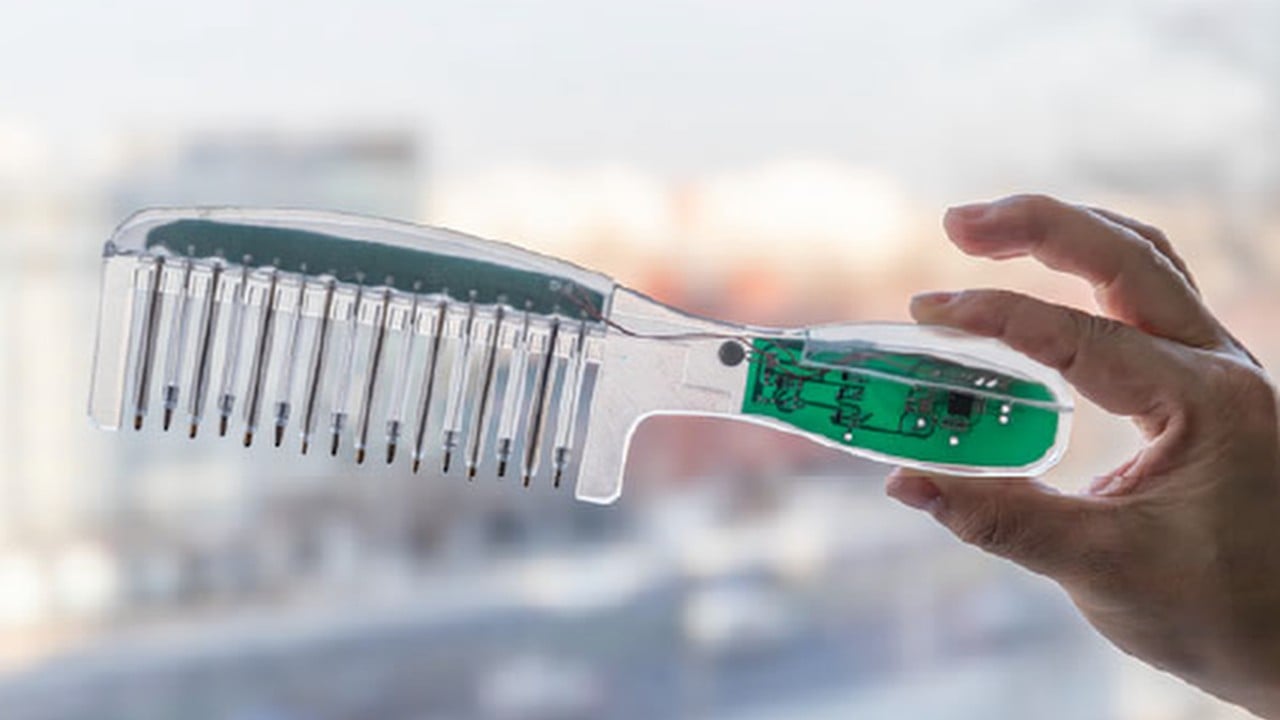
Mixed · 2A research team in China has developed a comb-shaped bioelectronic device called Detangle that uses small electrical pulses to stimulate hair follicles and deliver hair-growth treatments into the skin. Daily MailR “A team in China have developed an electric comb called Detangle that uses tiny pulses to stimulate hair follicles and deliver hair-growth treatments deep beneath the skin.” Read at Daily Mail ↗ South China Morning PostN “according to a Chinese research team which developed a comb that uses microelectronics to treat hair loss” Read at South China Morning Post ↗ Right · 1The team, from Beihang University in Beijing, reported its results in the journal Nature Communications, citing androgenetic alopecia (male pattern baldness) as affecting over 1.5 billion people. Daily MailR “the team, from Beihang University in Beijing, tested their device on mice with androgenetic alopecia.”“'Androgenetic alopecia affects over 1.5 billion individuals, causing progressive hair loss with psychological and quality-of-life burdens,' the team wrote in the journal Nature Communications.” Read at Daily Mail ↗ Mixed · 2In mice, nearly 100 per cent hair coverage was achieved within 28 days, with a bald patch turning into thick hair in that time. South China Morning PostN “nearly 100 per cent hair coverage was achieved in just 28 days using the device” Read at South China Morning Post ↗ Daily MailR “with a bald patch transforming into thick hair in 28 days” Read at Daily Mail ↗
Right · 1Electrical stimulation alone boosted hair growth, improved blood flow and increased follicle numbers, and results were better when combined with two genetic treatments, loaded into the comb's shorter teeth, that promote blood vessel growth and suppress DHT, the hormone largely responsible for male-pattern baldness. Daily MailR “They found that electrical stimulation alone boosted hair growth, improved blood flow and increased the number of hair follicles.”“These treatments were administered through a drug-delivery system also loaded into the shorter teeth of the comb.” Read at Daily Mail ↗ Right · 1According to the Daily Mail's account of the study, treated mice outperformed topical minoxidil and oral finasteride, with hair restoration rising from about 70 per cent with conventional treatments to nearly 100 per cent. Daily MailR “The researchers reported that hair restoration improved from around 70 per cent with conventional treatments to nearly 100 per cent with the Detangle system.” Read at Daily Mail ↗ Right · 1The researchers say the electrode design produces an electric field reaching up to nine times deeper into follicle regions than conventional external application, and that the pulses reduced inflammatory molecules and DHT in scalp tissue. Daily MailR “generate an enhanced electric field penetrating up to nine times deeper into hair follicle regions than conventional external application”“The scientists found the electrical pulses reduced levels of inflammatory molecules and DHT within the scalp tissue.” Read at Daily Mail ↗
Right · 1Repeated use did not cause signs of skin damage, inflammation or nerve injury in the mice. Daily MailR “repeated use did not trigger signs of skin damage, inflammation or nerve injury in the mice.” Read at Daily Mail ↗ Right · 1The device has so far been tested only in animals; the researchers suggest it could eventually help treat the condition in people, but no human results are reported. Daily MailR “While the electric comb has only been trialled in animal experiments, the findings suggest it could eventually help combat androgenetic alopecia” Read at Daily Mail ↗
Every sentence links to the reporting it rests on. The pill in front of each says where its sources sit: Left, Centre or Right when one side supplies at least half of them, Mixed when they are evenly split. The number is how many outlets it cites.
Left0 outlets
No left outlet in our sources has covered this story yet.
Centre1 outlet
- Framing
- The South China Morning Post presents the comb as a Chinese scientific advance, opening with the everyday routine of combing and the hope that it could reverse hair loss.
- Emphasis
- The scale of the condition and the near-100% coverage result in 28 days.
- Leaves out or plays down
- Beyond the opening text, further detail on mechanism, comparison drugs and the animal-only caveat is not evident in its coverage.
- Charged language
- “magic comb”
- For example
-
“Chinese scientists’ magic comb restores hair growth by nearly 100% in mice study” — South China Morning Post
Right1 outlet
- Framing
- The Daily Mail asks whether this is the 'key to curing hair loss' and leads with a consumer angle, while noting the work is in animals only.
- Emphasis
- Rapid growth, the comparison with minoxidil and finasteride, nine-times-deeper penetration and absence of skin or nerve damage.
- Leaves out or plays down
- Does not give details such as sample sizes or independent expert comment on whether results will translate to humans.
- Charged language
- “key to curing hair loss”“rapid growth”
- For example
-
“Is this the key to curing hair loss? Scientists invent an electric comb that promotes rapid growth in mice - and they say it could work in humans too” — Daily Mail
What every side reports
- A Chinese team developed a microelectronic comb to treat androgenetic alopecia.
- In mice, nearly 100% hair coverage was reported after 28 days.
- Androgenetic alopecia is said to affect more than 1.5 billion people.
- The work has been done in mice, not humans.
Hair loss research topic
Researchers from Beihang University present the comb as an efficient treatment delivered during daily combing, effective in mice and potentially in humans.
“Herein we develop a comb-shaped bioelectronic system for efficient androgenetic alopecia treatment during daily hair combing.” — Daily Mail
UK and Ireland1 outlet
The Daily Mail frames it as a possible cure for millions of people with thinning hair, hedged by animal-only testing.
“If you're one of the millions battling thinning hair, you might be using your comb less often these days.” — Daily Mail
Daily Mail
East and Southeast Asia1 outlet
The SCMP frames it as a result from a Chinese research team, stressing the near-100% coverage figure.
“A study on mice has found that nearly 100 per cent hair coverage was achieved in just 28 days using the device” — South China Morning Post
South China Morning Post
Left0 articles
No coverage yet.
Centre1 article
-
Chinese scientists’ magic comb restores hair growth by nearly 100% in mice study
Celebratory Presents the comb as a promising Chinese breakthrough that may reverse hair loss.
Right1 article
-
Mixed Hopeful consumer-science piece with a question headline, relaying study findings in detail and noting animal-only testing.
- 16 Nov 16:00 First Daily MailR Is this the key to curing hair loss? Scientists invent an electric comb that promotes rapid growth in mice - and they say it could work in humans too
- 18 Nov 01:00 +33h South China Morning PostN Chinese scientists’ magic comb restores hair growth by nearly 100% in mice study
Times are when each article was published, or when we first saw it if the outlet gave no time.
Ask about this story
Loading…