Senate leaders release text of bipartisan energy permitting reform bill
Senate negotiators released the text of a bipartisan energy permitting bill, the Bipartisan American Affordability and Jobs Act. Business groups back it, while the climate movement is split over it.
1 / 2
The story, neutrally told
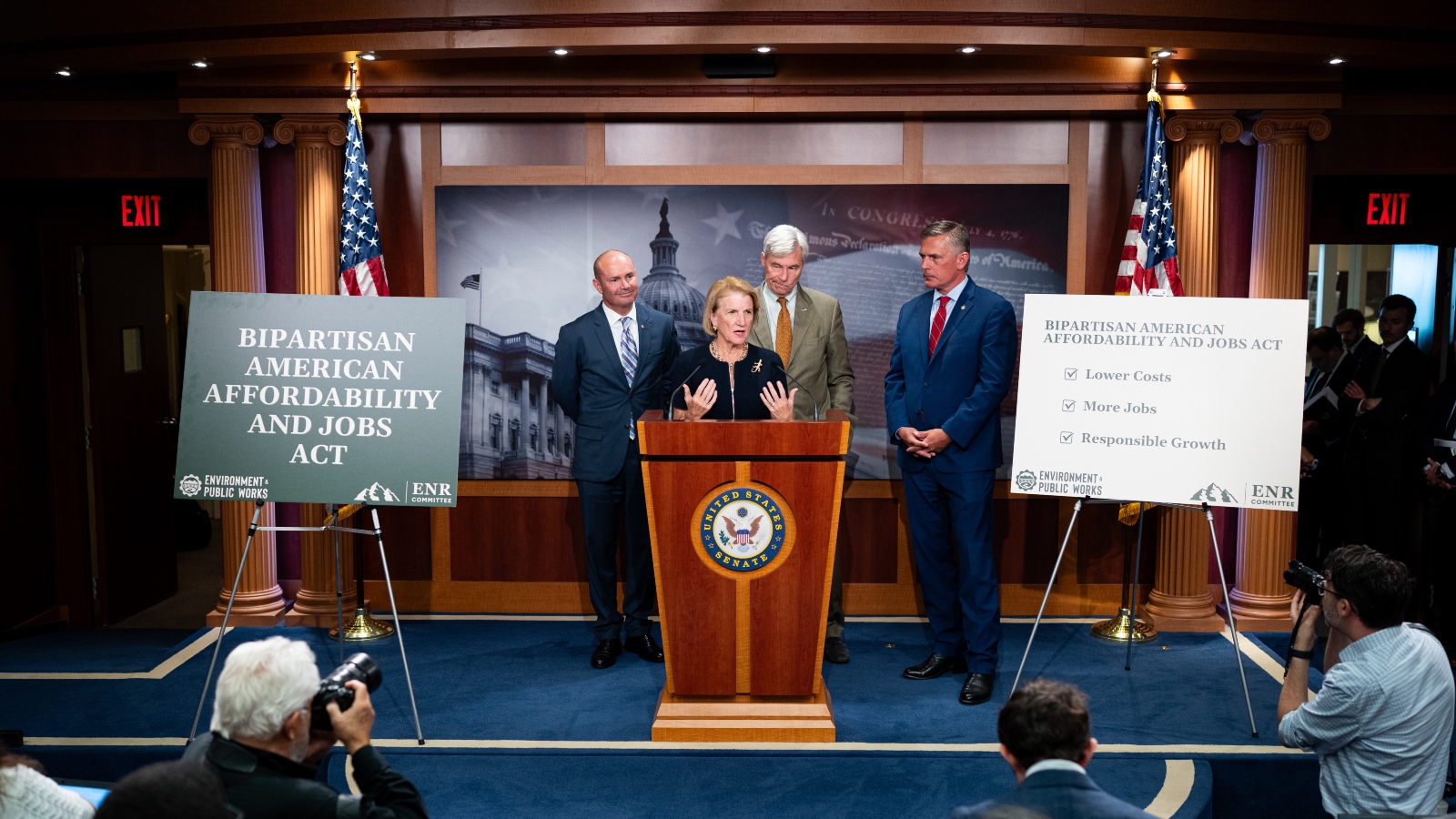
Mixed · 2Senate leaders released the text of a bipartisan energy permitting reform deal in the week of 7 October 2026. Washington ExaminerR “This week, Senate leaders released the text of a forthcoming energy permitting reform deal.” Read at Washington Examiner ↗ GristL “The inciting incident was the release of the Bipartisan American Affordability and Jobs Act, or BAAJA” Read at Grist ↗ Left · 1The bill, known as BAAJA, is a roughly 400-page Senate measure meant to enable construction of more power plants, transmission lines and gas pipelines. GristL “a sprawling 400-page bill with hundreds of individual provisions”“designed to enable the construction of more power plants, transmission lines, and gas pipelines” Read at Grist ↗ Left · 1It was negotiated by four senators on the energy and environment committees: Democrats Sheldon Whitehouse of Rhode Island and Martin Heinrich of New Mexico, and Republicans Mike Lee of Utah and Shelley Moore Capito of West Virginia. GristL “The two Democrats in the talks were Sheldon Whitehouse of Rhode Island and Martin Heinrich of New Mexico” Read at Grist ↗
Left · 1According to Grist, the bill speeds up agency permit timelines, makes it harder to cancel projects already federally approved, and weakens some bedrock environmental laws. Lawsuits under the National Environmental Policy Act (NEPA) would have to be filed within 150 days of the end of review rather than six years, and plaintiffs would have to have raised the issue during public comment. GristL “Litigation would need to be brought within 150 days of the end of the NEPA review process, rather than six years”“weakening some of the nation’s bedrock environmental laws, speeding up the timeline for government agencies to issue permits” Read at Grist ↗ Left · 1Under the bill a court could order an agency to redo its analysis while a project proceeds, rather than pausing it, and permits could be revoked only in limited circumstances such as a legal violation or risk of immediate or substantial harm to "life, property, national security, or defense." One provision would help developers seek compensation if the government is shown to have discriminated against a project type, such as offshore wind. GristL “a court could only order the agency to redo its analysis while a project moves forward, rather than pausing a project altogether”“help developers seek compensation if they can establish that the government has discriminated against a specific project type” Read at Grist ↗ Right · 1Ten state chambers of commerce, in an op-ed in the Washington Examiner, endorsed the deal. They say it sets concrete timelines, designates lead agencies, limits litigation and is technology-neutral, speeding gas pipelines and nuclear as well as wind, solar and geothermal, while keeping safety and environmental standards. Washington ExaminerR “The Senate deal establishes concrete timelines, designates lead agencies to streamline reviews, places reasonable limits on endless litigation”“this deal is technology-neutral” Read at Washington Examiner ↗
Right · 1The chambers say federal environmental review takes an average of four to seven years for major infrastructure projects, and that frivolous litigation and overlapping jurisdictions stall projects. Washington ExaminerR “it takes an average of four to seven years just to clear the federal environmental review process for major infrastructure projects” Read at Washington Examiner ↗ Left · 1Grist reports that the bill has split the climate movement. Clean-energy companies and some policy experts back it as a way to build more clean power, such as Ray Long of the renewables trade group ACORE, who called it "a great bill." Opponents call it a "Faustian bargain" that endangers tribal nations, marginalised communities and endangered species. GristL “Opponents say that’s a Faustian bargain, one that will jeopardize tribal nations, other marginalized communities, and endangered species.”““This is a great bill, and it’s a huge step in the right direction,” said Ray Long” Read at Grist ↗ Left · 1The bill has not yet cleared committee and faces an uncertain fate in the House. Grist says the Senate will not return to it until after the midterm elections, and that lobbying by supporters and opponents is expected in the meantime. GristL “the Senate will not return to take up the bill until after the midterm elections. The bill has not even made it through committee yet” Read at Grist ↗
Every sentence links to the reporting it rests on. The pill in front of each says where its sources sit: Left, Centre or Right when one side supplies at least half of them, Mixed when they are evenly split. The number is how many outlets it cites.
Left1 outlet
- Framing
- Grist treats the bill as a source of conflict inside the climate movement, weighing building clean energy against environmental and community protections.
- Emphasis
- NEPA litigation changes, transmission lines, offshore wind compensation, and the divide between 'builders' and 'blockers'.
- Leaves out or plays down
- Little on business-community backing beyond clean-energy trade groups.
- Charged language
- “tearing the climate movement apart”“civil war”“Faustian bargain”
- For example
-
“over the past week a kind of civil war has erupted between the different elements of the climate movement” — Grist
Centre0 outlets
No centre outlet in our sources has covered this story yet.
Right1 outlet
- Framing
- A joint op-ed by ten state chambers of commerce presents the deal as a landmark, pro-growth fix to bureaucracy and delay.
- Emphasis
- Jobs, lower costs, grid reliability, state-level reforms and the deal's technology-neutral approach.
- Leaves out or plays down
- Does not mention the environmental and community objections or the split among climate groups. It does not say when the bill might pass.
- Charged language
- “generational step forward”“trap of endless delay”“Frivolous litigation”
- For example
-
“Our decades-old regulatory framework has devolved from sensible environmental safeguards into a trap of endless delay.” — Washington Examiner
What every side reports
- Senate negotiators released the text of a bipartisan energy permitting reform bill this week.
- The bill aims to speed up permitting and limit litigation that delays energy projects.
- Both outlets say it covers clean and fossil energy infrastructure.
Where accounts differ
-
Whether the bill's litigation limits are a needed reform or a threat to the environment and communities
- Left
- Grist reports that it weakens bedrock environmental laws and that opponents fear harm to tribal nations, marginalised communities and endangered species.
- Right
- The chambers' op-ed says it places reasonable limits on endless litigation while maintaining strong safety and environmental standards.
Energy permitting reform topic
Business chambers strongly endorse the reform as a way to cut delays and costs, while Grist reports that environmental groups dispute it and clean-energy interests support it.
“we strongly endorse this deal and believe it could be a generational step forward for our economy” — Washington Examiner
“It is definitely exposing a potential fault line between the environmental community and clean energy interests” — Grist
Left1 article
-
GristL ·
The bipartisan energy bill tearing the climate movement apart
Mixed Explanatory piece on how the bill divides climate advocates, with detail on its litigation and transmission provisions.
Centre0 articles
No coverage yet.
Right1 article
-
Washington ExaminerR · · Opinion
America can’t build anything anymore. Congress is finally fixing it
Celebratory Opinion piece by ten state chambers praising the deal as a landmark that will end permitting delays.
- 7 Oct 16:00 First Washington ExaminerR America can’t build anything anymore. Congress is finally fixing it Opinion
- 8 Oct 21:19 +29h 19m GristL The bipartisan energy bill tearing the climate movement apart
Times are when each article was published, or when we first saw it if the outlet gave no time.