Sheffield researchers recreate colour-changing effect of Roman Lycurgus Cup
University of Sheffield scientists say they have replicated the green-to-red colour change of the 1,600-year-old Lycurgus Cup by embedding gold and silver nanoparticles in glass. A sculpture using the glass goes on show in Sheffield from 6 November.

1 / 2
The story, neutrally told
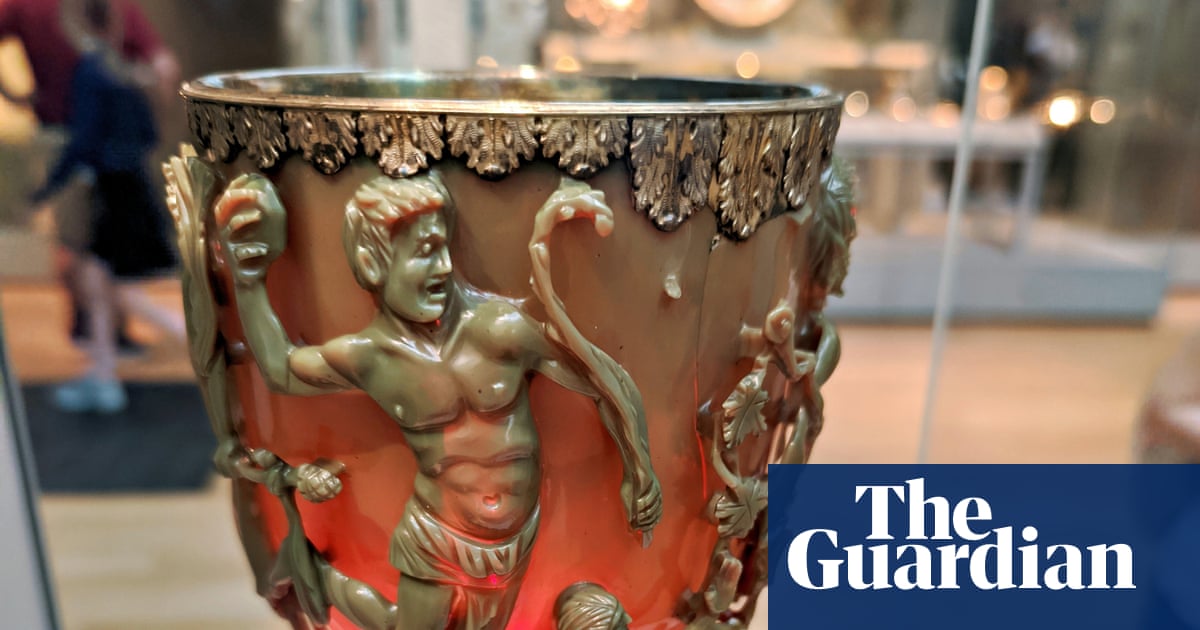
Mixed · 2Scientists at the University of Sheffield say they have replicated the optical behaviour of the Lycurgus Cup, a fourth-century Roman glass vessel in the British Museum, using an ancient recipe derived from a fragment of the original. The GuardianLC “Now scientists from the University of Sheffield have replicated its remarkable optical behaviour, using an ancient recipe derived from a fragment of the Roman “dichroic” (two-coloured) original.” Read at The Guardian ↗ GB NewsR “The breakthrough was achieved using an ancient recipe analysed from a fragment of the Roman original.” Read at GB News ↗ Mixed · 2The cup looks jade green in normal light and ruby red when lit from behind, an effect known as dichroism that has puzzled historians and glass-makers for centuries. The GuardianLC “the Lycurgus Cup changes colour, from jade green under normal lighting to ruby red when lit from behind” Read at The Guardian ↗ GB NewsR “The cup transforms from jade green under standard lighting to a deep ruby red when illuminated from behind” Read at GB News ↗ Mixed · 2Dr Lisa Hollands, a technician in the university's school of chemical, materials and biological engineering, did the initial research with Prof Caroline Jackson, a leading Roman glass expert. Hollands called the work "a labour of love", said "people have tried it before with limited success" and described the result as "magic". The GuardianLC “Hollands worked with Prof Caroline Jackson, a leading Roman glass expert, in conducting the initial research.” Read at The Guardian ↗ GB NewsR “She told The Guardian the project was "a labour of love", noting that "people have tried it before with limited success".” Read at GB News ↗
Mixed · 2The challenge was embedding gold and silver nanoparticles, each about a thousand times smaller than a grain of sand, into glass. The team made a thick molten glass, and as it cooled from well over 1,000C, gold and silver nanocrystals grew around particles within it. The GuardianLC “A thick molten glass was created and, as it cooled from well over 1,000C, gold and silver nanocrystals started to grow around particles within it.” Read at The Guardian ↗ GB NewsR “The central challenge lay in embedding nanoparticles of gold and silver - each roughly a thousand times smaller than a single grain of sand - into the glass itself.” Read at GB News ↗ Mixed · 2Hollands explained that light shone through the glass has its blue and green wavelengths blocked by the particles, so only reds and oranges pass. Light reflected off the surface is scattered by the particles, which gives the opaque green. The GuardianLC “the gold and silver particles block blue and green light, only allowing reds and oranges to pass through.” Read at The Guardian ↗ GB NewsR “Light striking the surface, by contrast, is scattered by the particles, producing the opaque green appearance.” Read at GB News ↗ Mixed · 2The original carries a mythological frieze, carved in deep relief, of the god Dionysus triumphing over King Lycurgus, who is ensnared by a vine. An international panel named it one of the seven glass wonders of the world in 2022. The GuardianLC “Carved in deep relief, it shows the triumph of the god of wine, Dionysus, over Lycurgus, who is ensnared by a vine.” Read at The Guardian ↗ GB NewsR “an international panel recognising the cup in 2022 as one of the seven glass wonders of the world” Read at GB News ↗
Mixed · 2Ian Freestone, emeritus professor of archaeological materials at University College London, said a similarly coloured glass was made in the 1960s, but the Sheffield work is much closer to the cup's actual green and red shades: "This is more ambitious and more precise." He said it will help show how Roman craftsmen worked. The GuardianLC “although a similar-coloured glass was replicated in the 1960s, Sheffield’s project is much closer to the actual green and red shades of the Lycurgus Cup.” Read at The Guardian ↗ GB NewsR “"This is more ambitious and more precise," he said.” Read at GB News ↗ Left · 1Freestone said the colour depended heavily on where the glass sat in the furnace, which suggests the Romans would have struggled to control it. In the Guardian's account he added, "with the Lycurgus glass, they hit the jackpot". The GuardianLC “The fact that the colour is so sensitive to the position in the furnace suggests that it would have been very difficult for the Romans to control the colour. It makes me think that, with the Lycurgus glass, they hit the jackpot.” Read at The Guardian ↗ Mixed · 2Freestone also cited a theory that the red-green shift symbolised the ripening of grapes, and that the cup may have been used in a drinking ceremony. A letter attributed to the emperor Hadrian refers to "parti-coloured cups that change colour" for use at banquets on feast days. The GuardianLC “So it could have been used in a drinking ceremony of some sort.” Read at The Guardian ↗ GB NewsR “a letter attributed to the emperor Hadrian, addressed to his brother-in-law, references "parti-coloured cups that change colour" intended for use "at banquets on feast days"” Read at GB News ↗
Mixed · 2Sheffield commissioned the glass artist Elliot Walker to make a contemporary sculpture using the effect. It will be unveiled at the Millennium Gallery during the university's Festival of the Mind, 6-15 November, and will then go on permanent display at the Turner Museum of Glass. The GuardianLC “It will be unveiled at the Millennium Gallery, as part of the university’s Festival of the Mind from 6-15 November, before a permanent display at the Turner Museum of Glass.” Read at The Guardian ↗ GB NewsR “the university commissioned glass artist Elliot Walker to create a contemporary sculpture.” Read at GB News ↗
Every sentence links to the reporting it rests on. The pill in front of each says where its sources sit: Left, Centre or Right when one side supplies at least half of them, Mixed when they are evenly split. The number is how many outlets it cites.
Left1 outlet
- Framing
- The Guardian ran it as an exclusive science feature, led by Hollands's quote that it is 'magic', with extended expert commentary.
- Emphasis
- Freestone's view on the Romans' difficulty controlling the colour ("hit the jackpot"), the human story of the researcher and the artist, and the Hadrian letter.
- Leaves out or plays down
- No notable omissions relative to the other outlet.
- Charged language
- “It’s magic”“labour of love”
- For example
-
“Exclusive: Optical engineering that went into 1,600-year-old Lycurgus Cup has baffled experts for centuries” — The Guardian
Centre0 outlets
No centre outlet in our sources has covered this story yet.
Right1 outlet
- Framing
- GB News presented it as an 'archaeology breakthrough', a shorter rewrite built on the Guardian's reporting and quoting Hollands as telling The Guardian.
- Emphasis
- The achievement and the cup's mystique, with repeated lines on the colour shift. It credits the Guardian as its source for Hollands's quotes.
- Leaves out or plays down
- Leaves out Freestone's remarks on the furnace sensitivity and the 'jackpot' comment, and does not name the Guardian as the exclusive source in its headline.
- Charged language
- “Archaeology breakthrough”“wondrous Roman creation”“astonishing piece of optical engineering”
- For example
-
“She told The Guardian the project was "a labour of love"” — GB News
What every side reports
- Sheffield researchers replicated the cup's green-to-red dichroic effect using gold and silver nanoparticles in glass.
- The original is a fourth-century Roman vessel in the British Museum.
- Ian Freestone said the work is more precise than a 1960s replication.
- A sculpture by Elliot Walker will be shown at the Millennium Gallery from 6 to 15 November, then at the Turner Museum of Glass.
University of Sheffield organisation
Presents the project as a successful replication by its own researchers, with a commissioned sculpture to mark it at its Festival of the Mind.
“Now scientists from the University of Sheffield have replicated its remarkable optical behaviour” — The Guardian
“Sheffield commissioned Elliot Walker, a glass artist, to bring the effect to life” — The Guardian
Lycurgus Cup other
The original object in the British Museum, whose colour change the Sheffield team set out to reproduce.
“The iconic piece is showcased in the British Museum” — GB News
Left1 article
-
‘It’s magic’: scientists rediscover how to make ancient Roman colour-changing glass
Celebratory Exclusive feature celebrating the rediscovery of a lost craft, with expert context.
Centre0 articles
No coverage yet.
Right1 article
-
GB NewsR ·
Archaeology breakthrough as scientists uncover secrets behind wondrous Roman creation
Celebratory Follow-up that recasts the Guardian exclusive as an archaeology breakthrough, with similar content and wording.
- 25 Oct 06:00 First The GuardianLC ‘It’s magic’: scientists rediscover how to make ancient Roman colour-changing glass
- 25 Oct 13:34 +7h 34m GB NewsR Archaeology breakthrough as scientists uncover secrets behind wondrous Roman creation
Times are when each article was published, or when we first saw it if the outlet gave no time.
Ask about this story
Loading…