South Korea test-flies its first domestically developed hypersonic weapon
South Korea flight-tested its first home-grown hypersonic weapon on 8 October, days after North Korea's own hypersonic missile test, amid tension over landmine blasts near the border.
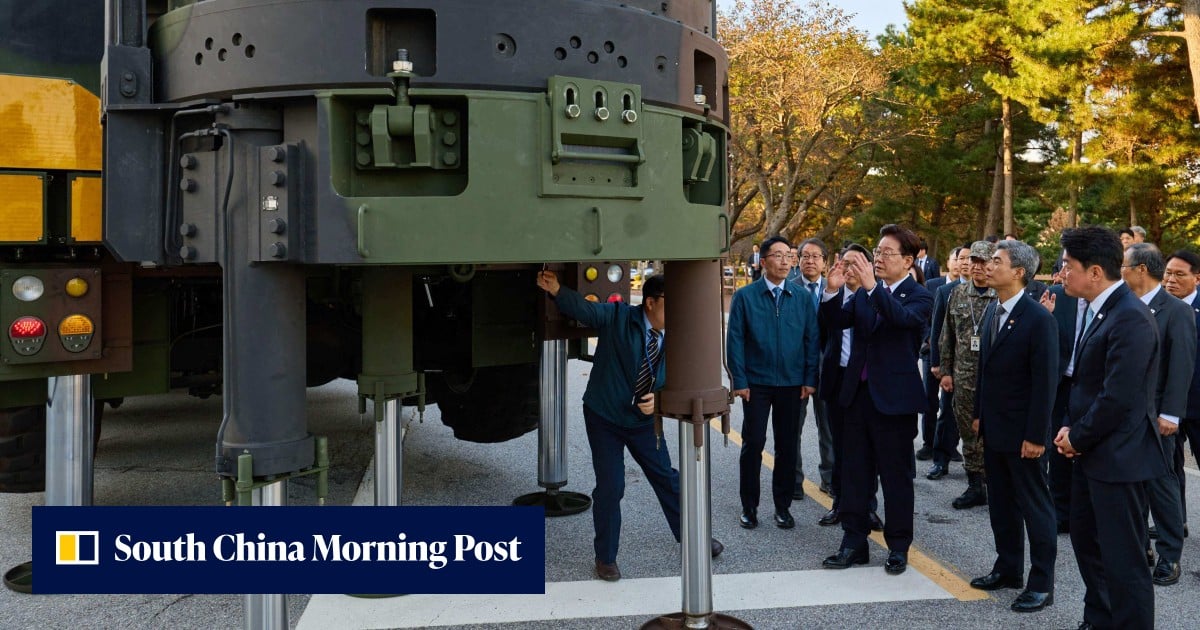
1 / 1
The story, neutrally told
Mixed · 2South Korea flight-tested its first domestically developed hypersonic weapon on Thursday 8 October 2026, designed to fly at least five times the speed of sound and evade missile defence systems. South China Morning PostN “South Korea flight-tested on Thursday its first domestically developed hypersonic weapon, designed to fly at least five times the speed of sound and evade missile defence systems” Read at South China Morning Post ↗ NPRLC “South Korea test-flies its first domestically developed hypersonic weapon” Read at NPR ↗ Centre · 1According to a statement, President Lee Jae Myung attended the test and called it a major step in strengthening the country's conventional defence capabilities; the statement did not say where it took place. South China Morning PostN “South Korean President Lee Jae Myung attended the test, saying it was a major step in strengthening the country’s conventional defence capabilities, according to a statement.” Read at South China Morning Post ↗ Centre · 1The statement said the weapon separated from its booster rocket at the planned altitude, then descended and manoeuvred vertically and horizontally before hitting a test target, and that once developed it could strike key targets by surprise in the "Korean peninsula theatre of operations". South China Morning PostN “the weapon separated from its booster rocket at the planned altitude, then descended and manoeuvred both vertically and horizontally before hitting a test target” Read at South China Morning Post ↗
Centre · 1Lee said South Korea "must secure our security through our own strength" and also inspected the country's most powerful Hyunmoo-5 ballistic missile, his office said; it did not mention direct comments by Lee on North Korea. South China Morning PostN “Lee stressed that South Korea “must secure our security through our own strength”, and also inspected the country’s most powerful Hyunmoo-5 ballistic missile on Thursday, his office said.” Read at South China Morning Post ↗ Mixed · 2The test follows North Korea's hypersonic missile test on 3 October; North Korea described it as an intermediate-range missile that flew more than 1,000km, while South Korea detected a flight of more than 700km and Japan assessed about 680km, with the missile landing outside Japan's exclusive economic zone. There was no immediate response from North Korea to the South's test. South China Morning PostN “North Korea launched what it described as a hypersonic intermediate-range missile that it said flew more than 1,000km (621 miles).”“South Korea said it detected the missile flying more than 700km, while Japan’s defence ministry said it assessed that the missile flew about 680km.” Read at South China Morning Post ↗ NPRLC “The test follows North Korea's recent hypersonic missile test.” Read at NPR ↗ Centre · 1Kim Yo-jong, sister of Kim Jong-un, claimed the differing estimates showed South Korea and Japan could not properly track such a missile and so could not intercept it. South China Morning PostN “Kim Yo-jong, the powerful sister of the North Korean leader, claimed the differing flight estimates by the two US allies showed they were incapable of properly tracking such a missile” Read at South China Morning Post ↗
Mixed · 2Inter-Korean tensions have risen after landmine explosions last month near the border injured three South Korean soldiers; the South's military and the US-led United Nations Command concluded North Korea planted the devices, while North Korea denies responsibility and has ridiculed demands for an apology. South China Morning PostN “The South’s military and the US-led United Nations Command concluded the blasts were caused by devices planted by North Korea, which has denied responsibility and ridiculed the South’s demands for an apology.” Read at South China Morning Post ↗ NPRLC “Tensions between the Koreas have increased after land mine explosions injured three South Korean soldiers near the border. North Korea denies responsibility.” Read at NPR ↗ Centre · 1Lee, who favours engagement with the North, has also called for stronger conventional defences and less reliance on the United States, which unilaterally scaled back a major joint exercise in August, with President Donald Trump citing his "very good relationship" with Kim. South China Morning PostN “Lee has also called for strengthening South Korea’s conventional defence capabilities while reducing its reliance on the United States, which unilaterally decided to scale back a major military exercise with the South in August” Read at South China Morning Post ↗
Every sentence links to the reporting it rests on. The pill in front of each says where its sources sit: Left, Centre or Right when one side supplies at least half of them, Mixed when they are evenly split. The number is how many outlets it cites.
Left1 outlet
- Framing
- NPR carries the Associated Press report, framing the test as following North Korea's hypersonic launch and the border landmine tensions.
- Emphasis
- The sequence of North Korean test, landmine blasts and the South's response; North Korea's denial.
- For example
-
“The test follows North Korea's recent hypersonic missile test.” — NPR
Centre1 outlet
- Framing
- The South China Morning Post runs the full Associated Press report, leading with the test and its capabilities, then regional context.
- Emphasis
- Technical flight details from the South's statement, Lee's remarks, differing missile-range estimates and Kim Yo-jong's claim, and US-Korea diplomacy.
- Charged language
- “game-changing”
- For example
-
“bringing Seoul closer to what it says could be game-changing weapons capabilities” — South China Morning Post
Right0 outlets
No right outlet in our sources has covered this story yet.
What every side reports
- South Korea test-flew its first domestically developed hypersonic weapon on 8 October.
- The test follows a recent North Korean hypersonic missile test.
- Three South Korean soldiers were injured by landmine blasts near the border, and North Korea denies responsibility.
Left1 article
-
NPRLC ·
South Korea test-flies its first domestically developed hypersonic weapon
Neutral Associated Press copy on NPR placing the test in the context of North Korea's missile test and border landmine tensions.
Centre1 article
-
South China Morning PostN · · via AP
South Korea test-flies its first home-grown hypersonic weapon
Neutral Associated Press copy on the SCMP giving the South's account of the test with regional and diplomatic background.
Right0 articles
No coverage yet.
- 8 Oct 13:01 First NPRLC South Korea test-flies its first domestically developed hypersonic weapon
- 8 Oct 14:05 +1h 4m South China Morning PostN South Korea test-flies its first home-grown hypersonic weapon via AP
Times are when each article was published, or when we first saw it if the outlet gave no time.