SpaceX Starship reaches orbit for first time on 14th test flight, deploys 26 Starlinks
SpaceX's 14th Starship flight on 28 September reached orbit for the first time, released 26 Starlink V3 satellites and splashed down in the Pacific. An engine failure led SpaceX to cut the orbital phase short.
Updated (version 2). New coverage since the last version from Ars Technica. Previously: “SpaceX Starship flies 14th test, reaches orbit for first time and splashes down”.

1 / 3
The story, neutrally told
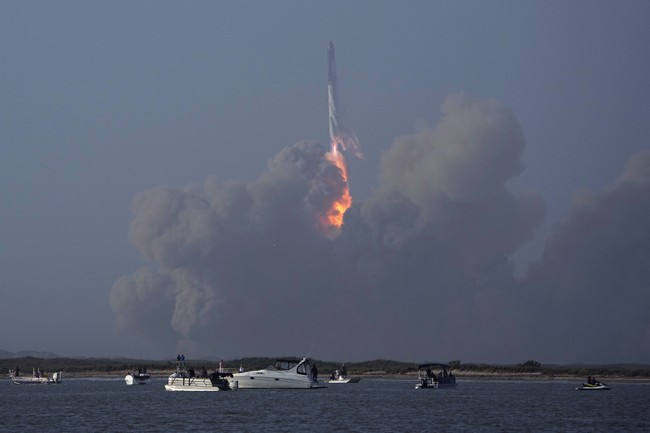
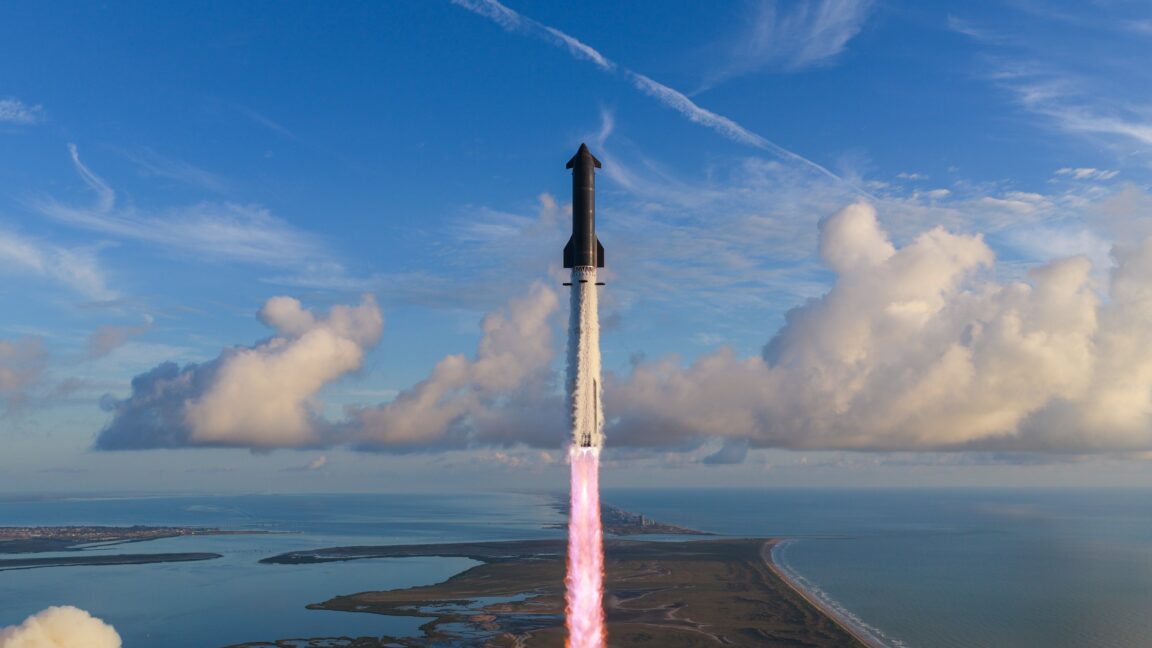
SpaceX's 14th Starship test flight reached orbit on Monday 28 September and splashed down in the Pacific Ocean just before noon. ABC NewsLC “successfully achieved orbit Monday morning and splashed down in the Pacific just before noon” Read at ABC News ↗ BBC NewsN “SpaceX's Starship rocket has splashed down in the Pacific Ocean after orbiting the Earth for about three hours.” Read at BBC News ↗ Ars Technica and Hot Air both say it was the first Starship flight to reach orbit, because all earlier flights were deliberately suborbital. Ars TechnicaLC “On all of Starship’s previous flights, SpaceX intentionally dialed back the full capability of the rocket to fly a suborbital trajectory” Read at Ars Technica ↗ Hot AirR “Starship has never reached orbit before. All previous test flights have been suborbital.” Read at Hot Air ↗ The ship released 26 next-generation Starlink V3 satellites. Ars Technica says SpaceX reported contact with all 26. BBC NewsN “The ship deployed 26 "next generation" Starlink V3 satellites” Read at BBC News ↗ Ars TechnicaLC “SpaceX reported that its satellite team established contact with all 26 Starlink V3s after separating from Starship.” Read at Ars Technica ↗
One of the ship's six engines shut down early during ascent, so mission managers debated whether to attempt the orbital burn before deciding to go ahead. Ars TechnicaLC “One of the six Raptors on Starship shut down prematurely during its ascent burn” Read at Ars Technica ↗ Hot AirR “About 22 minutes into the flight, the team decided it was safe to do so.” Read at Hot Air ↗ Both detailed accounts say the Super Heavy booster appeared to lose two of its 33 engines. They differ on when the failures happened and on how the booster's splashdown went. Ars TechnicaLC “the apparent failure of two of the 33 Raptor engines on the Super Heavy booster—one during launch and another during the booster’s return maneuvers” Read at Ars Technica ↗ Hot AirR “The booster appeared to lose two out of 33 engines but that was only near the end of the boost phase just before stage separation.” Read at Hot Air ↗ Because of the engine problem, SpaceX ended the orbital phase early. The mission had been planned to last about 10 hours and instead lasted about three. BBC NewsN “The mission was supposed to last about 10 hours, but the SpaceX team decided to end it early.” Read at BBC News ↗ Ars TechnicaLC “Out of an abundance of caution given the engine issue experienced during ascent” Read at Ars Technica ↗
Ars Technica adds that the Starlink V3 satellites can fly only on Starship and that SpaceX says each adds about ten times the capacity of older Falcon 9-launched satellites. It says the previous Starship flight in July carried V3s that burned up because that flight was suborbital. Ars TechnicaLC “They’re too large to fit inside the payload fairing of the Falcon 9 rocket”“that mission was suborbital, and the satellites quickly burned up as they fell back into the atmosphere” Read at Ars Technica ↗ The BBC gives SpaceX's stated aim for Starship: to carry crew and cargo to Earth orbit, the Moon, Mars and beyond. BBC NewsN “says it will eventually carry crew and cargo "to Earth orbit, the Moon, Mars and beyond"” Read at BBC News ↗ Hot Air calls the flight a partial success, saying not all the bugs have been worked out. ABC calls it successful. Ars Technica quotes a SpaceX commentator calling the orbital insertion burn "a huge success". Hot AirR “So, overall, it was a partially successful mission.” Read at Hot Air ↗ ABC NewsLC “WATCH: SpaceX Starship splashes down after successful 1st orbital flight test” Read at ABC News ↗ Ars TechnicaLC “So that was a huge success.” Read at Ars Technica ↗
Every sentence links to the reporting it rests on.
Left2 outlets
- Framing
- ABC runs a one-line video item calling the flight successful. Ars Technica gives a detailed technical report, leading with the orbital milestone and the first next-generation Starlink deployment.
- Emphasis
- Ars Technica stresses the Starlink V3 capability, the engine anomaly and how the decision to continue was made, the conservative safety planning, and analyst comment.
- Leaves out or plays down
- ABC gives no detail on engine problems or the shortened mission. Neither outlet says the booster exploded.
- Charged language
- “successful”
- For example
-
“successfully achieved orbit Monday morning and splashed down in the Pacific just before noon” — ABC News
“Starship had already flown 99 percent of the way to low-Earth orbit. Monday's flight added the last bit.” — Ars Technica
Centre1 outlet
- Framing
- The BBC runs a short video item on the launch-to-splashdown arc, giving the shortened mission and SpaceX's stated ambitions for Starship.
- Emphasis
- The BBC stresses the spectacle, the three-hour orbit against a 10-hour plan, and SpaceX's long-term goals.
- Leaves out or plays down
- The BBC does not mention the engine failures or the booster, and does not say that this was the first orbital flight.
- Charged language
- “fiery splashdown”“thunderous lift off”
Right1 outlet
- Framing
- Hot Air's blog-style post presents the flight as a suspenseful "nail-biter" and a partial success. It centres on the engine failure and the indecision over continuing.
- Emphasis
- The post stresses the drama on the ground, the booster's hard landing, the milestone of first orbit and working satellites, and its view that progress continues.
- Leaves out or plays down
- It gives no detail on the Starlink V3 capability or the low-inclination orbit. It does not say SpaceX described the booster's splashdown as controlled.
- Charged language
- “Nail-Biter”“partial success but not a complete success”
What every side reports
- Flight 14 reached orbit and splashed down in the Pacific Ocean.
- The ship deployed 26 Starlink V3 satellites (BBC, Hot Air, Ars Technica).
- The orbital phase was cut short from the plan (BBC, Hot Air, Ars Technica).
- One of the ship's six engines failed during ascent (Hot Air, Ars Technica).
Where accounts differ
-
How the Super Heavy booster's splashdown went
- Left
- Ars Technica says the booster made a controlled splashdown in the Gulf of Mexico.
- Centre
- The BBC does not cover the booster.
- Right
- Hot Air's author says it was not a soft landing, and that the booster hit the water hard and exploded.
-
When the booster lost two engines
- Left
- Ars Technica says one failed during launch and another during the return maneuvers.
- Centre
- Not covered by the BBC.
- Right
- Hot Air says both losses came near the end of the boost phase, just before stage separation.
-
How to characterise the outcome
- Left
- ABC calls it successful. Ars Technica reports the engine problems and the shortened mission alongside the milestone.
- Centre
- The BBC calls it a completed orbit test and does not give a verdict.
- Right
- Hot Air says it was a partial success but not a complete success.
-
Flight 14 was the first Starship flight to reach orbit; earlier flights were suborbital.
Reported- Supports 1
- Hot Air
- Reports 3
- ABC News, Ars Technica, BBC News
-
Starship deployed 26 Starlink V3 satellites on Flight 14.
Reported- Reports 3
- Ars Technica, BBC News, Hot Air
-
SpaceX ended the orbital phase earlier than planned (about 3 hours instead of about 10).
Reported- Reports 3
- Ars Technica, BBC News, Hot Air
SpaceX organisation
SpaceX says it shortened the orbital phase out of caution over the ascent engine issue and describes Starship as its route to crew and cargo flights to the Moon, Mars and beyond. It says the V3 satellites will greatly expand Starlink capacity.
“the flight control team decided to limit the duration spent on orbit and proceeded with de-orbiting Starship” — Ars Technica
“SpaceX describes Starship as "the world's most powerful launch vehicle ever developed"” — BBC News
Starship product
Starship is presented as having passed its first orbital flight, deploying real payloads. The engine failures and the untested long-duration phase remain open issues.
“giving up on a chance to test the vehicle’s long-duration endurance in orbit” — Ars Technica
“The ship did make it to orbit and did deploy working satellites for the first time.” — Hot Air
Left2 articles
-
WATCH: SpaceX Starship splashes down after successful 1st orbital flight test
Celebratory One-line video caption presenting the flight as a success and as the first orbital flight test.
-
SpaceX's Starship goes orbital, deploying first next-gen Starlinks
Sympathetic Detailed technical report presenting the orbital flight as a milestone, with the engine anomaly, safety planning and Starlink V3 significance covered in depth.
Centre1 article
-
Watch: From launch to fiery splashdown, SpaceX's Starship completes orbit test
Neutral Short video blurb describing the flight and giving SpaceX's ambitions, with no verdict or engine detail.
Right1 article
-
Hot AirR ·
Starship Test Flight 14 Was a Nail-Biter
Mixed Suspense-driven blog account that treats the flight as a partial success, focusing on the engine failure and a hard booster landing while praising the milestone.
- 28 Sep 14:59 First BBC NewsN Watch: From launch to fiery splashdown, SpaceX's Starship completes orbit test
- 28 Sep 17:24 +2h 25m ABC NewsLC WATCH: SpaceX Starship splashes down after successful 1st orbital flight test
- 28 Sep 18:00 +3h 1m Hot AirR Starship Test Flight 14 Was a Nail-Biter
- 28 Sep 22:26 +7h 27m Ars TechnicaLC SpaceX's Starship goes orbital, deploying first next-gen Starlinks
Times are when each article was published, or when we first saw it if the outlet gave no time.