Study: weekly wall squats helped keep blood pressure down for four weeks
A randomised trial of 100 adults in BMJ Open Sport & Exercise Medicine found four weeks of isometric wall squats lowered resting blood pressure. Training once or twice a week kept part of the drop for another four weeks. Stopping erased it.
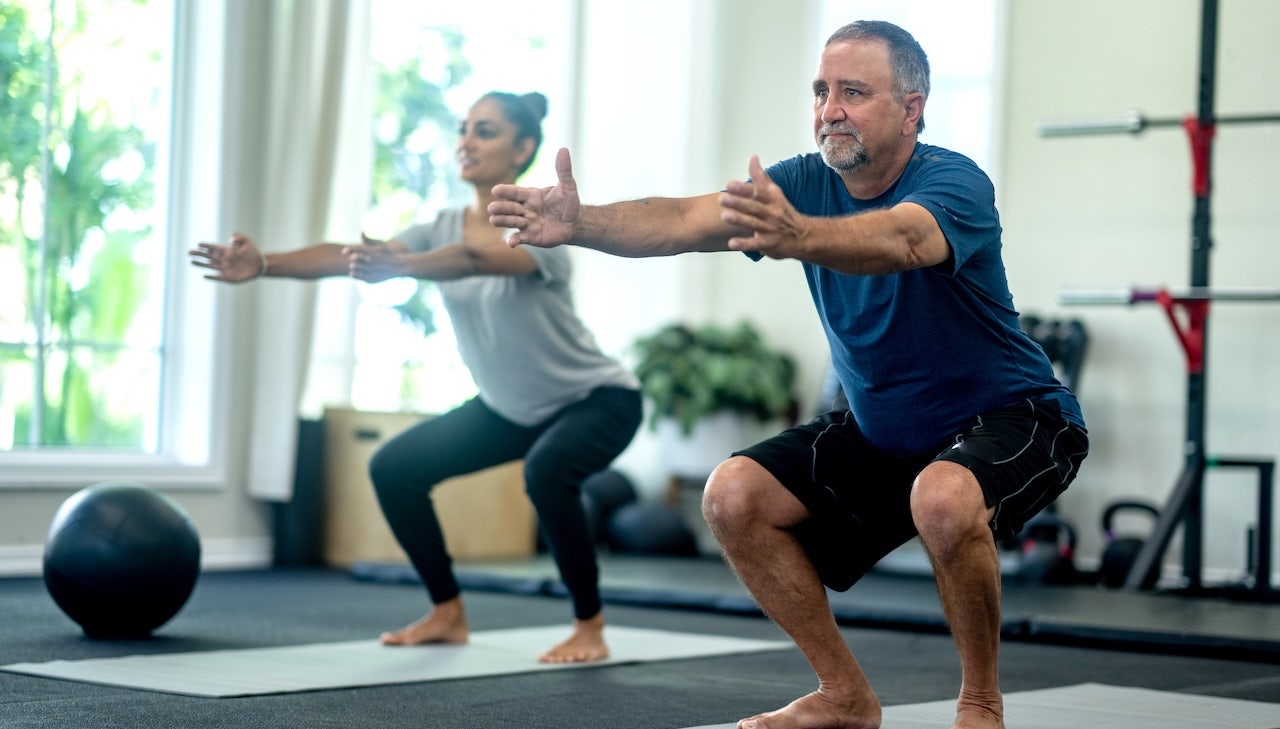

1 / 2
The story, neutrally told
Mixed · 2A randomised trial published in BMJ Open Sport & Exercise Medicine found that four weeks of isometric wall-squat training lowered resting blood pressure in inactive adults. Fox NewsR “isometric exercise training, where muscles contract without moving the joints, leads to meaningful drops in resting blood pressure within just four weeks” Read at Fox News ↗ NewsweekN “four weeks of isometric wall squat exercise lowers resting blood pressure in people with high-normal blood pressure” Read at Newsweek ↗ Mixed · 2The study involved 100 adults with systolic blood pressure of 120 to 140 mmHg who did not regularly exercise. Newsweek reports an average age of 37.4. Participants were non-smokers, took no blood pressure medication and had no hypertension diagnosis. Fox NewsR “The study followed 100 inactive adults with normal to high-normal blood pressure, defined as a systolic reading between 120 and 140 millimeters of mercury.” Read at Fox News ↗ NewsweekN “The new study involved 100 adults with an average age of 37.4.”“None of the participants had been diagnosed with hypertension.” Read at Newsweek ↗ Mixed · 2In the first four weeks, participants did home wall squats three times a week. Each session was four two-minute holds separated by two minutes of seated rest. Newsweek says the participants were randomly divided into five groups, one of them a control group. Fox NewsR “The routine consisted of four two-minute sessions separated by two minutes of seated rest” Read at Fox News ↗ NewsweekN “Participants were randomly divided into five groups. Four groups initially completed the same four-week home exercise program, while the fifth served as a control group” Read at Newsweek ↗
Mixed · 2After four weeks, systolic pressure had fallen by about 9.5 points on average, according to Fox News, and diastolic pressure also dropped compared with the control group. Newsweek says all exercise groups improved significantly against controls in systolic, diastolic and mean arterial pressure. Fox NewsR “participants’ top blood pressure number (systolic pressure) fell by about 9.5 points on average” Read at Fox News ↗ NewsweekN “all exercise groups had significant improvements compared with the control group, including reductions in systolic and diastolic blood pressure and mean arterial pressure” Read at Newsweek ↗ Mixed · 2For the next four weeks, the exercise groups trained three, two, one or zero times a week. At eight weeks, those training once or twice weekly kept significant reductions in systolic blood pressure and mean arterial pressure compared with controls, but not in diastolic pressure. NewsweekN “those exercising once or twice a week had maintained significant reductions in systolic blood pressure and mean arterial pressure compared with the control group, although neither schedule maintained a statistically significant improvement in diastolic blood pressure” Read at Newsweek ↗ Fox NewsR “participants who kept training just once or twice a week managed to hold onto a significant portion of their blood pressure reductions” Read at Fox News ↗ Centre · 1Systolic pressure fell by an average of 13.73 mmHg from the start of the study in the three-times-weekly group, 6.95 mmHg in the twice-weekly group and 6.56 mmHg in the once-weekly group. Only the three-times-weekly group also kept improvements in total peripheral resistance and heart rate variability. NewsweekN “Their systolic blood pressure fell by an average of 13.73 mmHg from the start of the study, compared with reductions of 6.95 mmHg among those exercising twice weekly and 6.56 mmHg among those training once a week.”“The three-times-weekly group also maintained improvements in total peripheral resistance, an indicator related to blood-vessel narrowing, and heart rate variability.” Read at Newsweek ↗
Mixed · 2Participants who stopped exercising lost their gains. By eight weeks their readings were no longer statistically different from the control group. NewsweekN “by eight weeks, their readings were no longer statistically different from the control group” Read at Newsweek ↗ Fox NewsR “Those who stopped exercising completely saw their blood pressure bounce back to baseline within four weeks” Read at Fox News ↗ Centre · 1Lead author Jim Wiles, a professor at Canterbury Christ Church University, told Newsweek that training could drop to once a week for at least four more weeks before reductions began to revert. He said this makes blood pressure management with the exercise more efficient for people short of time or motivation. NewsweekN “it is then possible to reduce the training frequency to once a week for at least another four weeks before the reductions in resting blood pressure start to revert back to previous levels.”“This makes blood pressure management using this highly accessible form of exercise even more efficient” Read at Newsweek ↗ Centre · 1The authors said lower-frequency training may be enough to maintain blood pressure reductions in the short term, but higher frequencies are needed to keep the vascular and cardiac autonomic adaptations. NewsweekN “higher frequencies are required to preserve these benefits and the associated vascular and cardiac autonomic adaptations” Read at Newsweek ↗
Right · 1Cardiologist Aseem Malhotra, who was not involved in the study, called it fascinating and noted that wall squats cost nothing. He told Fox News Digital that, in his clinical experience, dietary change, specifically a low-carb Mediterranean diet, is the most effective intervention for blood pressure and metabolic health. Fox NewsR “It also doesn’t cost anything to do wall squats at home.”“A low-carb Mediterranean diet is, in my view, the most substantial and effective intervention” Read at Fox News ↗ Mixed · 2The researchers noted limits. The maintenance phase lasted only four weeks, so longer trials are needed. Fox News adds that the findings cannot automatically be applied to people with diagnosed hypertension, older people with mobility limits, or people on heart medication. It also notes that participants and researchers knew each person's exercise group. NewsweekN “Longer studies will be needed to establish whether less frequent isometric exercise can preserve the same benefits over months or years.” Read at Newsweek ↗ Fox NewsR “The findings cannot automatically be generalized to individuals with diagnosed hypertension, older populations with mobility limitations, or patients who are already on heart medications”“participants and researchers knew each person’s assigned exercise group” Read at Fox News ↗
Every sentence links to the reporting it rests on. The pill in front of each says where its sources sit: Left, Centre or Right when one side supplies at least half of them, Mixed when they are evenly split. The number is how many outlets it cites.
Left0 outlets
No left outlet in our sources has covered this story yet.
Centre1 outlet
- Framing
- Newsweek presents the study as evidence that infrequent, equipment-free exercise can help maintain lower blood pressure, and leads with the findings and the lead author's comments.
- Emphasis
- Group-by-group figures, the study design and participant criteria, the authors' statements and the full citation.
- Leaves out or plays down
- Does not mention that participants and researchers knew group assignments, and offers no independent outside expert.
Right1 outlet
- Framing
- Fox News frames the study as a simple, free home exercise with health benefits, then qualifies it with a cardiologist's view that diet may matter more.
- Emphasis
- The headline benefit of once-weekly exercise, an outside cardiologist's comments, the low cost, and the study's limits including unblinded participants.
- Leaves out or plays down
- Gives fewer group-level figures (no per-frequency reductions), does not name the study authors or quote them, and does not say which metrics only the three-times-weekly group kept.
- Charged language
- “Simple exercise”
- For example
-
“Isometric exercise training like home wall squats produced significant blood pressure drops, but a cardiologist says dietary change may matter even more.” — Fox News
“In my own personal clinical practice, I regularly see significant improvements in blood pressure with many patients coming off medication just from dietary change alone” — Fox News
What every side reports
- The trial was published in BMJ Open Sport & Exercise Medicine and involved 100 adults with normal to high-normal blood pressure.
- Four weeks of home wall squats lowered resting blood pressure.
- Training once or twice weekly kept some of the reduction for four more weeks; stopping exercise lost it.
- The maintenance phase lasted only four weeks, so longer trials are needed.
Where accounts differ
-
How much the findings should be weighed against diet
- Centre
- Newsweek centres on the study authors and the practical value of low-frequency exercise, with no outside comment on diet.
- Right
- Fox News quotes cardiologist Aseem Malhotra, who says a low-carb Mediterranean diet is the most effective intervention and that many of his patients come off medication through diet alone.
Hypertension topic
Both outlets treat high-normal blood pressure as a precursor to hypertension. Newsweek says it warrants lifestyle recommendations, and the lead author says wall squats may help prevent progression to stage 1 hypertension. Fox says the results cannot be generalised to people with diagnosed hypertension.
“to help prevent them from developing stage 1 hypertension and its associated disease risk” — Newsweek
“The findings cannot automatically be generalized to individuals with diagnosed hypertension” — Fox News
Left0 articles
No coverage yet.
Centre1 article
-
Scientists Find Simple Exercise Against a Wall Could Lower Blood Pressure
Neutral Detailed, author-led account of the trial's design and results, presented as a practical option for people who struggle to exercise often, with caveats on the short follow-up.
Right1 article
-
Simple exercise done just once a week could help lower blood pressure
Mixed Upbeat health-tip framing of a simple, free exercise, balanced by a cardiologist's argument that diet matters more and by study limits.
- 27 Oct 21:53 First Fox NewsR Simple exercise done just once a week could help lower blood pressure
- 28 Oct 18:35 +20h 42m NewsweekN Scientists Find Simple Exercise Against a Wall Could Lower Blood Pressure
Times are when each article was published, or when we first saw it if the outlet gave no time.
Ask about this story
Loading…