Supreme Court to hear Kentucky church's shrine dispute under federal religious land-use law
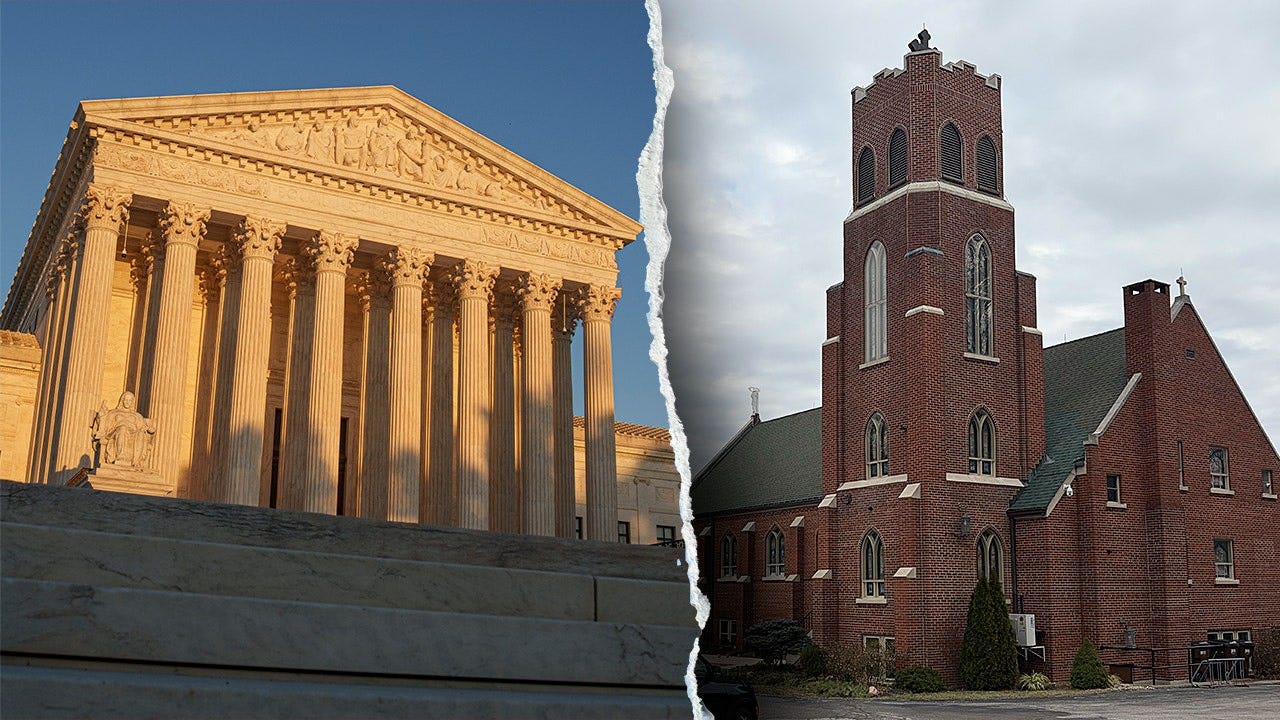
The US Supreme Court agreed on Thursday to hear a Kentucky Catholic church group's challenge over a Virgin Mary shrine on adjacent residential land. The case turns on what counts as a "substantial burden" under the federal religious land-use law, RLUIPA.
1 / 2
The story, neutrally told
The US Supreme Court agreed on Thursday 1 October to hear a dispute over whether a religious institution may build a shrine to the Virgin Mary on residential property next to its Kentucky church. The IndependentLC “The Supreme Court agreed on Thursday to consider whether a religious institution possesses the right to construct a shrine dedicated to the Virgin Mary on residential property neighboring its Kentucky church.” Read at The Independent ↗ Fox NewsR “The Supreme Court agreed Thursday to hear a Kentucky church’s fight to build a prayer grotto on its property” Read at Fox News ↗ The church's owner is the Missionaries of Saint John the Baptist, a nonprofit established by Roman Catholic priests. It argues the Kentucky Supreme Court misread a federal statute when it ruled against the plan. The IndependentLC “The church's owner, a nonprofit organization established by Roman Catholic priests, contends that the Kentucky Supreme Court misread a federal statute” Read at The Independent ↗ The statute is the Religious Land Use and Institutionalized Persons Act (RLUIPA), enacted in 2000, which the group says can, under certain conditions, bar local governments from enforcing land-use rules that place a "substantial burden" on religious exercise. Fox NewsR “The case centers on the Religious Land Use and Institutionalized Persons Act, known as RLUIPA, a federal law enacted to protect religious institutions from certain burdens on the use of their property.” Read at Fox News ↗ The IndependentLC “They argue that a federal statute can, under specific conditions, prohibit local governments from enforcing land use regulations that place a "substantial burden" on their religious expression.” Read at The Independent ↗
The church applied in March 2021 for a conditional-use permit and variance to build a 16-by-39-foot grotto, with a shrine, plaza, walking path and retaining wall, behind its building in Park Hills, a Cincinnati suburb. The Park Hills Board of Adjustment approved it in April 2021. Fox NewsR “The church applied in March 2021 for a conditional-use permit and variance to build the grotto behind its building”“The Park Hills Board of Adjustment approved the church’s permit in April 2021.” Read at Fox News ↗ The IndependentLC “a zoning board in Park Hills, Kentucky, a suburb of Cincinnati” Read at The Independent ↗ Neighbours Joel and Elizabeth Frederic challenged the approval in state court, worried about neighbourhood traffic. A trial court ruled for the church, but the Kentucky Court of Appeals reversed, finding the board exceeded its authority and that RLUIPA was not violated. Fox NewsR “Two neighboring property owners, however, Joel and Elizabeth Frederic, objected and challenged the board’s decision in Kentucky state court.”“A trial court ruled in the church’s favor, but the Kentucky Court of Appeals reversed” Read at Fox News ↗ The IndependentLC “worried that the proposal would worsen neighborhood traffic” Read at The Independent ↗ In December 2025 the Kentucky Supreme Court affirmed, holding that the zoning board lacked legal authority to grant the variance and affirming the RLUIPA ruling, which led the church to seek US Supreme Court review. The IndependentLC “Last December, the state's highest court determined that a zoning board in Park Hills, Kentucky, a suburb of Cincinnati, lacked appropriate legal authority” Read at The Independent ↗ Fox NewsR “The Kentucky Supreme Court affirmed the RLUIPA ruling in December 2025, prompting the church to seek Supreme Court review.” Read at Fox News ↗
The church asked the justices to review two RLUIPA questions, but the court took only one: whether barring a religious institution from building a religious structure on its own property is a "substantial burden" on religious exercise. Oral argument is expected in the coming months. Fox NewsR “the Supreme Court agreed to hear only one: whether prohibiting a religious institution from building a religious structure on its own property constitutes a "substantial burden" on religious exercise under the law.” Read at Fox News ↗ The IndependentLC “The nation's highest court will listen to oral arguments in the coming months” Read at The Independent ↗ The church says lower courts are in a "deeply entrenched" conflict over the standard. The Frederics say appellate courts generally weigh similar factors, that differing outcomes reflect differing facts, and that there is no reason for federal intervention in a local zoning matter. The IndependentLC “"The conflict among lower courts is deeply entrenched and widely acknowledged," the group's lawyers wrote.”“stating there is no justification for federal intervention in a local zoning dispute” Read at The Independent ↗ Fox NewsR “The Frederics disputed that characterization in their opposition brief, arguing appellate courts generally consider similar factors” Read at Fox News ↗ Opponents also say the church knew zoning rules barred a shrine on the adjacent residential land when it acquired it, and has not shown why it cannot build on church land. The IndependentLC “Opponents assert the church group knew that zoning laws prohibited building the shrine on adjacent residential land when acquiring the property.” Read at The Independent ↗ Fox NewsR “The Frederics also argued that the Missionaries failed to show that alternative locations for the grotto were unavailable.” Read at Fox News ↗
Ryan Gardner, senior counsel at First Liberty Institute, which represents the church, told Fox News Digital the case could affect "every single zoning law" in the country and that a narrow reading of RLUIPA could have "dire consequences". An attorney for the Frederics did not immediately respond to the outlet's request for comment. Fox NewsR “"This is a massive case for religious liberty because it has the potential to impact every single zoning law in this country,"”“An attorney for the Frederics did not immediately respond to Fox News Digital's request for comment.” Read at Fox News ↗ The property history is more complicated than shorthand suggests: the church building has stood for nearly a century, predating Park Hills' 1974 zoning ordinance, while the grotto site is an adjacent parcel under a perpetual lease that would be transferred to the church as a condition of approval. Fox NewsR “The church building itself has stood on the property for nearly a century, which predates Park Hills’ zoning ordinance adopted in 1974.”“initially subject to a perpetual lease that would be transferred to the religious organization as a condition of the project’s approval” Read at Fox News ↗
Every sentence links to the reporting it rests on.
Left1 outlet
- Framing
- Brief, even-handed news report on the court taking the case, giving the church's and the neighbours' arguments, framed as the court's latest religious rights case.
- Emphasis
- The neighbouring family's traffic concerns, the opponents' point that the church knew of the zoning limits, and the local-dispute argument.
- Leaves out or plays down
- Does not give the grotto's size, the 2021 timeline, the narrowing to one question, or the national-impact argument.
- Charged language
- “religious mission”
- For example
-
“The nation's highest court will hear arguments in the coming months in its latest case involving religious rights” — The Independent
“Opponents assert the church group knew that zoning laws prohibited building the shrine on adjacent residential land when acquiring the property.” — The Independent
Centre0 outlets
No centre outlet in our sources has covered this story yet.
Right1 outlet
- Framing
- Exclusive built around the church's counsel, presenting the case as a major religious liberty matter with nationwide zoning implications.
- Emphasis
- Gardner's warnings of national impact, the small 600-square-foot footprint, the unusual private-neighbour origin, and the narrowing to one question.
- Leaves out or plays down
- The Frederics' side comes only through their brief; no comment from their attorney. The article does not mention the family's traffic concern.
- Charged language
- “massive case for religious liberty”“dire consequences”“prayer grotto”
What every side reports
- The Supreme Court agreed on Thursday to hear the Kentucky church's case.
- The church group is the Missionaries of Saint John the Baptist, and the site is in Park Hills, Kentucky.
- The Kentucky Supreme Court ruled against the church in December 2025.
- Neighbours challenged the zoning approval and say the church has not shown it cannot build elsewhere.
Where accounts differ
-
Whether lower courts are split on what counts as a RLUIPA 'substantial burden'
- Left
- Reports the church's claim of a 'deeply entrenched' conflict and the family's opposing view.
- Right
- Gardner says courts have developed different approaches; the Frederics say courts consider similar factors and outcomes reflect differing facts.
-
Whether the shrine would be on the church's own property
- Left
- Describes it as residential land neighbouring the church, acquired for the project.
- Right
- Headline and lede call it the church's property, but the article notes the grotto involves an adjacent parcel under a perpetual lease.
Supreme Court of the United States organisation
Agreed on Thursday to hear the case, limited to one RLUIPA question on what constitutes a 'substantial burden'; arguments are expected in the coming months.
“the Supreme Court agreed to hear only one: whether prohibiting a religious institution from building a religious structure on its own property constitutes a "substantial burden" on religious exercise under the law.” — Fox News
“The nation's highest court will listen to oral arguments in the coming months” — The Independent
Left1 article
-
Supreme Court intervenes in dispute over church’s plan to build shrine on residential land
Neutral Straightforward report setting out both the church's and the neighbours' arguments.
Centre0 articles
No coverage yet.
Right1 article
-
Sympathetic Leads with the church's counsel and stresses the case's national religious-liberty stakes.
- 1 Oct 22:05 First The IndependentLC Supreme Court intervenes in dispute over church’s plan to build shrine on residential land
- 2 Oct 01:13 +3h 7m Fox NewsR EXCLUSIVE: Supreme Court prayer grotto case could impact 'every single zoning law' in America, attorney says
Times are when each article was published, or when we first saw it if the outlet gave no time.