Tundra Merlin Arctic drills in Alaska; report details Canadian troops' cold-weather problems
Fox News describes US and Canadian forces rehearsing rapid Arctic deployments under Tundra Merlin in Alaska. CBC reports on internal evaluations of a separate February exercise, Global Response, in which Canadian troops struggled in the cold.
1 / 1
The story, neutrally told
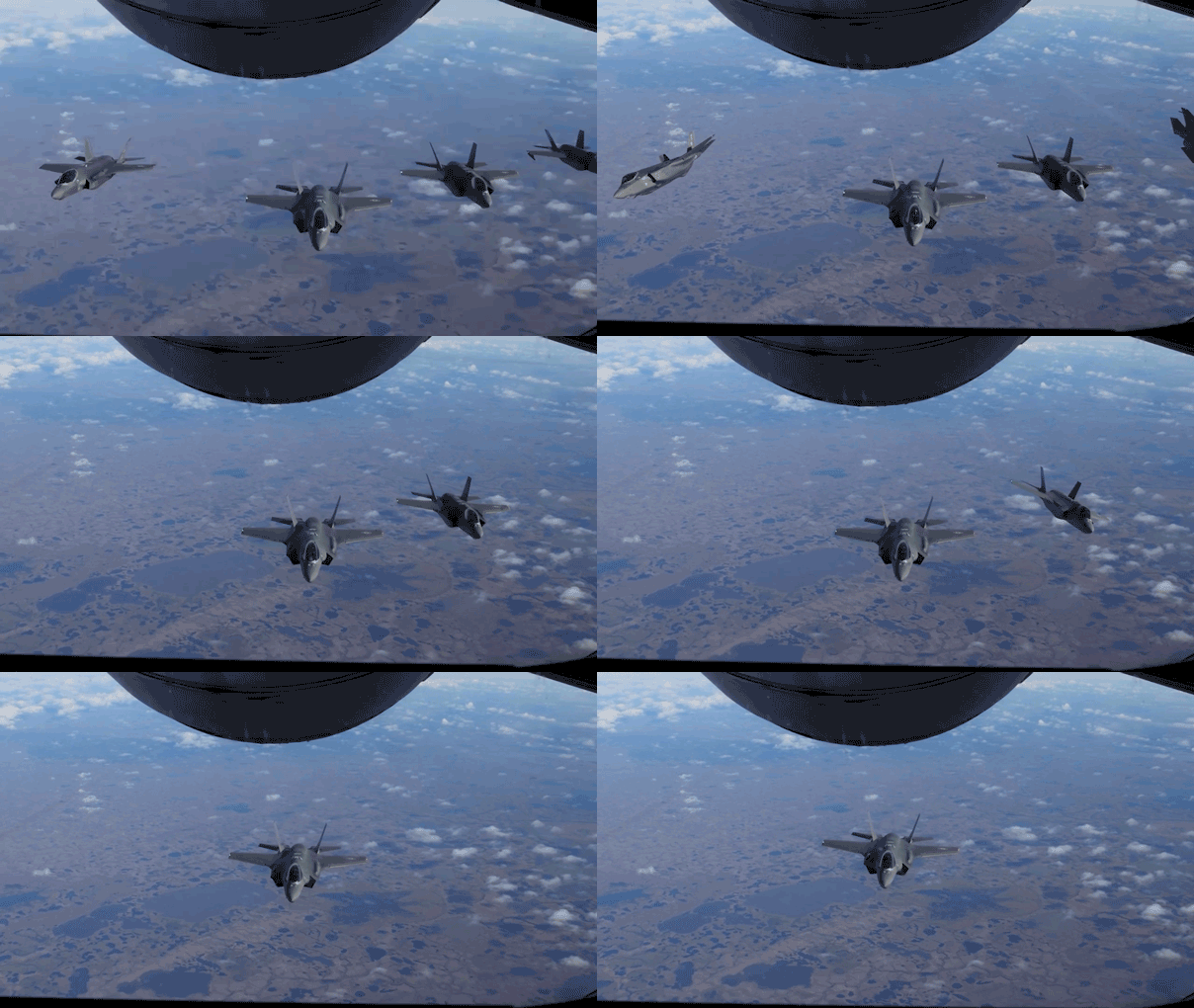
Right · 1Fox News reports that US and Canadian forces are taking part in Tundra Merlin, which it describes as an enduring US military campaign to show that American and allied forces can quickly assemble combat power across Alaska's distances and Arctic conditions. Fox NewsR “The operations are part of Tundra Merlin, an enduring U.S. military campaign aimed at proving that even across Alaska’s vast distances and extreme Arctic conditions” Read at Fox News ↗ Right · 1In one demonstration, a US Army HIMARS rocket system and an AN/TPQ-53 radar were flown into western Alaska aboard a Royal Canadian Air Force C-17 and linked with F-35s, F-16s and a KC-135 tanker; according to US Northern Command, F-35s and HIMARS engaged a simulated ground target about 135 miles away while F-16s intercepted F-35s acting as incoming aerial threats. Fox NewsR “F-35s and HIMARS synchronized against a simulated ground target approximately 135 miles away, while F-16s simultaneously intercepted F-35s acting as simulated incoming aerial threats, according to U.S. Northern Command.” Read at Fox News ↗ Right · 1From 18 to 22 September, US and Canadian forces ran a joint maritime strike scenario about 100 nautical miles north of Dutch Harbor, involving the US Coast Guard, Royal Canadian Navy vessels, Canadian patrol aircraft, and US Air Force F-35s and E-3 aircraft. Fox NewsR “From Sept. 18–22, U.S. and Canadian forces conducted a joint maritime strike scenario roughly 100 nautical miles north of Dutch Harbor” Read at Fox News ↗
Right · 1Lt. Gen. Robert Davis, commander of Alaskan Command, told Fox News Digital that melting sea ice has made the Arctic more accessible and that China and Russia are advancing their military capabilities with an interest in showing they can use them there; he said Alaska is "postured very well" for anticipated near-term threats but would request more forces if escalation were indicated. Fox NewsR “"One is that the melting sea ice has made the Arctic more accessible.”“"We're postured very well for any of the anticipated threats that we think would come our way in the very near term,"” Read at Fox News ↗ Right · 1Fox cites the Pentagon's 2024 Arctic Strategy, which warned that growing Russia-China cooperation could "alter the Arctic’s stability and threat picture", and a July 2024 NORAD intercept of two Russian Tu-95 and two Chinese H-6 bombers in the Alaskan Air Defense Identification Zone, which NORAD said was not considered a threat. Fox NewsR “alter the Arctic’s stability and threat picture”“NORAD said the flight itself was not considered a threat” Read at Fox News ↗ Left · 1CBC News, in a separate report, says internal Department of National Defence documents it obtained suggest Canadian troops were ill-prepared and occasionally ill-equipped during Exercise Global Response in February at the Joint Pacific Multinational Readiness Center north of Fairbanks; this is a different exercise from the Tundra Merlin activities Fox describes. CBC NewsLC “A series of internal Department of National Defence documents suggest Canadian troops were ill-prepared and occasionally ill-equipped”“during Exercise Global Response in February at the Joint Pacific Multinational Readiness Center, north of Fairbanks, Alaska” Read at CBC News ↗
Left · 1More than 400 members of the 3rd Battalion Royal Canadian Regiment were folded into a larger US Army brigade; evaluations cited problems with off-the-shelf civilian gear such as stoves and tents, a "lack of emphasis on basic winter soldiering skills" in some units, as many as 30 troops with frostbite, drone batteries drained to about 10 minutes of flight time, and communications gaps because of the lack of satellites so far north. CBC NewsLC “The training involved over 400 members of the 3rd Battalion Royal Canadian Regiment (3RCR)”“as many as 30 troops suffering various levels of frostbite”“leaving in some cases only 10 minutes of flying time” Read at CBC News ↗ Left · 1One evaluation said medics misunderstood their role and, on three occasions, were seen using personal phones for long calls that gave away positions; they received a four-hour seminar rather than a five-day US-led Arctic medicine course. CBC NewsLC “On three occasions some of them were seen using personal phones for long calls, giving away their positions to the enemy.” Read at CBC News ↗ Left · 1A separate US assessment by the Ted Stevens Center for Arctic Security Studies found US units had similar difficulties, including a lack of snow-clearing equipment and fuel shortages. CBC NewsLC “It pointed to basic preparation problems such as a lack of snowclearing equipment and a shortage of fuel” Read at CBC News ↗
Left · 1Lt.-Col. Aaron Corey, commander of 3RCR, disagreed with the criticism, saying his troops trained for winter conditions for a year and every soldier was cold-weather operator qualified; the reports also noted the battalion met its training objectives. CBC NewsLC “"Every soldier to go up on that exercise had to be a cold weather operator qualified,"”“the battalion was successful in the exercise by capturing its training objectives” Read at CBC News ↗ Left · 1Experts quoted by CBC, including retired colonel Pierre Leblanc and University of Calgary's Rob Huebert, said Canada must relearn Arctic skills and rely less on technology, and that the Carney government's winter exercises are smaller in scale than those of the 1950s and 60s. CBC NewsLC “Today's high-tech, web-enabled, satellite-tethered military needs a serious back-to-basics approach”“Huebert acknowledged the increase in winter exercises that the Carney government has enabled through its increase in defence spending. But he says they are a smaller scale.” Read at CBC News ↗
Every sentence links to the reporting it rests on. The pill in front of each says where its sources sit: Left, Centre or Right when one side supplies at least half of them, Mixed when they are evenly split. The number is how many outlets it cites.
Left1 outlet
- Framing
- CBC leads with leaked internal evaluations showing Canadian troops struggled with the cold in a separate exercise, Global Response, framing it as the military relearning Arctic warfare.
- Emphasis
- Frostbite, failing batteries, communications gaps, equipment and training shortfalls, expert calls for back-to-basics skills, and historical decline in Canadian Arctic capability.
- Leaves out or plays down
- Does not mention Tundra Merlin or the HIMARS and maritime demonstrations Fox describes.
- Charged language
- “Cold reality”“litany of concerns”
- For example
-
“The evaluation reports, obtained by CBC News, show the military has a lot to learn and a long way to go to rebuild its capability to defend the Arctic.” — CBC News
Centre0 outlets
No centre outlet in our sources has covered this story yet.
Right1 outlet
- Framing
- Fox News frames Tundra Merlin as a show of American strength against Russian and Chinese activity, led by the Alaskan Command commander's account.
- Emphasis
- Weapons and aircraft (HIMARS, F-35s, F-16s), deterrence, geography near Russia, and Davis's quotes on China and Russia.
- Leaves out or plays down
- Does not report any shortcomings or Canadian training difficulties, beyond a general note that cold affects equipment and personnel.
- Charged language
- “war machine roars to life”“chilling new reality”
- For example
-
“Across one of the coldest, most remote and strategically exposed corners of the United States, American forces are practicing how to fight on land, at sea and in the air” — Fox News
What every side reports
- US and Canadian forces are training together in Alaska.
- Extreme cold and vast distances make Arctic operations difficult for troops and equipment.
- Both outlets treat Arctic readiness as a growing priority for the US and Canada.
Where accounts differ
-
How well prepared forces are for Arctic conditions
- Left
- CBC, citing internal evaluations, says Canadian troops were ill-prepared and occasionally ill-equipped, with a litany of concerns; the 3RCR commander disagrees.
- Right
- Fox presents the operations as a show of rapid combat readiness; Davis says forces are "postured very well" while noting equipment must be conditioned for sub-zero use.
Left1 article
-
Cold reality: Canadian troops struggle in Alaska as military relearns Arctic warfare
Critical Uses leaked evaluations to show Canadian troops' cold-weather shortcomings, balanced by the battalion commander's rebuttal and expert context.
Centre0 articles
No coverage yet.
Right1 article
-
Alarmist Presents Tundra Merlin as a muscular deterrent to Russia and China, built around the Alaskan Command commander's interview.
- 4 Oct 16:00 First Fox NewsR America’s Arctic war machine roars to life as commander reveals chilling new reality on Russia’s doorstep
- 5 Oct 09:00 +16h 59m CBC NewsLC Cold reality: Canadian troops struggle in Alaska as military relearns Arctic warfare
Times are when each article was published, or when we first saw it if the outlet gave no time.