US Army rehearses digging mass temporary graves at Fort Bragg
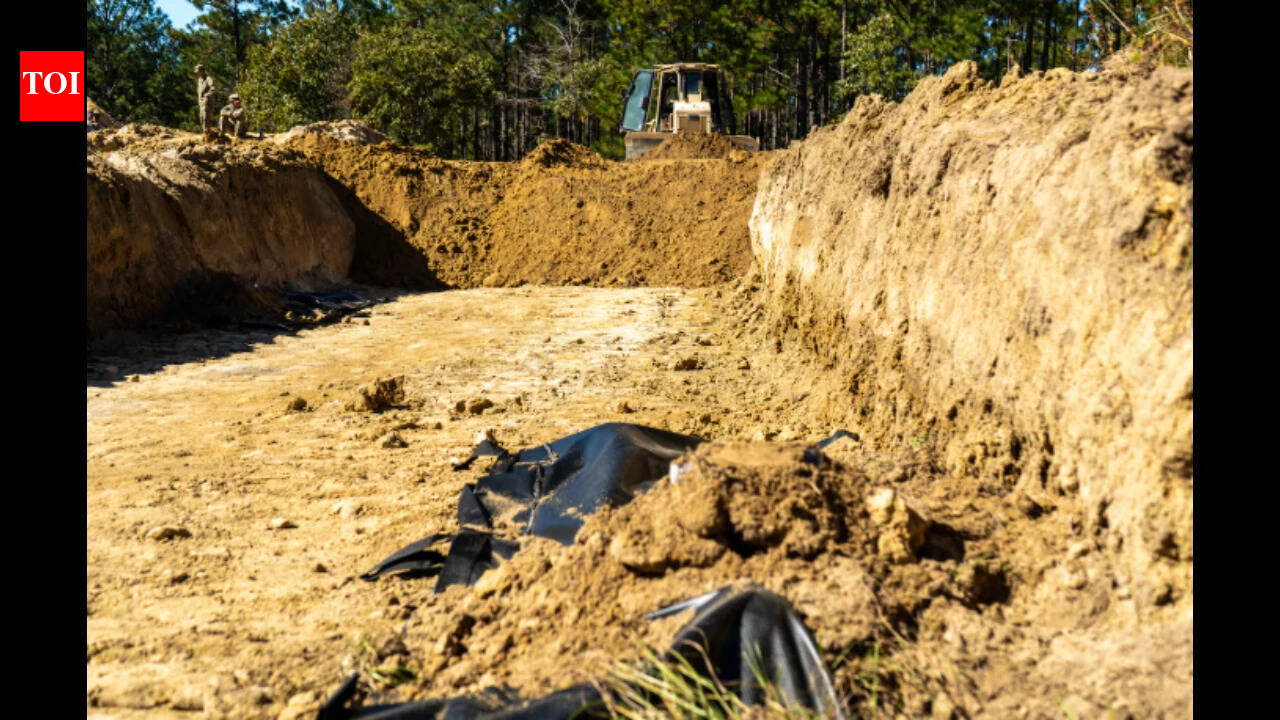
US Army units at Fort Bragg practised digging mass temporary burial trenches for a high-casualty war, which the Army says it has not done at scale since the Korean War.
Updated (version 3). New coverage since the last version from Daily Mail, The Times of India.


1 / 5
The story, neutrally told
Mixed · 2US Army soldiers have trained to bury large numbers of fallen troops in temporary graves, rehearsing a response to heavy casualties in a high-intensity war. NewsweekN “U.S. Army soldiers are training to bury fellow troops in temporary graves en masse for the first time in decades” Read at Newsweek ↗ MetroLC “For the first time in decades, the exercise was conducted to rehearse how troops would respond if they suffered a high number of losses in conflict.” Read at Metro ↗ Mixed · 2The exercise took place at Fort Bragg, North Carolina, and involved the 3rd Corps Sustainment Command, the 20th Engineer Brigade and religious support personnel including chaplains. NewsweekN “Soldiers with the 3rd Corps Sustainment Command and the 20th Engineer Brigade, based in Fort Bragg, North Carolina” Read at Newsweek ↗ MetroLC “involved the 3rd Corps Sustainment Command and the 20th Engineer Brigade, along with religious figures” Read at Metro ↗ Right · 1The Daily Mail says the drill took place on October 22 and that news of it only reached the public later, prompting public concern about the motive at a time of possible war. Daily MailR “While it occurred on October 22, news of the drill just reached the public, who raised concerns about the motive amid a time of potential war.” Read at Daily Mail ↗
Right · 1The Washington Examiner identifies it as Phase II of Operation Dragon Covenant, held earlier in October and described as the first openly disclosed exercise testing mass burial at scale; it used simulated skeletal models and sealed water containers in place of remains. Washington ExaminerR “It carried out its first openly disclosed exercise testing this ability at scale, Phase II of Operation Dragon Covenant, earlier this month.”“the exercise used simulated skeletal models and sealed water containers to simulate human remains.” Read at Washington Examiner ↗ Centre · 1Newsweek reports that the Army said it has not needed to do this on a large scale since the Korean War, and that in Iraq and Afghanistan US forces instead evacuated the dead quickly to the US. NewsweekN “The U.S. Army hasn't needed to do this on a large scale since the Korean War, the U.S. Army said in a statement.”“have instead quickly evacuated deceased soldiers back to the U.S. during the wars in Iraq and Afghanistan.” Read at Newsweek ↗ Mixed · 2The graves are meant as a temporary measure so that bodies stay preserved until they can be identified and repatriated to the United States. NewsweekN “preserve bodies intact until they could be identified and repatriated to the U.S.” Read at Newsweek ↗ MetroLC “the goal would be to identify the well-preserved bodies and repatriate them to the United States.” Read at Metro ↗
Centre · 1According to the Army, a standard temporary plot has five trenches holding 100 casualties in total; soldiers filled each plot in an average of one hour and 15 minutes, and eight bulldozers and four excavators could bury up to 2,400 soldiers in 24 hours. NewsweekN “a temporary internment plot has five trenches, able to hold 100 casualties in total.”“The remains of up to 2,400 soldiers could be temporarily buried in 24 hours, using eight bulldozers and four military excavators” Read at Newsweek ↗ Right · 1The Washington Examiner, citing the Army, reports that crews found the old doctrine of five trenches holding 100 bodies each too narrow for modern equipment, widening trenches to 15 feet with a nine-foot pillar of undisturbed soil between them so bulldozers do not crush remains, and cutting digging time from about three hours per trench to one hour and 15 minutes. Washington ExaminerR “we expanded the trench to a 15-foot width and maintained a nine-foot pillar of undisturbed soil between each trench.”“going from around three hours per trench in previous exploratory trials to just one hour and 15 minutes.” Read at Washington Examiner ↗ Mixed · 2Sergeant 1st Class Delbert Ruede of the 3rd Corps Sustainment Command said the exercise let the Army look critically at how it manages its fallen, adding: "If we went to war tomorrow, we would be making this up as we went along." NewsweekN “"If we went to war tomorrow, we would be making this up as we went along.” Read at Newsweek ↗ MetroLC “systematically manage our fallen in a high-intensity conflict” Read at Metro ↗
Centre · 1Newsweek says it was the first time in more than 20 years that Army chaplains trained to help with battlefield gravedigging. NewsweekN “were the first time in more than 20 years that U.S. Army chaplains” Read at Newsweek ↗ Right · 1The Washington Examiner says 130 religious support personnel took part, and that Army planning indicated units doing the burials could suffer physical, emotional and spiritual exhaustion within four to six hours, requiring rapid rotation. Washington ExaminerR “with 130 religious support personnel participating”“could experience physical, emotional, and spiritual exhaustion within four to six hours” Read at Washington Examiner ↗ Left · 1Metro reports that faith leaders said chaplains may be unable to stop for graveside services in combat, especially if they do not know a soldier's religion, and that blessing potential burial sites in advance was agreed as a way to reassure families. MetroLC “chaplains may not be able to stop for graveside services during active combat”“blessing potential mass burial sites ahead of time in conflict would help assure families that their loved ones were buried with care” Read at Metro ↗
Left · 1Metro places the exercise against a backdrop of heightened geopolitical tension, noting that the Pentagon this week was reported by Reuters to have asked NATO states including Lithuania, Latvia and Estonia to tone down rhetoric about Russia; the Pentagon declined to comment on the allegations. MetroLC “The exercise was conducted at a time of heightened geopolitical tensions”“Private conversations among allies are just that, so we will not comment on these allegations.” Read at Metro ↗ Right · 1The Washington Examiner reports the news prompted social media speculation that the drill preceded a ground operation in Iran, and says the Army framed it purely as testing capabilities that had grown rusty; the paper's own view is that likely operations against Iran would not involve casualties on that scale. Washington ExaminerR “speculation rife that the operation was a dress rehearsal for an imminent ground operation in Iran.”“the Army framed the exercise as purely an operation to test capabilities that had grown rusty for lack of need.” Read at Washington Examiner ↗ Right · 1The Daily Mail links the drill to fears of a looming war with Iran, reporting that Admiral Brad Cooper, the top US Middle East commander, has reportedly briefed President Donald Trump on options to resume attacks on Iran; it does not report the Army tying the exercise to any operation. Daily MailR “The training comes as America's top Middle East commander, Admiral Brad Cooper, has reportedly briefed President Donald Trump on attack options to resume the war in Iran.” Read at Daily Mail ↗
Mixed · 2The Daily Mail and The Times of India, quoting the Army, say the exercise was a "test of concept" for large-scale battlefield temporary interment, and the Mail adds that nearly 37,000 US personnel died in the Korean War. Daily MailR “The exercise served as a critical test of concept to validate the feasibility of battlefield temporary interment” Read at Daily Mail ↗ The Times of IndiaN “completed a “test-of-concept” exercise for large-scale battlefield temporary interment” Read at The Times of India ↗ Centre · 1The Times of India says the dig was held near the St. Mere Eglise Drop Zone as part of Dragon Covenant; earlier trials with standard backhoes took about three hours per trench for ten remains, whereas 27th Engineer Battalion operators using D6 bulldozers completed a 20-remains trench in an average of one hour and 15 minutes. The Times of IndiaN “In previous exploratory trials, units attempted excavation using standard backhoes, averaging three hours per trench for only ten remains.”“completing a full 20-remains trench in an average time of one hour and 15 minutes” Read at The Times of India ↗ Right · 1According to the Daily Mail, operators held the bulldozer blade 18 inches above the ground so loose soil fell into the trench, and model skeletons and water containers were later uncovered uncrushed; engineers noted soil type (dry sand, frozen ground, clay, mud) would affect the process. Daily MailR “Operators kept the bulldozer blade 18 inches above the ground, allowing loose soil to fall into the trench instead of forcing it down.”“they found both had survived without being crushed” Read at Daily Mail ↗
Right · 1The Daily Mail reports that the findings will be used to update Army guidance and that a further exercise next spring will test the process in daylight and blackout conditions using night-vision systems. Daily MailR “A further exercise planned for next spring will test the process during daylight and blackout conditions using night-vision systems.” Read at Daily Mail ↗ Right · 1Lt Col Ruska, chaplain for the 3rd Corps Sustainment Command, said teams cannot stop a 24-hour interment operation for individual religious services, and Maj Warwick Fuller consecrated the site with a prayer before digging began. Daily MailR “fatality management teams cannot stop a 24-hour interment operation for individualized religious gravesite services.”“Maj Warwick Fuller, chaplain for the 20th Engineer Brigade, offered a prayer to consecrate the burial site.” Read at Daily Mail ↗
Every sentence links to the reporting it rests on. The pill in front of each says where its sources sit: Left, Centre or Right when one side supplies at least half of them, Mixed when they are evenly split. The number is how many outlets it cites.
Left1 outlet
- Framing
- Metro presents the drill as a notable sign of the times, tying it to heightened geopolitical tensions and a Pentagon-NATO story about Russia rhetoric.
- Emphasis
- Chaplains' role, blessing burial sites in advance, and the wider tension context.
- Leaves out or plays down
- Omits the Korean War comparison, trench and timing figures, and the Iran speculation.
- For example
-
“The exercise was conducted at a time of heightened geopolitical tensions” — Metro
Centre2 outlets
- Framing
- Newsweek and The Times of India report the drill as a practical readiness story built on Army statements and the Korean War precedent; the Times of India leads on rarity and Ruede's quote.
- Emphasis
- Korean War precedent, trench and timing figures, Ruede's candid quote; the Times of India details the trench-spacing fix and bulldozer versus backhoe times.
- Leaves out or plays down
- Neither links the drill to current tensions or Iran speculation; the Times of India omits chaplains' role and the 2,400 figure.
- For example
-
“The US Army conducted a rare test practice of digging mass battlefield graves that have not been needed since the Korean War.” — The Times of India
Right2 outlets
- Framing
- The Washington Examiner treats the drill as a detailed defence-readiness story and rebuts Iran fears; the Daily Mail frames it as preparation for mass casualties 'amid a looming war threat', leading on Iran war fears.
- Emphasis
- Doctrine flaws found and fixed, trench dimensions, equipment, chaplains and responder stress; the Mail adds Iran briefings, the bulldozer technique and spring follow-up drill.
- Leaves out or plays down
- Neither mentions the Pentagon-NATO Russia rhetoric story that Metro links to the drill; the Mail does not carry the Examiner's view that Iran operations would not involve such casualties.
- Charged language
- “amid a looming war threat”
- For example
-
“US Army prepares for mass casualties with drill digging graves amid a looming war threat” — Daily Mail
“The U.S. Army ran a rare large-scale exercise at Fort Bragg testing its ability to carry out mass burials” — Washington Examiner
What every side reports
- The exercise was at Fort Bragg, North Carolina, with the 3rd Corps Sustainment Command and 20th Engineer Brigade plus religious personnel.
- It rehearses temporary mass burial after heavy wartime casualties, with later identification and repatriation.
- Both quote Sgt 1st Class Delbert Ruede and cite the 2,400-soldier capacity.
-
The US Army has not needed to bury large numbers of its dead in mass graves since the Korean War.
Reported- Supports 1
- Washington Examiner
- Reports 4
- Metro, Newsweek, The Times of India, Daily Mail
-
The Army's drill found that about eight bulldozers and four excavators could bury up to 2,400 soldiers in 24 hours.
Reported- Reports 4
- Metro, Newsweek, Daily Mail, Washington Examiner
-
The mass graves are temporary, so bodies can later be identified and repatriated to the United States.
Reported- Reports 5
- Metro, Newsweek, The Times of India, Daily Mail, Washington Examiner
United States Army organisation
Presents the drill as a systematic, respectful approach to caring for the fallen in a high-intensity conflict, admitting it currently lacks a tested plan.
“What we are doing here is taking a scientific, field-tested approach so that we can maintain positive control and respectfully care for our fallen.” — Newsweek
UK and Ireland2 outlets
Metro ties the drill to geopolitical tension and Russia; the Daily Mail ties it to a possible Iran war.
“amid fears of a looming war with Iran” — Daily Mail
“The exercise was conducted at a time of heightened geopolitical tensions” — Metro
Metro, Daily Mail
South Asia1 outlet
The Times of India reproduces the Army's account with technical detail and no geopolitical link.
“The core of the exercise, conducted near the St. Mere Eglise Drop Zone” — The Times of India
The Times of India
North America2 outlets
Newsweek and the Washington Examiner present it as a capability test; the Examiner rebuts Iran speculation.
“The U.S. Army ran a rare large-scale exercise at Fort Bragg testing its ability to carry out mass burials” — Washington Examiner
Newsweek, Washington Examiner
Left1 article
-
MetroLC ·
The US Army is practising how to dig mass graves in conflict
Mixed Short account of the drill, linked to geopolitical tension and an unrelated Pentagon-NATO item.
Centre2 articles
-
US Army Starts Practicing Digging Mass Battlefield Graves
Neutral Fact-led account relaying Army statements and figures with historical context.
-
Neutral Relays the Army's account of a rare test with technical detail, quoting Ruede.
Right2 articles
-
US Army prepares for mass casualties with drill digging graves amid a looming war threat
Alarmist Frames a routine capability test as preparation for mass casualties amid Iran war fears, while carrying detailed Army findings.
-
US Army conducted rare test of mass burial capabilities, not used since Korean War, at Fort Bragg
Neutral Detailed, Army-sourced account of a rare drill that calms Iran-war speculation and highlights doctrine improvements.
- 29 Oct 14:26 First NewsweekN US Army Starts Practicing Digging Mass Battlefield Graves
- 30 Oct 09:46 +19h 20m MetroLC The US Army is practising how to dig mass graves in conflict
- 30 Oct 17:54 +27h 28m Daily MailR US Army prepares for mass casualties with drill digging graves amid a looming war threat
- 30 Oct 18:23 +27h 58m Washington ExaminerR US Army conducted rare test of mass burial capabilities, not used since Korean War, at Fort Bragg
- 31 Oct 14:07 +47h 42m The Times of IndiaN Not used since the Korean War; US Army practices digging mass battlefield graves, 'If we went to war tomorrow...'
Times are when each article was published, or when we first saw it if the outlet gave no time.
Ask about this story
Loading…