US conducts non-nuclear underground experiment in Nevada to improve nuclear blast detection
The US National Nuclear Security Administration ran a non-nuclear high-explosive experiment at the Nevada National Security Site to improve detection of low-yield, "decoupled" nuclear explosions, a test type Washington alleges China carried out in 2020. China denies the allegation.

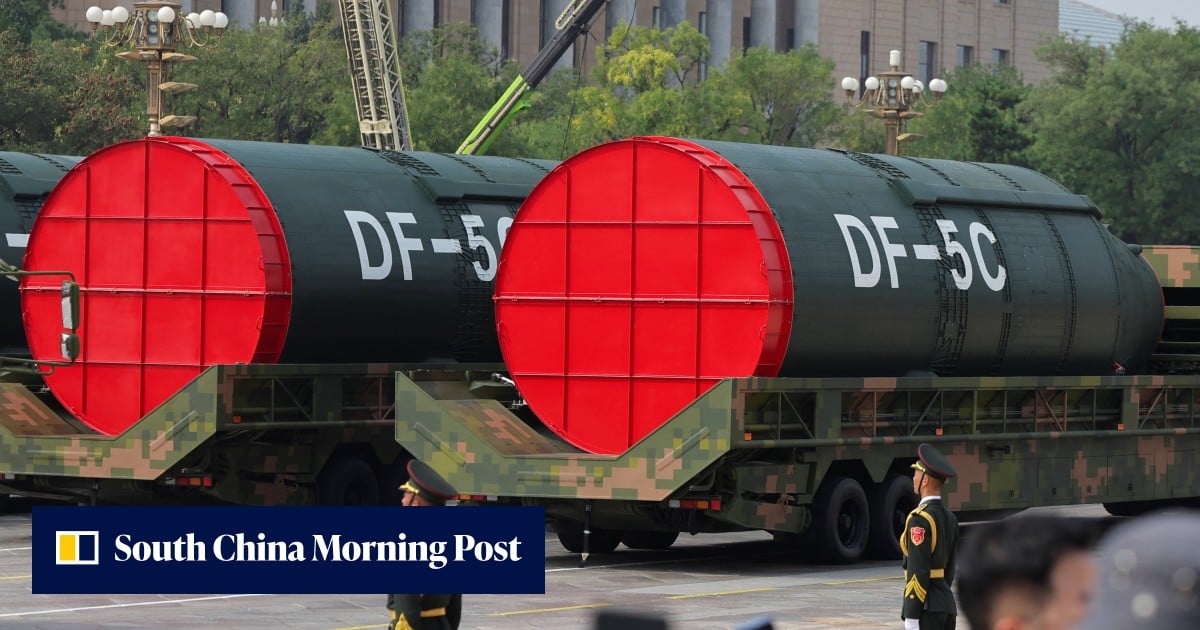
1 / 2
The story, neutrally told
Mixed · 2The US National Nuclear Security Administration (NNSA) conducted a "subsurface, non-nuclear chemical high-explosive experiment" on Wednesday 30 September 2026, which the Energy Department said aimed to improve the US ability to detect low-yield nuclear explosions. The Straits TimesRC “The US National Nuclear Security Administration conducted a "subsurface, non-nuclear chemical high-explosive experiment" on Wednesday that the Energy Department said aimed to improve the United States' ability to detect low-yield nuclear explosions.” Read at The Straits Times ↗ South China Morning PostN “The US Department of Energy announced on Wednesday that the National Nuclear Security Administration (NNSA) conducted a “subsurface, non-nuclear chemical high-explosive” experiment” Read at South China Morning Post ↗ Right · 1According to the Energy Department, the experiment took place in the P Tunnel in Area 12 of the Nevada National Security Site and used chemical high explosives and radiotracers. The Straits TimesRC “at the Nevada National Security Site in the P Tunnel in Area 12, using chemical high-explosives and radiotracers” Read at The Straits Times ↗ Mixed · 2The department said the data will be used to validate scientific models and refine algorithms critical to US nuclear explosion detection. The Straits TimesRC “data collected from the experiment will be used to validate scientific models and refine algorithms critical to US nuclear explosion detection efforts” Read at The Straits Times ↗ South China Morning PostN “collected data to validate scientific models and refine algorithms critical to US nuclear explosion detection capabilities” Read at South China Morning Post ↗
Mixed · 2The experiment focused on detecting a "decoupled" explosion, in which a warhead is detonated inside a large underground cavity so that the seismic signal is lowered; Washington alleges China conducted this type of test in June 2020. The Straits TimesRC “the type of test Washington alleged China had conducted in June 2020 to decrease the effectiveness of seismic monitoring” Read at The Straits Times ↗ South China Morning PostN “a nuclear test where the warhead is detonated inside a large underground cavity instead of being in close contact with the surrounding rock, lowering the seismic signal” Read at South China Morning Post ↗ Mixed · 2The US accused China earlier this year of a secret nuclear test in 2020 as it called for a broader arms control treaty; the Trump administration said it was at the Lop Nur site and breached the Comprehensive Nuclear-Test-Ban Treaty (CTBT). China called the claim "entirely unfounded" and an attempt "to fabricate excuses for resuming" US nuclear testing, and says it abides by the CTBT. The Straits TimesRC “China said at the time that the US allegation was "entirely unfounded" and an attempt "to fabricate excuses for resuming" US nuclear testing.” Read at The Straits Times ↗ South China Morning PostN “alleging that China had breached the Comprehensive Nuclear-Test-Ban Treaty (CTBT)” Read at South China Morning Post ↗ Centre · 1The CTBTO has said its International Monitoring System detected no event consistent with a nuclear test explosion on 22 June 2020, though it recorded "two very small seismic events" 12 seconds apart, and the available seismic data cannot establish the cause with confidence. South China Morning PostN “the international nuclear-test monitoring body has said the available seismic data cannot establish the cause of the events with confidence”“there were “two very small seismic events” spaced 12 seconds apart on that day” Read at South China Morning Post ↗
Centre · 1Arms control experts quoted by the South China Morning Post said the experiment could improve US detection but has limits: Daryl Kimball of the Arms Control Association said detection and deterrence need international cooperation, and Tong Zhao of the Carnegie Endowment said it could strengthen deterrence and complicate any Chinese warhead-design testing. South China Morning PostN “detecting and actually deterring nuclear tests requires international cooperation”“If China were indeed seeking to advance its nuclear-warhead designs through nuclear testing inconsistent with its CTBT commitment, improvements in US detection capabilities could complicate such efforts.” Read at South China Morning Post ↗ Centre · 1Context: President Donald Trump ordered the resumption of US nuclear testing in October 2025, and the US and China both signed the CTBT in 1996 but neither has ratified it. The South China Morning Post said it had asked the Chinese embassy in Washington for comment. South China Morning PostN “US President Donald Trump has also ordered the resumption of US nuclear testing for the first time since 1992”“neither country has ratified the treaty, so it has not yet entered into force”“The South China Morning Post has asked the Chinese embassy in Washington for comment.” Read at South China Morning Post ↗
Every sentence links to the reporting it rests on. The pill in front of each says where its sources sit: Left, Centre or Right when one side supplies at least half of them, Mixed when they are evenly split. The number is how many outlets it cites.
Left0 outlets
No left outlet in our sources has covered this story yet.
Centre1 outlet
- Framing
- SCMP frames the experiment as aimed at China's alleged secret testing, with expert analysis of detection limits and deterrence.
- Emphasis
- Expert commentary, CTBTO inconclusive data, Chinese stockpile growth, Trump's testing order.
- Leaves out or plays down
- Does not include the P Tunnel, Area 12 and radiotracer details given in the Reuters copy.
- Charged language
- “alleged secret nuclear testing”
- For example
-
“US blast simulation targets China’s alleged secret nuclear testing” — South China Morning Post
“The Nevada test highlights the constraints of verifying suspected low-yield nuclear tests.” — South China Morning Post
Right1 outlet
- Framing
- Reuters copy carried by the Straits Times gives a brief factual account of the Energy Department announcement with China's earlier rebuttal.
- Emphasis
- Technical details of the experiment and the US allegation and China's denial.
- Leaves out or plays down
- No independent expert analysis, CTBTO findings or context on Trump's testing order.
- For example
-
“The experiment was focused on improving US capabilities to detect a "decoupled" explosion” — The Straits Times
What every side reports
- The NNSA conducted a non-nuclear, subsurface chemical high-explosive experiment at the Nevada National Security Site on Wednesday.
- It aims to improve detection of low-yield, 'decoupled' nuclear explosions.
- The US alleges China conducted such a test in June 2020; China denies it.
Where accounts differ
-
Whether China conducted a secret nuclear test in June 2020
- Centre
- SCMP reports the US allegation, Beijing's denial and the CTBTO saying data is inconclusive.
- Right
- Reuters (via Straits Times) reports the US accusation and China's rejection as 'entirely unfounded'.
National Nuclear Security Administration organisation
Says it successfully conducted the experiment to validate models and refine detection algorithms.
“The US National Nuclear Security Administration successfully conducted the experiment at the Nevada National Security Site” — The Straits Times
Department of Energy organisation
Says the experiment will strengthen the 'unmatched' US capability to detect foreign nuclear testing.
“strengthen the “unmatched” capability to detect any foreign nuclear testing” — South China Morning Post
China place
Denies any covert test, says it abides by the CTBT and called the US claim an attempt to fabricate excuses to resume testing.
“China said at the time that the US allegation was "entirely unfounded"” — The Straits Times
“Beijing denied the accusation and contended that it continues to abide by the terms of the CTBT.” — South China Morning Post
Left0 articles
No coverage yet.
Centre1 article
-
US blast simulation targets China’s alleged secret nuclear testing
Neutral Analytical piece linking the experiment to the China allegation, with expert views and context.
Right1 article
-
The Straits TimesRC · · via Reuters
US says it conducted experiment aimed at improving ability to detect nuclear blast
Neutral Concise wire report of the Energy Department statement with background on the US allegation and China's rebuttal.
- 1 Oct 00:57 First The Straits TimesRC US says it conducted experiment aimed at improving ability to detect nuclear blast via Reuters
- 2 Oct 23:38 +46h 41m South China Morning PostN US blast simulation targets China’s alleged secret nuclear testing
Times are when each article was published, or when we first saw it if the outlet gave no time.
Ask about this story
Loading…