US raises intelligence-sharing concerns with South Korea, Seoul's ambassador says
South Korea's ambassador to Washington, Kang Kyung-wha, told lawmakers the US has raised intelligence-cooperation concerns that Seoul has not fully addressed. Bloomberg's analysis says this is one of several strains in the alliance.
1 / 2
The story, neutrally told
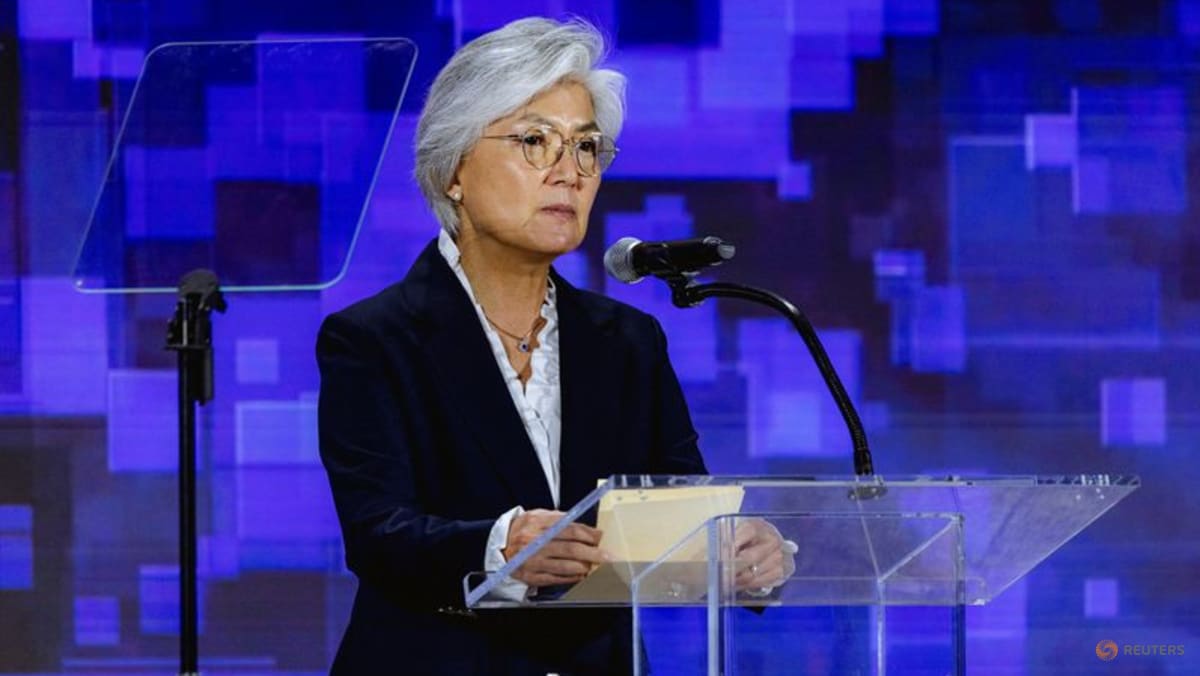
Centre · 1South Korea's ambassador to the United States, Kang Kyung-wha, said Washington had raised concerns about intelligence cooperation and that Seoul had not yet fully addressed US expectations, Yonhap news agency reported on 13 October. CNAN “South Korea's ambassador to the United States said Washington had raised concerns about intelligence cooperation between the allies and that Seoul had not yet fully addressed” Read at CNA ↗ Centre · 1Kang told a South Korean parliamentary audit in Washington that intelligence sharing was the most difficult issue in bilateral relations, and said US Secretary of State Marco Rubio raised it with South Korean Foreign Minister Cho Hyun last month. CNAN “intelligence sharing was the most difficult issue in bilateral relations”“US Secretary of State Marco Rubio raised the matter during talks with South Korean Foreign Minister Cho Hyun last month” Read at CNA ↗ Centre · 1She did not detail Washington's concerns, but said communication between the two countries' intelligence agencies was continuing and had made progress; she also said access to senior White House officials had been limited. CNAN “Kang did not detail Washington's concerns, but said communication between the two countries' intelligence agencies was continuing and had made progress.”“The ambassador also said access to senior White House officials had been limited” Read at CNA ↗
Centre · 1Bloomberg, in a piece carried by the South China Morning Post, quoted Kang as saying 'There are limitations in our communication with the White House' and 'I find it somewhat frustrating', and described this as a rare admission of an 'issue' with Washington's sharing of covert data. South China Morning PostN ““There are limitations in our communication with the White House,” Kang Kyung-wha told lawmakers. “I find it somewhat frustrating.”” Read at South China Morning Post ↗ Centre · 2South Korean media reported that Washington asked that Seoul's National Intelligence Service be excluded from a June meeting with US and Japanese officials on North Korean cyber threats; the NIS said this reflected a past misunderstanding that had been resolved, acknowledged restrictions on some intelligence tied to the earlier dispute, and denied that the US had reduced sharing of North Korean missile information or cut overall intelligence flow. CNAN “Seoul's spy agency said the matter reflected a past misunderstanding and had been resolved, acknowledging restrictions on some intelligence connected to the earlier dispute” Read at CNA ↗ South China Morning PostN “in June local media reported the country's spy agency was excluded from a trilateral meeting with the United States and Japan on North Korea at Washington’s request” Read at South China Morning Post ↗ Centre · 1Bloomberg also cited earlier reports that a South Korean official disclosed US intelligence about a secret North Korean nuclear facility, which President Lee Jae Myung rejected as 'absurd'. South China Morning PostN “President Lee Jae Myung had rejected those allegations, calling them “absurd”.” Read at South China Morning Post ↗
Centre · 1A State Department spokesman said the US expects South Korea to uphold the standards of an alliance, 'particularly' on intelligence and counter-intelligence matters, while White House spokeswoman Anna Kelly said the US has a strong relationship with South Korea and that a recent Trump–Lee meeting 'enhanced' it. South China Morning PostN ““This is particularly true of intelligence and counter-intelligence matters,” the person added.”““The United States has a strong relationship with South Korea,” White House spokeswoman Anna Kelly said” Read at South China Morning Post ↗ Centre · 2An official at South Korea's presidential office said the government is working to strengthen trust with the US and called the alliance the cornerstone of its foreign and security policy; the NIS did not respond to Bloomberg's calls, and the foreign ministry had no immediate comment to Reuters. South China Morning PostN “An official at South Korea’s presidential office said the government is working to strengthen trust with the US” Read at South China Morning Post ↗ CNAN “South Korea's foreign ministry did not immediately have a response to a Reuters request for comment on the report.” Read at CNA ↗ Centre · 1Bloomberg placed the intelligence issue among wider frictions: US complaints that Seoul slow-walked an investment deal and discriminated against Coupang, Lee's questioning of an Alaska LNG project, Trump scaling back military drills, and a politician's cancelled US trip over a reported visa delay. South China Morning PostN “marred by US accusations South Korea has slow-walked its investment deal and discriminated against American-listed e-commerce giant Coupang”“a prominent South Korean politician was forced to cancel a US trip this month after reports his visa was held up” Read at South China Morning Post ↗
Centre · 1Analysts quoted by Bloomberg said the dispute is serious: Victor Cha of CSIS said it conveys that the US does not trust Korea as an ally, and Jenny Town of the Stimson Centre said it paints an alliance that is 'highly strained and losing trust'; Bloomberg noted no sign the US will withdraw any of its 28,000 troops. South China Morning PostN ““The most damaging aspect of the friction over intelligence restrictions is it conveys the US does not have trust in Korea as an ally,””“While there is no sign the US will prematurely withdraw any of its 28,000 troops stationed on the Korean peninsula” Read at South China Morning Post ↗ Centre · 1Kang also said Seoul and Washington were discussing ways to secure South Korean rights to enrich uranium and reprocess spent fuel, and that there was no progress toward a Trump–Kim Jong Un summit. CNAN “Kang said Seoul and Washington were discussing ways to secure South Korean rights to enrich uranium and reprocess spent nuclear fuel”“No progress had been made towards a summit between US President Donald Trump and North Korean leader Kim Jong Un” Read at CNA ↗ Centre · 2Lee told a cabinet meeting that South Korea should avoid subservient attitudes, while calling the US alliance a central pillar of diplomacy that should be developed further and saying differences should be managed through discussion. CNAN “Lee called the US alliance a central pillar of South Korean diplomacy which should be further developed” Read at CNA ↗ South China Morning PostN “avoid a submissive or overly deferential approach in relations with other countries” Read at South China Morning Post ↗
Every sentence links to the reporting it rests on. The pill in front of each says where its sources sit: Left, Centre or Right when one side supplies at least half of them, Mixed when they are evenly split. The number is how many outlets it cites.
Left0 outlets
No left outlet in our sources has covered this story yet.
Centre2 outlets
- Framing
- CNA reports Kang's remarks straightforwardly, with the NIS's denial; SCMP carries Bloomberg's broader analysis of an alliance 'losing trust'.
- Emphasis
- CNA: Kang's statements, NIS response, nuclear and North Korea issues. Bloomberg: cumulative frictions, analyst warnings, official responses.
- Leaves out or plays down
- CNA gives little analyst context; the Bloomberg piece gives less of the NIS's denial of reduced missile-information sharing.
- Charged language
- “losing trust”“widening cracks”
- For example
-
“Kang did not detail Washington's concerns, but said communication between the two countries' intelligence agencies was continuing and had made progress.” — CNA
““paint a picture of an alliance that’s highly strained and losing trust”” — South China Morning Post
Right0 outlets
No right outlet in our sources has covered this story yet.
What every side reports
- Ambassador Kang Kyung-wha acknowledged difficulties in intelligence sharing with the US.
- South Korean media reported the NIS was excluded from a June trilateral meeting on North Korea at Washington's request.
- President Lee Jae Myung told his cabinet to avoid subservient attitudes while calling the US alliance central.
Where accounts differ
-
Extent of US intelligence restrictions
- Centre
- CNA/Reuters: the NIS acknowledged restrictions on some intelligence tied to the earlier dispute but denied reduced missile-information sharing or an overall cut. Bloomberg (via SCMP) cites analysts saying the restrictions signal lost US trust.
Kang Kyung-wha person
Says intelligence sharing is the most difficult bilateral issue, that Seoul has not fully met US expectations, and that White House access is limited, while agency-level communication is progressing.
“intelligence sharing was the most difficult issue in bilateral relations” — CNA
““I find it somewhat frustrating.”” — South China Morning Post
South Korea place
Seoul's presidential office says it is working to strengthen trust and calls the alliance the cornerstone of policy; its spy agency says the dispute was a resolved misunderstanding.
“stressed the alliance is the cornerstone of Seoul’s foreign and security policy” — South China Morning Post
“Seoul's spy agency said the matter reflected a past misunderstanding and had been resolved” — CNA
Left0 articles
No coverage yet.
Centre2 articles
-
CNAN ·
South Korea says US raises intelligence cooperation concerns, Yonhap says
Neutral Agency-style report of Kang's remarks with the NIS rebuttal and Lee's comments.
-
South China Morning PostN · · via Bloomberg
South Korea-US alliance losing ‘trust’ amid widening cracks in ties
Critical Bloomberg analysis framing the intelligence issue as part of a deteriorating alliance.
Right0 articles
No coverage yet.
- 13 Oct 05:37 First CNAN South Korea says US raises intelligence cooperation concerns, Yonhap says
- 16 Oct 03:08 +69h 32m South China Morning PostN South Korea-US alliance losing ‘trust’ amid widening cracks in ties via Bloomberg
Times are when each article was published, or when we first saw it if the outlet gave no time.
Ask about this story
Loading…