Virgin Galactic names first Delta-class spaceship Apeiron, moves it to New Mexico
Virgin Galactic named its first Delta-class spaceship Apeiron after a public vote and flew it from Arizona to New Mexico for avionics validation and flight tests. The company has pushed the first commercial flight to early Q2 2027.

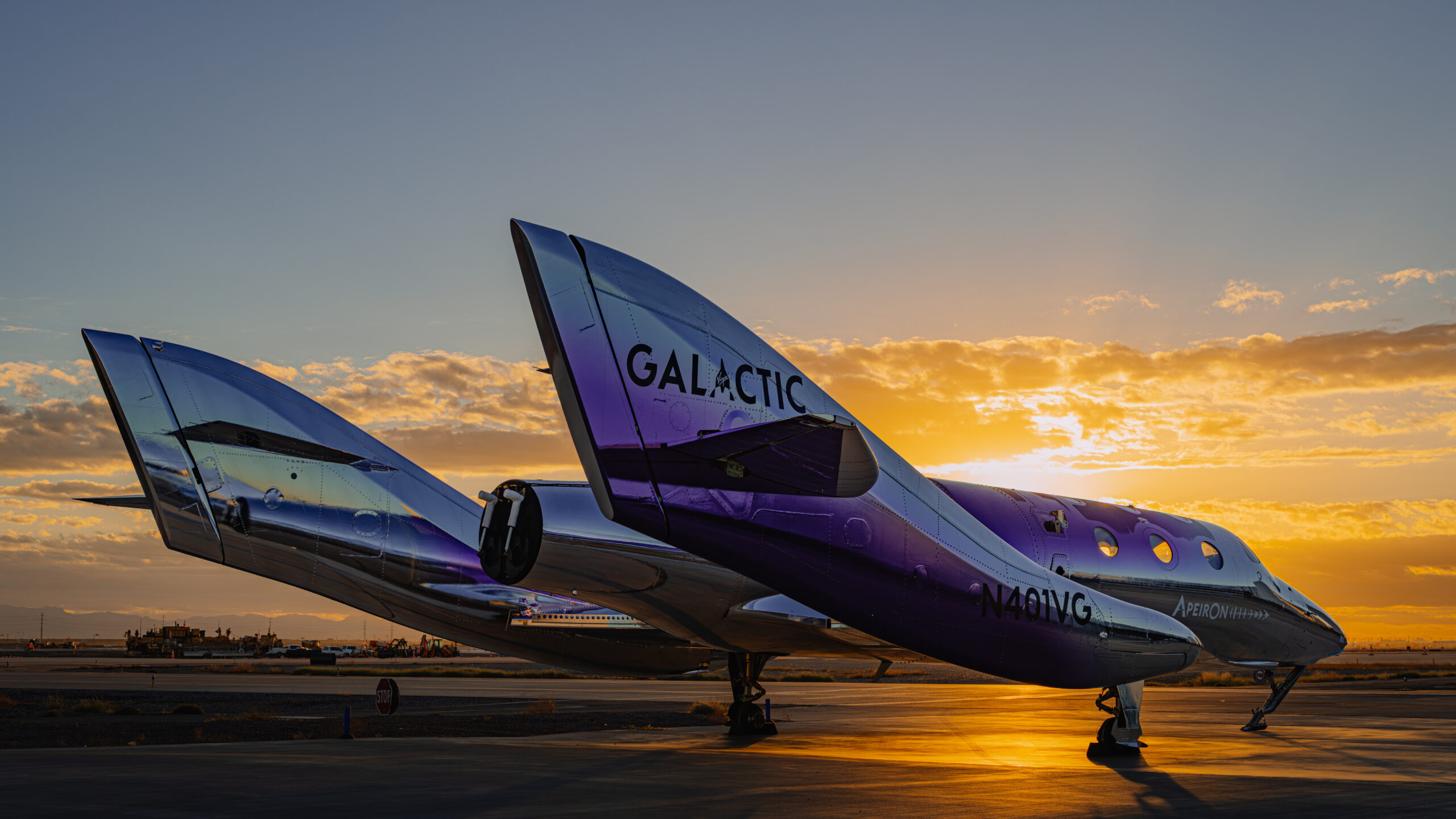
1 / 2
The story, neutrally told
Left · 2Virgin Galactic unveiled the first of its new Delta-class spaceships on Wednesday 28 October 2026 and named it Apeiron, a name chosen by a public vote. The VergeLC “Virgin Galactic’s new spaceship is here, dubbed “Apeiron” by popular vote from a public poll.” Read at The Verge ↗ Ars TechnicaLC “On Wednesday, the first Delta-class ship received a name: Apeiron.” Read at Ars Technica ↗ Left · 1Ars Technica, citing the company's news release, says the name comes from the ancient Greek concept of the boundless. It quotes chief executive Michael Colglazier saying the lead ship "will carry a name chosen by the people who share our excitement for what comes next". Ars TechnicaLC “the name is drawn from the ancient Greek concept of the boundless”“will carry a name chosen by the people who share our excitement for what comes next” Read at Ars Technica ↗ Left · 2Apeiron was due to leave Virgin Galactic's Spaceship Factory in Mesa, Arizona, on Wednesday, carried by the Eve launch aircraft in a captive-carry flight to Spaceport America in New Mexico. The VergeLC “Apeiron is leaving Virgin Galactic’s Mesa, Arizona Spaceship Factory on Wednesday onboard a captive-carry flight with its Eve launch vehicle, heading to Spaceport America in New Mexico” Read at The Verge ↗ Ars TechnicaLC “Apeiron would be moved from its Spaceship Factory in Mesa, Arizona, to Spaceport America in New Mexico later on Wednesday.” Read at Ars Technica ↗
Left · 2In New Mexico, engineers are to complete avionics equipment and flight software work before flight tests begin. Ars Technica describes the sequence as further ground tests, renewed captive-carry tests with Eve, a drop test, and finally a powered test flight above 80 km. The VergeLC “engineering team plans to complete avionics software validation before beginning flight tests.” Read at The Verge ↗ Ars TechnicaLC “Following additional ground tests, Apeiron will be mated again to Eve for captive carry tests, followed by a drop test and ultimately a powered test flight above 80 km.” Read at Ars Technica ↗ Left · 1Earlier in the week the company announced another delay. It now expects the lead ship's first commercial spaceflight in early Q2 2027, and the second ship's commercial operations in late Q2 or early Q3 2027. It attributes the change to extra time for avionics software integration and validation. The Verge notes the company had previously pushed the next commercial flight to February 2027, from late 2026. The VergeLC “The lead Spaceship’s first commercial spaceflight is now expected in early Q2 2027, and the second Spaceship is expected to begin commercial spaceflight operations in late Q2/early Q3 2027.”“Virgin Galactic had previously delayed its next commercial spaceflight to February 2027, rather than late 2026.” Read at The Verge ↗ Left · 2The Verge says Virgin Galactic's last commercial spaceflight was in June 2024, when it retired VSS Unity. Ars Technica says that when Unity made its final flight, the company planned to have two Delta-class ships in service by 2026, but none is in service yet. The VergeLC “It’s now been over two years since Virgin Galactic’s last commercial spaceflight in June 2024, when it retired its VSS Unity spacecraft.” Read at The Verge ↗ Ars TechnicaLC “It planned to bring two of these Delta-class ships into service by the year 2026. Of course, it is now 2026, and there are no Delta-class ships in service.” Read at Ars Technica ↗
Left · 1Ars Technica adds context and doubt. It says the US has gone about 10 months without a space tourism mission and that the new date should be taken "with a grain of salt", though it finds flights with paying customers within 12 to 18 months plausible. It also reports scepticism about the commercial viability of suborbital tourism and says the stock trades near $2.50 a share, against a brief peak of $1,118 in 2021. Ars TechnicaLC “More recently it has been trading in the vicinity $2.50 a share.”“So we are now 10 months, and counting, without a space tourism mission in the United States.”“There is considerable skepticism about the commercial viability of Virgin Galactic’s space tourism ambitions.” Read at Ars Technica ↗
Every sentence links to the reporting it rests on. The pill in front of each says where its sources sit: Left, Centre or Right when one side supplies at least half of them, Mixed when they are evenly split. The number is how many outlets it cites.
Left2 outlets
- Framing
- The Verge reports the unveiling and the latest delay briefly. Ars Technica gives an analytical, sceptical column on whether space tourism can succeed, with Virgin Galactic as its main hope.
- Emphasis
- Delays against earlier targets, the avionics validation and test sequence, and doubts about commercial viability and the share price.
- Leaves out or plays down
- Neither gives the ship's specifications, passenger capacity or ticket prices, and neither quotes critics or investors directly.
- Charged language
- “The last, best hope for space tourism”
- For example
-
“Earlier this week, Virgin Galactic announced another delay in its launch timeline” — The Verge
“As with every other projected date in aerospace, this should be taken with a grain of salt.” — Ars Technica
Centre0 outlets
No centre outlet in our sources has covered this story yet.
Right0 outlets
No right outlet in our sources has covered this story yet.
What every side reports
- The first Delta-class ship is named Apeiron, chosen by public vote.
- Apeiron moves from Mesa, Arizona, to Spaceport America, New Mexico, on 28 October 2026 aboard Eve.
- Avionics software validation must finish before flight tests.
- First commercial spaceflight is now expected in early Q2 2027.
Virgin Galactic organisation
Virgin Galactic presents the naming as a public-driven milestone and attributes the delay to the time needed for avionics software integration and validation, which it says will finish at Spaceport America.
“We’re proud that the lead ship in Virgin Galactic’s Spaceship fleet will carry a name chosen by the people who share our excitement for what comes next” — Ars Technica
“The updated timeline reflects additional time for completing avionics software integration and validation” — The Verge
Left2 articles
-
Here’s Virgin Galactic’s new Apeiron spaceship
Neutral Short news item on the naming and move, setting it against the company's repeated delays.
-
The last, best hope for space tourism just rolled onto a runway in Arizona
Mixed Opinionated analysis that treats Apeiron as a significant step but stresses missed targets, doubts about viability and the low share price.
Centre0 articles
No coverage yet.
Right0 articles
No coverage yet.
- 28 Oct 14:17 First The VergeLC Here’s Virgin Galactic’s new Apeiron spaceship
- 28 Oct 19:20 +5h 3m Ars TechnicaLC The last, best hope for space tourism just rolled onto a runway in Arizona
Times are when each article was published, or when we first saw it if the outlet gave no time.
Ask about this story
Loading…