Voters use AI chatbots to research and compare candidates in 2026 midterms
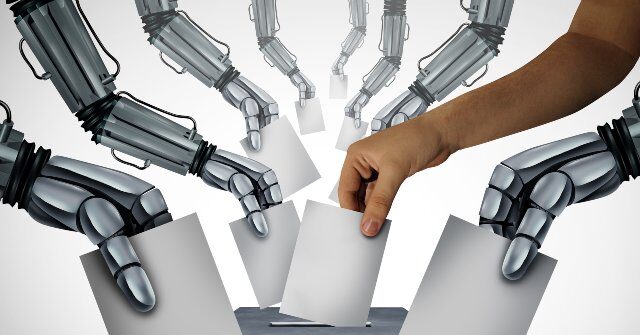
Some US voters are asking AI chatbots to help research their midterm ballots and even decide how to vote, prompting concern about bias and flattery from the tools.
1 / 1
The story, neutrally told
Left · 1Some US voters are asking AI chatbots to help research their ballots and even decide who to vote for in the 2026 midterms, NPR reported on 5 October, as early voting was already under way. NPRLC “Voters are already voting in the midterms. This year, some voters are trying something new to get ready for the election: asking AI to help research their ballot and even decide wh” Read at NPR ↗ Right · 1Breitbart, relaying NPR's reporting, described Adam Johnson, a West Virginia voter and illustration student who typically votes Republican but does not support the MAGA movement, spending a September evening asking ChatGPT to compare Sen. Shelley Moore Capito (R-WV) with Democratic challenger Rachel Fetty Anderson. BreitbartR “That night, he wanted to compare Sen. Shelley Moore Capito (R-WV) with challenger Rachel Fetty Anderson in West Virginia’s Senate race.” Read at Breitbart ↗ Right · 1Breitbart cited Pew Research Center figures that about half of American adults use AI chatbots and roughly 42 percent of those users use them to search for information. BreitbartR “About half of American adults say they use AI chatbots, according to Pew Research Center, and roughly 42 percent of those users turn to the tools to search for information.” Read at Breitbart ↗
Right · 1In the exchange, ChatGPT said it should not try to manipulate users' political views or tell them how to vote, but could investigate candidates by criteria the user chooses. On immigration it said Capito has supported stronger border enforcement, while less detailed material was available on Fetty Anderson, so it avoided assigning her generic Democratic positions. BreitbartR “I shouldn’t try to manipulate your political views or tell you how to vote, but I can help investigate candidates according to criteria you choose, compare evidence, discuss political philosophy, and reason through priorities.”“Fetty Anderson had less detailed immigration material publicly available at the time, so I avoided assigning her generic Democratic positions without evidence.” Read at Breitbart ↗ Right · 1Johnson said ChatGPT is "just kind of a people pleaser" that speaks positively of whatever a user leans towards. BreitbartR ““ChatGPT is just kind of a people pleaser. Whatever you lean towards, it will speak positively about it,” he said.” Read at Breitbart ↗ Right · 1Rafael Batista, a Johns Hopkins fellow who studies how AI shapes people's experience of the world, said such tendencies can reinforce existing views so users leave more confident without learning more. He suggested hiding personal preferences in prompts and using incognito mode to limit bias from a chatbot's memory. BreitbartR “So you leave more confident, without necessarily learning more about the world,” he said.”“Batista also suggested users hide their personal preferences in prompts and browse in incognito mode” Read at Breitbart ↗
Right · 1Another voter, Lisa Veldran, 65, of Madison, Wisconsin, used Gemini to compare gubernatorial primary candidates Francesca Hong and David Crowley, and said voters must stay mindful of who owns and builds these tools. BreitbartR “used Gemini this summer to compare gubernatorial primary candidates Francesca Hong and David Crowley” Read at Breitbart ↗ Right · 1Breitbart added its own argument that the chatbots are made by "Silicon Valley leftists", citing author Wynton Hall's claim that Google Gemini labelled seven Republican senators, Vice President JD Vance and Secretary of State Marco Rubio as violating its hate speech policies when he prompted it to assess senators' statements. BreitbartR “Gemini AI declared that the following seven Republican Senators, Vice President JD Vance, and Secretary of State Marco Rubio are guilty of violating Gemini’s “hate speech policies.”” Read at Breitbart ↗
Every sentence links to the reporting it rests on. The pill in front of each says where its sources sit: Left, Centre or Right when one side supplies at least half of them, Mixed when they are evenly split. The number is how many outlets it cites.
Left1 outlet
- Framing
- NPR presents the trend as a new way voters prepare for the election, leading with voters asking AI to research ballots and help decide.
- Emphasis
- Voters' new habits as early voting begins.
- Leaves out or plays down
- Little beyond the opening is available to compare.
- For example
-
“some voters are trying something new to get ready for the election: asking AI to help research their ballot” — NPR
Centre0 outlets
No centre outlet in our sources has covered this story yet.
Right1 outlet
- Framing
- Breitbart recasts NPR's story as a warning about chatbots built by 'Silicon Valley leftists' and adds a Gemini hate-speech example of alleged bias against Republicans.
- Emphasis
- Ideological bias of AI companies, sycophancy, and Gemini's treatment of Republicans.
- Leaves out or plays down
- Does not report any company response to the Gemini claims.
- Charged language
- “Silicon Valley leftists”“smeared”
- For example
-
“Americans are turning to chatbots created by Silicon Valley leftists to determine how they will vote in the midterm elections.” — Breitbart
What every side reports
- Some US voters are using AI chatbots to research and compare candidates ahead of the 2026 midterms.
- Voting in the midterms has already begun.
Where accounts differ
-
Whether chatbots are politically biased against the right
- Left
- NPR's available text frames the trend as voters trying something new, without a bias claim.
- Right
- Breitbart says the chatbots are made by 'Silicon Valley leftists' and cites a Gemini test as evidence of political bias.
Artificial intelligence topic
Chatbots are presented as tools voters use to compare candidates; ChatGPT says it will not tell users how to vote, while critics cite flattery and bias.
“I shouldn’t try to manipulate your political views or tell you how to vote” — Breitbart
Left1 article
-
NPRLC ·
Voters are increasingly using AI chatbots to fact-check and compare candidates
Neutral Reports voters increasingly using AI to research ballots and decide how to vote.
Centre0 articles
No coverage yet.
Right1 article
-
Americans Turn to AI Chatbots to Decide How to Vote in Midterm Elections
Critical Reworks NPR's reporting into a critique of left-leaning AI makers and alleged bias against Republicans.
- 5 Oct 10:00 First NPRLC Voters are increasingly using AI chatbots to fact-check and compare candidates
- 5 Oct 18:07 +8h 7m BreitbartR Americans Turn to AI Chatbots to Decide How to Vote in Midterm Elections
Times are when each article was published, or when we first saw it if the outlet gave no time.